Do you have a cherished teacup set languishing in the back of your china cabinet? The kind you picture at an old-timey tea party? There’s not much call for tea parties any more but that pretty little cup and saucer need not be forgotten. Perhaps it’s time to repurpose it and give it a new lease on life. How about turning that neglected china cup and saucer into a handy little pincushion? Here’s my favorite teacup set repurposed as a pincushion.
In today’s post, I share step-by-step instructions to make your own teacup pincushion. The approach and technique used are similar to those from my last DIY tutorial post, Vintage Bangle to Keepsake Box. Felt is used to make a stuffed pad for the pincushion which is lavishly embellished with felt flowers and leaves. The pincushion pad is adhered inside the rim of the teacup.
Start by examining the pattern on your teacup and saucer—many have beautiful flowers or stunning floral arrangements. Let this pattern be your inspiration. Which flowers are used? What are the forms and colors? Here are a few examples.
Colorful felt flowers are the key to this project but buying felt in the desired colors can be a little tricky. The best way, of course, is to shop in person where you can hold the teacup up against the felt. But that’s not possible when shopping online. I’ve found using a photo of the item I’m trying to match is a good way to select colors online. Shoot the photo against a white background in bright, clear, natural light. Then view your photo beside the vendor’s colors. It’s helpful to take snippets of the color samples and drop them directly onto your photo. This method isn’t foolproof but the side-by-side comparison is a good indicator of which colors will work best. And it’s much better than holding a teacup up to your computer monitor! The below photo shows a few color samples from Prairie Point Junction’s wool blend felt (see More Info below).

I selected a few options and ordered them in ⅓ yard cuts. The wool blend felt is available in 36” wide yardage so ⅓ yard yields a generous 12” x 36” piece. This project doesn’t require much felt so it’s possible to order a few different colors at a reasonable cost.
In the end, I selected 2 greens (Grassy Meadow and Shady Grove), 2 blues (Bluer Than Blue and Periwinkle), 2 pinks (Fuchsia and Pink Violet) and 1 white (Antique White) to make flowers in an open rose form, a daisy form and a hydrangea form. Alternatively, you may wish to make one of the flower forms (ie a closed rose form, an apple blossom form or a dogwood flower form) that I shared in my previous post Vintage Bangle to Keepsake Box – DIY Tutorial.
Supplies Needed
. Teacup and Saucer
. Template – Download Felt Flowers for Teacup Pincushion – Complimentary Download to print the patterns for the felt flowers.
. Felt – Wool blend felt in the colors of your choice. I used approximately 12” x 6” in white for the pincushion pad; 4” x 8” in pinks for the open rose form; 3” x 1½” in blues for the hydrangea form; 4” x 1” in blue for the daisy form; 1” x 3” in greens for the leaves; ½” x 3” in yellow for the stamen.
. Freezer Paper
. Thread – To match the felt for your pincushion pad and flowers.
. Filling – Polyester fiberfill or other material to stuff the pincushion.
. Embroidery Floss – Pink (or your choice of color) to wrap the pincushion pad and green for the leaves.
. Hulled Millet (Dried Beans or Rice) – Approximately ½ cup to add weight to the teacup.
Equipment and Tools Needed
. Printer
. Iron
. Pencil
. Fabric Marker or Chalk
. Pins
. Scissors
. Scissors – Sharp, short-bladed scissors, such as embroidery or applique scissors, are ideal.
. Sewing Machine
. Needles – 1 needle for thread; 1 needle for embroidery floss; 1 extra-long embroidery needle; 1 large-eyed needle such as a darning needle.
. Stick – A small, round stick or dowel to hold the felt stamen.
. Hot Glue Gun
Step 1 Cut Pincushion Pad Parts Place the teacup upside down on a piece of freezer paper (shiny side down). Trace around the outside rim. Add ½“ to the circumference of this circle. Cut out the circle leaving a narrow border outside the cutting lines. Use the iron to press the freezer paper pattern (shiny side down) onto the felt you’ve selected for the pincushion pad. Cut out the felt circle with sharp, short-bladed scissors. Take care to cut precisely.

Remove the freezer paper pattern. Repeat for a second felt circle using the same color. After removing the freezer paper pattern, find the center of the circle. Transfer the center mark to the wrong sides of both of the felt circles. Select one of the circles to be the bottom. Draw a 2-3” line through the center mark. Cut on this line to create a slit in the bottom circle.
Step 2 Construct Pincushion Pad Lay the felt circles for the pincushion pad on top of each other with right sides facing. Align the edges and pin. Use the sewing machine to sew a ⅛“ seam around the entire circle.
Gently turn the felt circle inside out through the slit. Push out seam by running finger along the inside of the seam. Press. Stuff pincushion pad with polyester fiberfill or other material. Ensure outside edge is stuffed evenly. Take care not to overstuff—the seams should not be strained. Use matching thread and whipstitch (or stitch of your choice) to close the back slit.
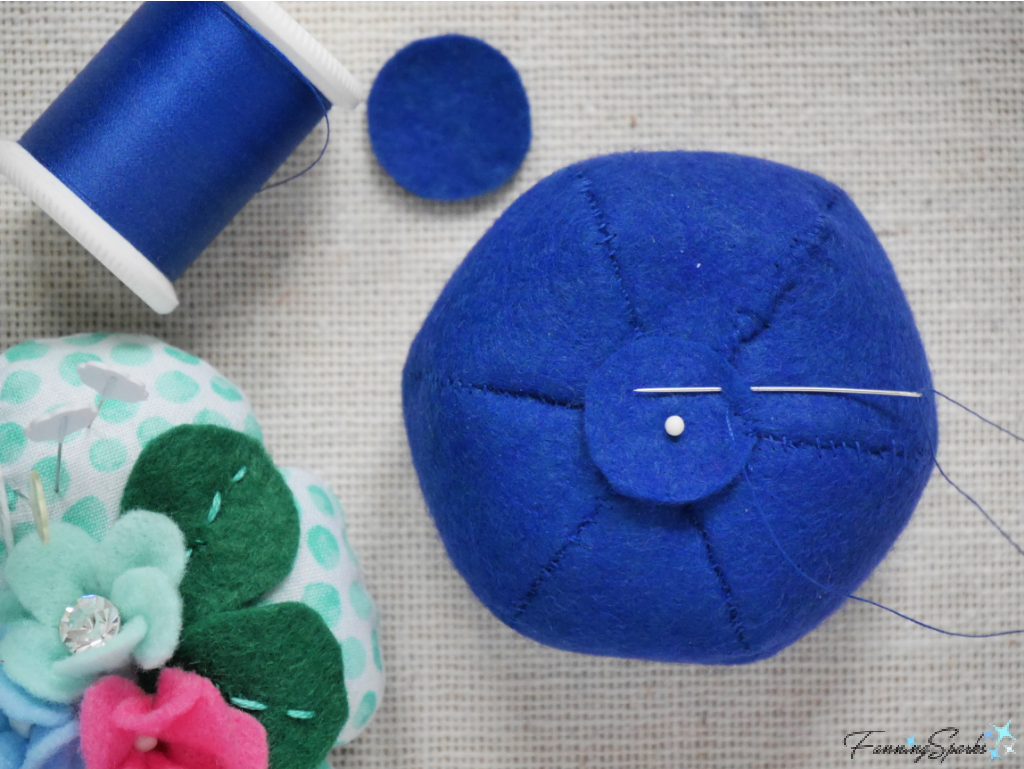
Choose embroidery floss to divide the pincushion pad into petals—the color can match or contrast as you wish. Wrap the 6-strand floss around the pincushion pad 3 times to measure the length needed. Mine was 32” long. Cut and thread the floss onto a long embroidery needle. Insert a pin near the center point on the bottom and wrap the floss tail around this pin to anchor it. Insert the needle at the center point on the bottom of the pad, pull it up through the pad and exit at the center point on the top. Wrap the floss around the outside of the pad and return the needle to the center point on the bottom.

Pull the floss snug—this creates the indented points for the “petal” look. Pull needle through pad to top again. Repeat 5 times spacing out evenly around the circle into 6 petals. Check the fit of the pincushion pad in the teacup—it should sit snuggly in the rim. If needed, tighten or loosen the floss to adjust fit. Finish with a small stitch on the top and return the needle to the back. Knot the ends of the floss securely.

Step 3 Cut Flower Parts Download Felt Flowers for Teacup Pincushion – Complimentary Download to print the patterns for the felt flowers and leaves. Alternatively, you may wish to make one of the flower forms (ie a closed rose form, an apple blossom form and a dogwood flower form) that I shared in the Felt Flowers for Bangle Keepsake Box – Complimentary Download in my previous post Vintage Bangle to Keepsake Box – DIY Tutorial.
Cut a sheet of freezer paper to the size of a sheet of printer paper (ie 8 ½“ x 11“) and put it into the printer tray with the shiny side down. Print the template onto the freezer paper. Since not all printers work the same, please adjust this technique to the specifics of your own printer. Once you have your design printed on the freezer paper, cut out the individual patterns leaving a small border outside the cutting lines. Match up the pattern pieces with your felt colors.
Place a piece of felt on your ironing surface and lay the freezer paper pattern on top of it with the shiny side down. Use your iron to press the freezer paper pattern into place—a few seconds is all that’s needed. Take care to use the heat setting appropriate for your felt. Cut out the pattern piece (freezer paper and felt) using sharp, short-bladed scissors for precision. Then simply pull the freezer paper off the felt. Repeat with all felt pieces.
Cut the following:
. TWO #1 Open Rose Form Rolled Spiral Flower in pink. I cut one from Fuchsia and one from Pink Violet.
. ONE large #2 Hydrangea Form 3-Pointed Petals Flower in dark blue. I cut mine from Bluer Than Blue.
. ONE small #2 Hydrangea Form 3-Pointed Petals Flower in medium blue. I cut mine from Periwinkle.
. ONE stamen for #2 Hydrangea Form 3-Pointed Petals Flower in vibrant yellow. I cut mine from some scrap felt which I had on hand.
. ONE #3 Daisy Form Row of Petals Flower in medium blue. I cut mine from Periwinkle.
. ONE stamen for #3 Daisy Form Row of Petals Flower in vibrant yellow. I cut mine from some scrap felt which I had on hand.
. TWO #4 Leaves in green. I cut one from Grassy Meadow and one from Shady Grove.

Step 4 Sew #1 Open Rose Form Rolled Spiral Flower Align the two open rose spirals with the lighter color on top. Thread sewing needle with matching thread. (Note: I’m using black thread for visibility in the photo below.) Start at the center of the spiral taking 2 small stitches to connect the two pieces of felt. Take 4 small running stitches along the inside edge of the spiral. Stop stitching to gather this section. Pull the end of thread bunching the felt together. Take 2 small stitches over the edge to lock in the gathers. Repeat this process, stopping every 5-7 stitches to gather and lock, until you reach the end of the spiral. Turn stitched spiral over with the light color on the top. Position the gathered spirals into a pleasing arrangement. Turn flower over and lock in the arrangement with a few stitches hidden on the bottom.

Step 5 Sew #2 Hydrangea Form 3-Pointed Petals Flower Lay the small hydrangea form on top of the large one staggering the points of the petals. Thread sewing needle with matching thread. (Note: I’m using white thread for visibility in the photo below.) Take 2 small stitches to connect the two pieces of felt. Pull stamen through a large-eyed needle such as a darning needle. Pull the needle and felt, from the back to the front, through the center of the flower. Pull gently but firmly. Loop felt stamen over a small stick to prevent it from pulling out. Pull the needle and felt, from the front to the back, through the same opening in the center of the flower. Turn flower over and trim the ends of the stamen to hide them. Lock the stamen in place with a few stitches hidden on the bottom.

Step 6 Sew #3 Daisy Form Row of Petals Flower Thread sewing needle with matching thread. (Note: I’m using white thread for visibility in the photo below.) Leaving a long tail of thread, sew a row of small running stitches along the bottom straight edge of the flower. Leave a long tail of thread at the end. Grasp ends of thread and pull together to gather felt. Pull snuggly and knot securely. Pull stamen through a large-eyed needle such as a darning needle. Pull the needle and felt, from the back to the front, through the center of the flower. Pull gently but firmly. Loop felt stamen over a small stick to prevent it from pulling out. Pull the needle and felt, from the front to the back, through the same opening in the center of the flower. Turn flower over and trim the ends of the stamen to hide them. Lock the stamen in place with a few stitches hidden on the bottom.

Step 7 Make the Leaves Use 2-strands of contrasting embroidery floss to stitch a decorative vein down the center of each leaf. Fold leaf in half. Take 2-3 small whipstitches along the base of the leaf near the folded center. This creates a slight tuck at the base of the leaf.

Step 8 Embellish the Pincushion Pad Position the flowers and leaves in a pleasing arrangement on the pincushion pad. Use needle with matching thread to attach each element. Work under the elements. Make small stitches taking care to keep them hidden. Alternatively, you may choose to glue the elements in place.

Step 9 Assemble Pincushion A teacup can be a little unstable when seated on a saucer. Since working with a wobbly pincushion would be less than ideal, I decided to try a couple of tweaks to stabilize it. First, I added weight to the bottom of the teacup by filling it with hulled millet. I used millet because I had some left over from another project. You could use dried beans or rice instead.

Then I used a hot glue gun to create a bead of glue around the cup just below the rim. I pressed the pincushion pad into the glue to secure the pincushion and seal the millet. The final step is to glue the bottom of the teacup to the saucer. I chose to do this for added stability but it’s optional.
And there you have it—your new teacup pincushion!
More Info
You can download the project template here: Felt Flowers for Teacup Pincushion – Complimentary Download.
Please pin this image to share or save for future reference.

I purchased my wool blend felt online from Prairie Point Junction which is the home of Wool Felt Central. They offer a wide selection of colors in a wool and rayon blend. I’m pleased with the quality of this felt; the colors are vibrant and the felt is easy to work with. My order was filled and shipped on the same day I placed it. The folks at Prairie Point Junction thoughtfully packed my felt in the same sequence as the order form so I could easily identify my colors. Prairie Point Junction is located in Nebraska, USA and their website shows shipping information for the USA. If you’re not located in the USA, you may want to check if they ship to your location. Alternatively, I suggest checking Etsy for wool blend felt. There are several well-established vendors showing thousands of positive reviews.
Today’s Takeaways
1. Consider incorporating cherished treasures into everyday use.
2. Wool blend felt, which is available in a rainbow of colors, can be made into an endless variety of forms.
3. Consider turning a neglected china cup and saucer into a handy little pincushion.


One in particular, a chunky, bejeweled costume jewelry bangle, caught my imagination. With the help of a little felt flower-making research, some colorful felt and a few accents, a pretty little keepsake box emerged. It was a fun process with lots of opportunity to get creative. Today’s post includes detailed step-by-step instructions for transforming any bangle bracelet into a keepsake or trinket box.
Equipment and Tools Needed
B. Next comes the best part, place your felt on your ironing surface and lay the freezer paper pattern on top of the felt with the shiny side down. Use your iron to press the freezer paper pattern into place—a few seconds is all that’s needed. Take care to use the heat setting appropriate for your felt. The amazing thing is the iron melts the plastic just enough to make the paper stick to the felt while you cut out your piece.
C. Cut out the pattern piece (freezer paper and felt) using sharp, short-bladed scissors for precision. Then simply pull the freezer paper off the felt. Surprisingly, it comes off very easily and no residue is left behind. Pattern pieces can be reused so take care when removing them from the felt.
Measure the height of the inside of the bangle using a ruler. Add ¼“ for the seam allowance. This will be the height of the liner wall. Cut a rectangle of white felt with the length and width calculated.
Cut out the circle leaving a small border outside the cutting line. Follow Steps B-C of the Freezer Paper Technique as described above to adhere and cut out a white felt circle. Reuse the freezer paper pattern to cut 3 more white felt circles.
Start by sewing one long edge of the felt rectangle, which will become the liner wall, to one of the felt circles. Use 2-strands of matching embroidery floss with a blanket stitch. Start and finish ½“ from the ends of the rectangle.
Hold the short ends of the rectangle together ensuring the remaining unsewn bottom edges are aligned and fit snuggly against the bottom circle. Trim the short ends if necessary. Pin and stitch the short ends with a blanket stitch. Finish stitching the long edge of the felt rectangle to the bottom circle.
Glue this felt circle to the top of the foam board circle. Insert embellished bottom into the liner. If desired, glue felt liner walls to the inside edge of bangle.
Hold ribbon by loop and gently pull the ends of the ribbon through the hole in the felt circle and then the hole in the cardboard. Push cardboard and felt circle together. Securely fasten the ends of the ribbon together. You can twist the ends if the ribbon is wired. Knot or stitch if the ribbon is unwired. Keep ends as flat as possible under the cardboard. You may wish to glue or tape the ends in place.
Make Apple Blossom Form Round Petal Flower
Make Dogwood Form Pointed Petals Flower
Make the Leaves
Step 6 Embellish Lid Now comes the fun part—embellishing the felt lid! Position the flowers and leaves in a pleasing arrangement.
Voilà! Your new keepsake box is done!
Now it’s time to put your new creation to work—mine holds a pretty little vintage button collection.


Another item that seems to have grown into a collection is vintage textiles. I have a few displayed on a ladder in the hallway to my studio. The top piece, taking pride of place, is a tablecloth hand-embroidered by my Mom. It’s a beautiful piece! The other pieces were collected from near (US Southeast) and far (Japan and Germany).
Sometimes a vintage or thrift store find can be repurposed for an entirely new role. I shared an example in the post
But vintage finds need not be limited to the inside of the home. We have a small collection of vintage white French enamelware which we collected while living in Germany. It’s displayed on our porch and reminds us of our time in Europe. Here’s one of those pieces playing an unexpected role as a wren’s nest.


In the same way vintage finds add interest and uniqueness to our home, they can add personality and punch to photos. I’m always on the lookout for vintage or thrift store finds to serve as photo props. The little porcelain figurine of a young girl holding the number 2 was a timely vintage find for the post
Here’s another example of a thrift store find that needed a little attention. The wicker picnic basket was in good condition but the top covers were missing. The updated basket, complete with new covers, starred in the post
Vintage pieces are often time-worn but I think that can add to their appeal. This vintage croquet set, which played a key role in the post
There’s one more reason I like to explore vintage shops—to scout for inspiration. I love to find handmade items from the past. It’s interesting to see what people made—to see what materials and techniques they used. These vintage finds can serve as thought-starters for new projects. The wooden trivet, shown top right in the photo below, inspired the Christmas wreath I shared in the post 
This postcard featuring Rafael Ortega, a famous Spanish bullfighter, is elaborately enhanced with embroidery.
Vintage postcards are fun to collect. They’re small and easy to transport and store. Yet they can be quite fascinating as can be seen in this set of 3 vintage postcards from an antique market in Tongeren, Belgium.
The illustrations are signed by “Girona”. The postcards were printed in Spain. They are incredibly cutesy but special and unique. Here’s a closer look at the little girl and boy winding yarn.
An interesting detail that I didn’t notice before is the girls are knitting with extra-long straight needles positioned under their arms—that’s the way my mother knits too. It’s just another reason to treasure these vintage finds!


Cut 6 lunar panels and 2 end circles for EACH ball. Use a fabric marker or chalk to clearly mark the wrong sides of the cut pieces.
Step 3 Sew Juggling Ball Align a pair of matching lunar panels with RIGHT sides together. Pin. Check that the two pieces are identical especially at the tips. Sew only one side of the lunar panels. Use a single strand of matching sewing thread and a whipstitch/ overcast stitch (or your stitch of choice). Note: I’m using white (instead of blue) thread for visibility in the photo below. Take your time to firmly secure the lunar panels with small, strong, even stitches, spaced close together, catching both edges in each stitch.
Repeat this process with the other 2 sets of lunar panels. You should have 3 pairs of lunar panels stitched together along one side. Prepare to sew 2 sets of lunar panels together by tucking one set of panels inside the other. Ensure the RIGHT sides are facing. Once again, take care to align the tips. Connect the final set of lunar panels in this same manner.
Sew the final seam connecting the first and sixth lunar panel sides. Stop sewing about 1” before the tip leaving a small opening for turning and filling. At this point, you may want to sew the other 2 balls together. Follow the same process, as outlined in this step, for each set of 6 lunar panels.
Step 4 Fill Juggling Ball Gradually turn the ball right side out. Take care not to stretch the felt at the opening. Insert finger into the turned ball. Run finger along each seam, firmly pressing it smooth and flat. Working over a container or bowl, insert a small funnel into the unsewn opening in the ball. Use a spoon to slowly scoop the millet into the funnel. Carefully tamp down the millet so it runs into the ball. Remove funnel. Spoon small amounts of millet directly into the ball. Use the spoon handle to gently pack the millet into the ball.
Fill the ball as full as possible while ensuring you can still grasp the edges of the opening. Pin the opening. Sew the opening closed with a whipstitch/ overcast stitch. Repeat on the other 2 juggling balls.
Step 6 Cut Pouch Parts Cut TWO 10” x 6 ½ “ rectangles from fabric.
I chose to add a few felt appliques for a little color and punch on my emoji juggler. I simply cut these pieces, a hat, 3 balls, bowtie and suspenders, from small pieces of felt. Then I hand-stitched them into place with a blanket stitch using 2-strands of matching embroidery floss. Alternatively, you could use fabric glue to attach felt pieces.
Step 8 Sew Pouch Note: Take care not to touch the transferred design with a hot iron as you construct the pouch.
Pin folds. Make a tiny snip into the seam allowances on the sides just below the folded edge. Sew across the top edge of the front pouch panel. Sew a second seam along the folded edge. Repeat with back pouch panel.
Prepare to sew front and back pouch panels together. Place the pouch panels on your working surface with the right sides together. Align edges and pin. Stitch ¼” seam along the sides and bottom—beginning and ending at the folded edge. Turn the pouch right side out. Push out the seams and corners. Press edges.
There are a number of free online resources that will teach you how to juggle. I suggest checking out the videos on the International Jugglers Association website (see More Info) or on YouTube. Look for a 3-Ball Cascade—this seems to be the easiest technique for beginners to learn. Here are a few tips I gleaned by comparing several resources:

Step 3 Sew Heart Slit Fold a felt heart vertically along the cut slit with right sides together. Use a whipstitch/overcast stitch to sew the two sides of the slit together with tiny, tight stitches. The sewn slit adds shape and dimension to the heart. Repeat on the other five felt hearts.
Step 4 Embroider Heart Lay a piece of tissue or parchment paper over one of the heart design patterns. Trace the outline of the heart as well as the inside design (X, O and heart). Trim the outside edge of the tissue paper heart. Align the tissue paper heart with a felt heart and pin in place. Use an outline/stem stitch (or your stitch of choice) to embroider the design onto the felt heart with 2 strands of white embroidery floss. If you’re new to embroidery or need a refresher, check out the More Info section at the end of the post. Stitch through the tissue paper. After stitching is completed, carefully tear away the tissue paper. Repeat on the other five felt hearts embroidering 2 X’s, 2 O’s, and 2 hearts.
Step 5 Sew Hearts Together Align a pair of matching hearts with WRONG sides together. Pin. Use a single strand of matching sewing thread. (Note: I’m using white thread for visibility in the photo below.) Use a whipstitch/ overcast stitch (or your stitch of choice) to sew the hearts together. Leave a small 1” opening along one of the long sides. Take your time to firmly secure the hearts with small, strong even stitches, spaced close together, catching both edges in each stitch. You don’t want the filling to come out when the juggling begins!
Step 6 Fill Heart Working over a container or bowl, insert a small funnel into the unsewn opening in the heart. Use a spoon to slowly scoop the millet into the funnel. Carefully tamp down the millet so it runs into the heart. Remove funnel. Spoon small amounts of millet directly into the heart. Use the spoon handle, or a thin stick such as a chopstick, to gently push the millet into all the sections of the heart.
Fill the heart as full as possible while ensuring you can still grasp the edges of the opening. Pin the opening. Sew the opening closed with a whipstitch/ overcast stitch. Repeat on 2 remaining hearts.
Step 8 Cut Pouch Parts Cut TWO 10” x 6 ½ “ rectangles from white felt. Cut TWO 7 ½“ lengths of 1” red grosgrain ribbon. Cut THREE small applique hearts from red felt using the method described above in Step 2.
Repeat for the remaining 2 small hearts. After stitching is completed, carefully tear away the remaining tissue paper. It’s best to press down on the embroidery stitches with the fingers of one hand while tearing the tissue paper with the other hand.
Start by making the casing. Place front pouch panel on working surface with the wrong side facing up. Fold down 1½“ from the top edge. Press. Unfold top edge. Place front pouch panel on working surface with right side facing up. Measure down ½” from pressed fold edge and align top edge of grosgrain ribbon with this line—top edge of ribbon is 2” from top edge of panel. Pin ribbon in place. Ends of ribbon should extend over side edges by ½“. Fold ribbon ends to the back side of the panel. Pin and stitch ribbon ends at the side edges of the front pouch panel. Repeat with back pouch panel.
Place front pouch panel on working surface with the right side facing up. Refold the top edge to the back at the pressed fold which is 1½” from top edge. Ensure ribbon is placed straight and level at ½” from folded edge. Pin ribbon in place. Stitch across the panel along the top and bottom edges of the ribbon. Repeat with back pouch panel.
Prepare to sew front and back pouch panels together. Place back pouch panel on working surface with wrong side facing up. Place front pouch panel on back panel with right side facing up. The two panels should match and the ribbon ends should align. Pin in place. Stitch ¼” seam along the sides and bottom—beginning and ending at the bottom edge of the ribbon.
Your Valentine’s Juggling Hearts are ready to share with a fun-loving person in your life. Happy Valentine’s Day!


Our hotel was in the Montmartre district close to the beautiful Sacré-Coeur Basilica.


Despite the cool wintertime temperatures, there were lots of people strolling along the Via Partenope enjoying Naples’ seaport.
There were many beautiful views on that trip to Italy. We rented a car and drove along the magnificent Amalfi Coast. We spent a couple of nights in the small, scenic town of Ravello which is designated as a UNESCO World Heritage Site. The town was magical and the views were spectacular. This was the view from our hotel room balcony.
Here’s the same view at night.


That brings me full circle—back home to Georgia and our beautiful views of Lake Oconee. Sunrise over the lake is always beautiful but some conditions, such as a drastic temperature change, saturate the color and heighten the drama.