
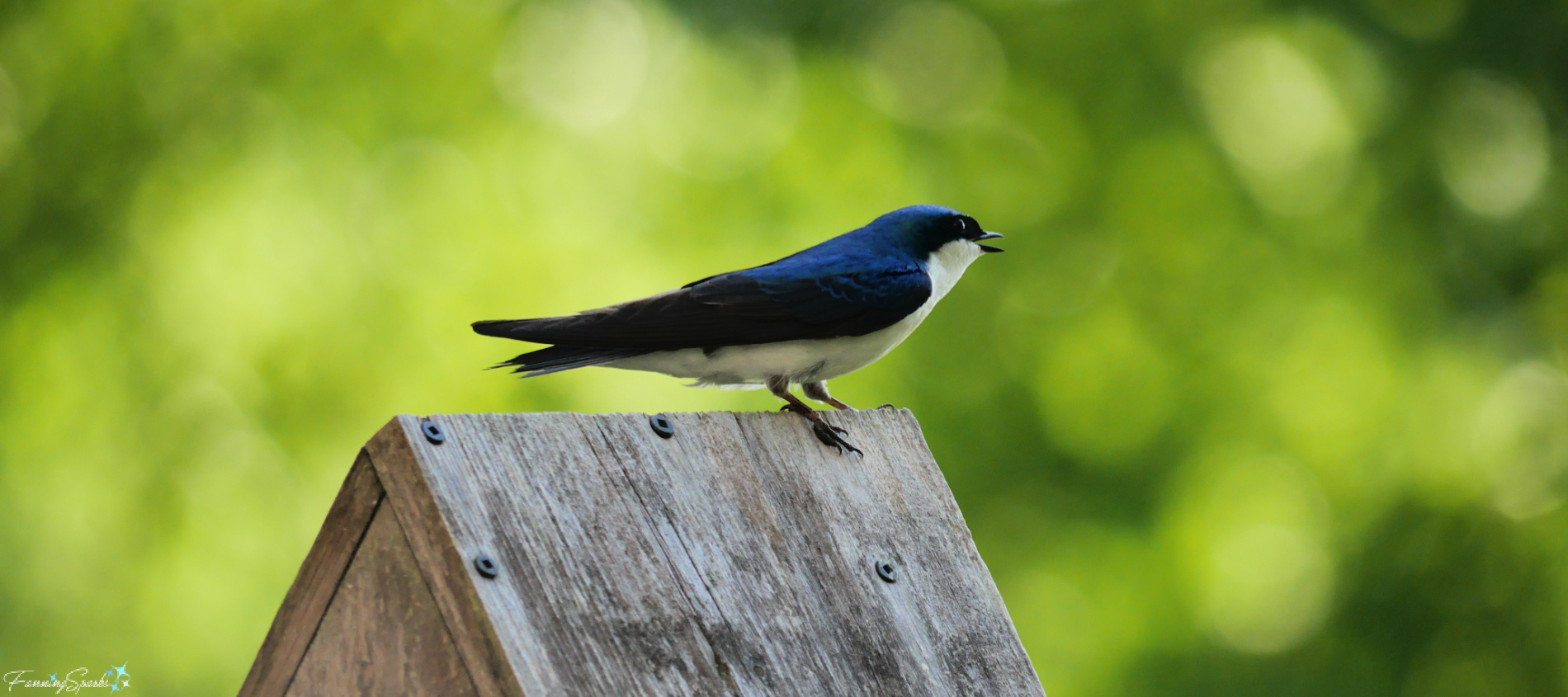
One of the many joys of living in a new locale is observing and studying the dance of the seasons, the patterns of the weather and the rhythm of the local wildlife. There are many highlights to look forward to in Mother Nature’s calendar but my favorite, by far, is the arrival of spring. The return of migratory birds and the start of nesting activities are sure signs spring has arrived.
Longer days, another indicator of spring, allow for magical evening strolls along the shore to observe nature and enjoy the sunset.
A few days ago, I noticed some new shorebirds mixed in among the usual gulls. It’s difficult to identify them with certainty, but I believe they were Eastern Willets (Tringa semipalmata semipalmata). Eastern Willets, typically return to Atlantic Canada between late-April and early-May after spending the winter on the northern coast of South America.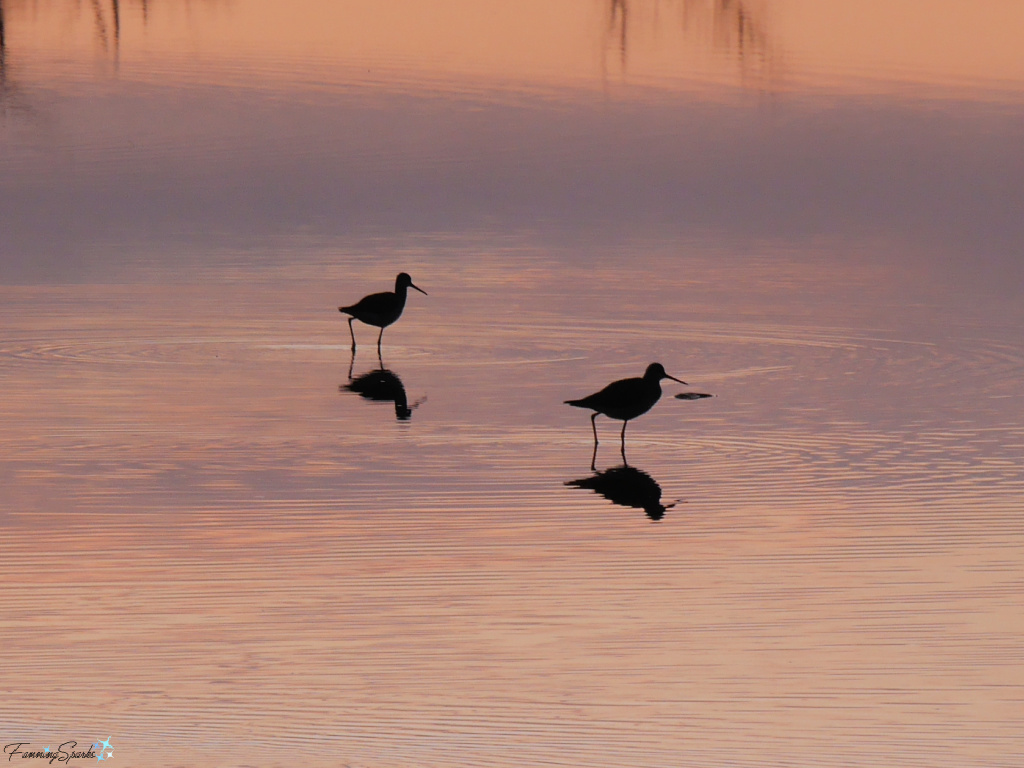
Nova Scotia, I’ve learned, plays a crucial role in the Atlantic Flyway which is a vital, high-traffic migratory route along North America’s East Coast. Sometimes referred to as an “avian superhighway”, it is used by millions of birds, including shorebirds, raptors, and waterfowl every year.
The below image, from the Ducks Unlimited Canada website, shows the North American section of the Atlantic Flyway which stretches “from the Arctic tundra of Baffin Island to the Caribbean”. I’ve circled Nova Scotia to call out its crucial location for essential staging and refueling stopovers. The other three flyways are the Mississippi Flyway, Central Flyway and Pacific Flyway. “The Atlantic is the most densely populated of the four flyways”.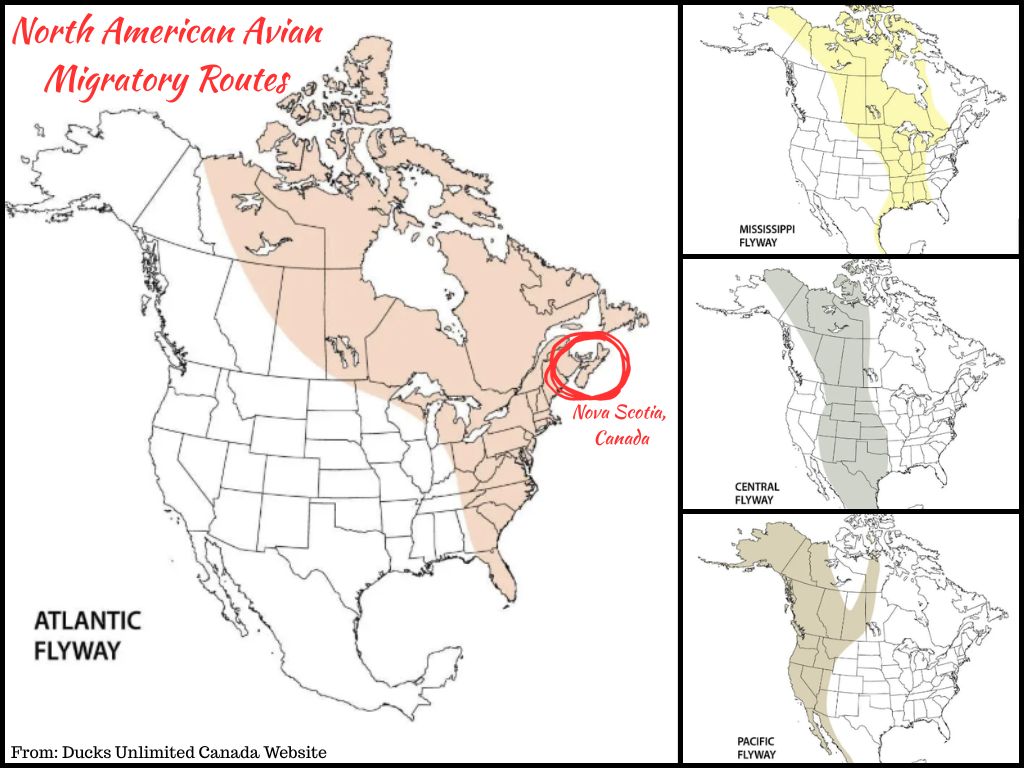
Not all migratory birds pass through Nova Scotia ― many stay on this small Canadian province for the breeding season. According to a 2019 Migratory Bird Survey Focus Report completed for a major environmental assessment in the region, “spring migration in northern Nova Scotia typically begins in March, with migrating water birds, hawks, and songbirds. During April, the pace of migration and the number of returning species increases, and reaches a peak during the month of May, with a wide diversity of birds either passing through the area on their way to Arctic nesting grounds or arriving on their breeding territories in Nova Scotia. By early June, migration is nearly complete … Nesting in northern Nova Scotia can begin as early as mid-March … and continue into early-September … the vast majority of birds are engaged in nesting activities from mid-April to late August”.
Reading about that timeline was just the push I needed to get my newest birdhouse installed. It’s a simple wooden nesting box specifically designed to attract tree swallows (Tachycineta bicolor) like the one pictured below.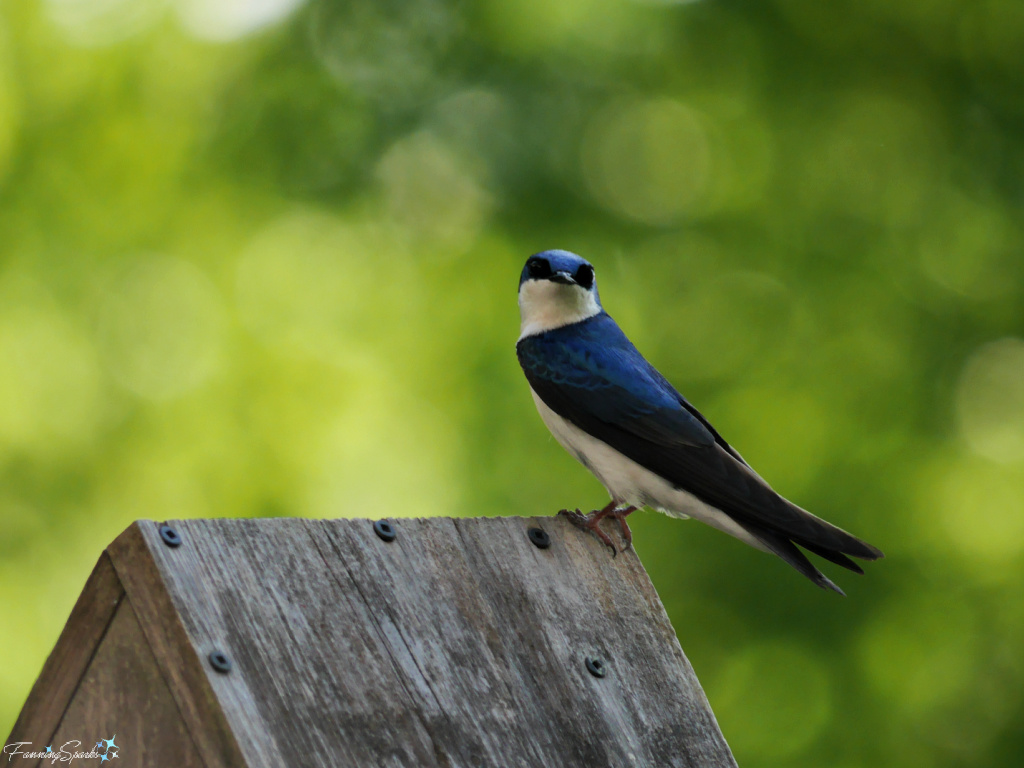
The All About Birds website, from the Cornell Lab of Ornithology, describes tree swallows this way ― “Handsome aerialists with deep-blue iridescent backs and clean white fronts, Tree Swallows are a familiar sight in summer fields and wetlands across northern North America. They chase after flying insects with acrobatic twists and turns, their steely blue-green feathers flashing in the sunlight. Tree Swallows nest in tree cavities; they also readily take up residence in nest boxes. This habit has allowed scientists to study their breeding biology in detail, and makes them a great addition to many a homeowner’s yard or field.”
I didn’t see many tree swallows when we lived in the US Southeast but a pair did take up residence in one our bluebird birdhouses once. I’ve since learned, tree swallows may move into bluebird houses but they can’t thrive because the boxes are typically too small.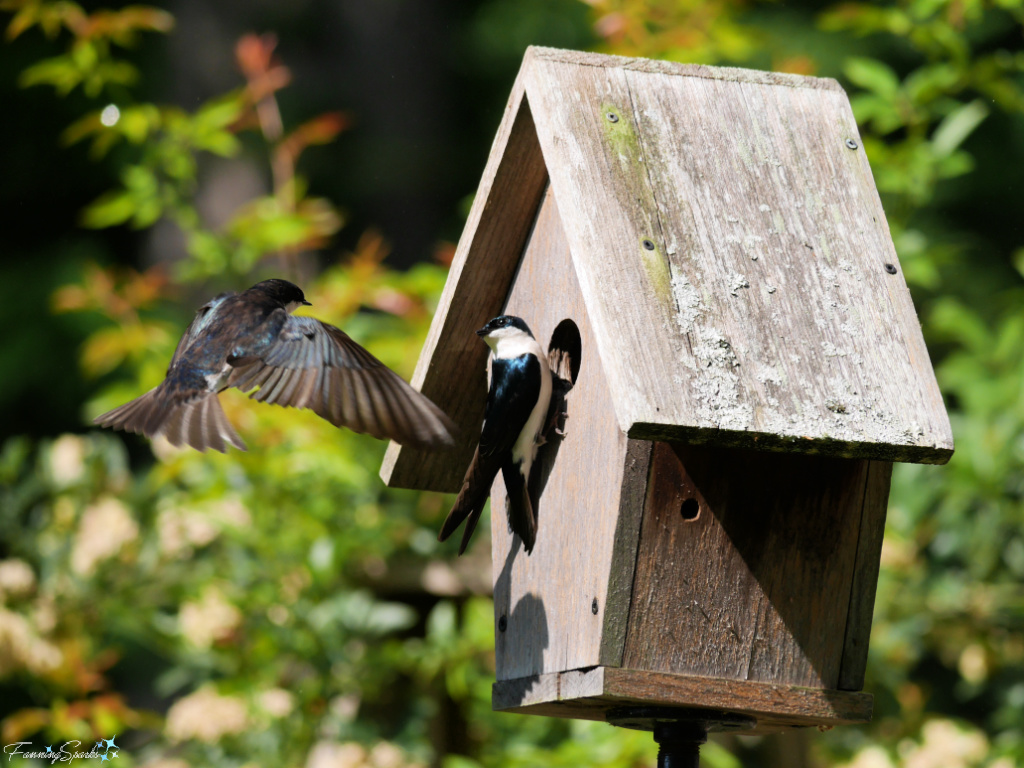
The TreeSwallows.com website, the go-to resource for all things tree swallow, explains that bluebird houses are typically “far too small for swallow broods of up to seven young … to avoid problems for Tree Swallow young, be certain your floors are at least 5″ x 5″, preferably more”.
The bluebird birdhouse shown in these photos is the same as the one showcased in my DIY Bluebird-Approved Birdhouse Tutorial. As shown below, it has a 6½” x 4½” bottom. At first glance that might seem big enough for tree swallows but, given the wood is ¾” thick, the interior floor size is only 5¾” x 3¾” which, unfortunately, is less than the minimum for tree swallows.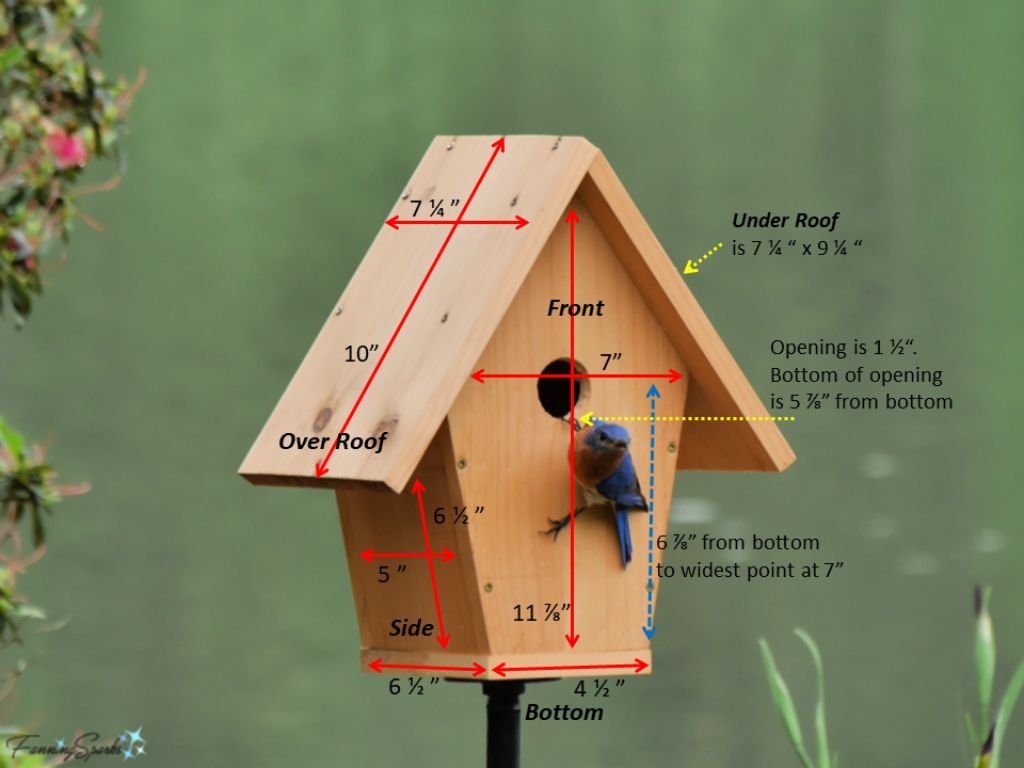
I learned about a better nesting box for tree swallows at a recent Swallow Box Building Workshop. The workshop was co-sponsored by the Nova Scotia Bird Society and Ducks Unlimited Canada.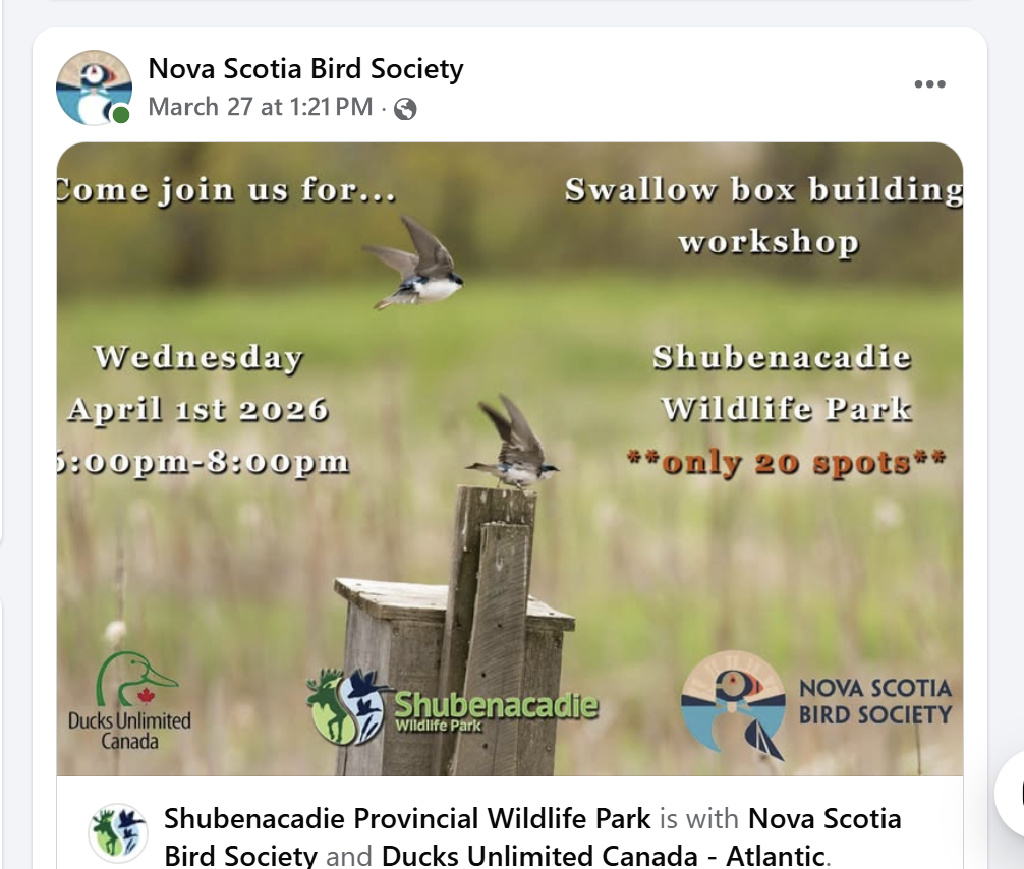
It was held in the Wetland Centre at the Shubenacadie Provincial Wildlife Park. The Wetland Centre, explains the Shubenacadie Wildlife Park website, “was built in partnership by both Ducks Unlimited Canada (DUC) and the Province of Nova Scotia in 2006. Today, the centre serves as a community hub for hands-on learning about wetlands, wildlife and the environment”.
This workshop was part of the Nova Scotia Bird Society’s From Waste to Wings program. As explained in a recent Instagram post “Tree swallows across Nova Scotia … are in steep decline, with over 50% of natural nesting cavities lost due to tree removal, development, and shoreline change. Without safe nesting sites, breeding success drops sharply. Nesting boxes directly replace this lost habitat. When properly built and installed, they significantly improve swallow reproduction while offering a clear benefit to homeowners: a single swallow family can consume thousands of flying insects per day, naturally reducing mosquitoes and lawn pests”.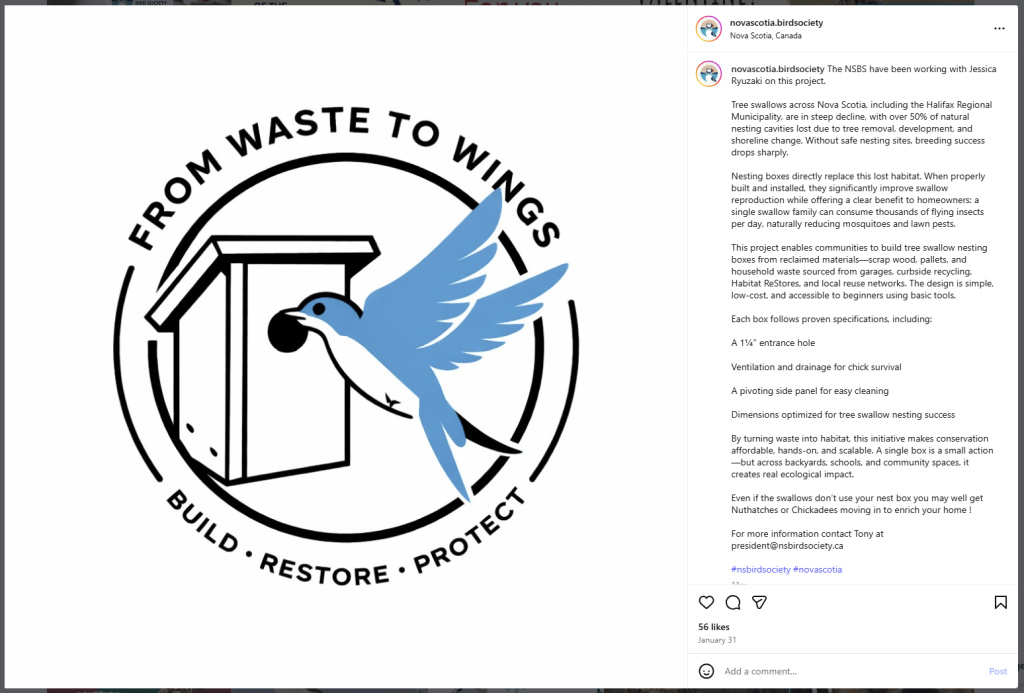
Concerns about the population decline of tree swallows are not limited to Nova Scotia. Nor are they limited to tree swallows.
The State of Canada’s Birds Report, published in 2024 by Birds Canada and Environment and Climate Change Canada, explains the bigger picture ― “The rise and fall of bird populations tells us how they, and by extension their habitats, are doing. Birds reflect our impact on the environment, tell us where conservation action is working, and show us where we need to focus more effort.”
The below graphic from the report illustrates “Canada’s Birds at a Glance” and shows how “Canada’s bird populations have changed. Some have grown in the last 50 years, while others have declined dramatically.” I added a call-out for tree swallows to show they are included in the aerial insectivores category.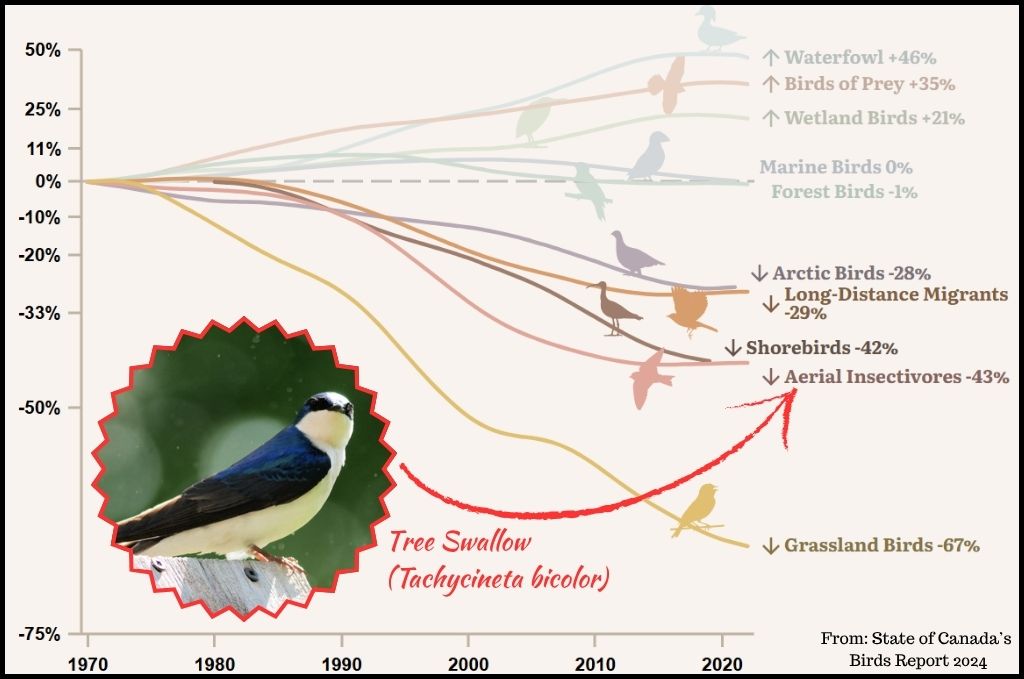
Aerial insectivores, the report explains, “are linked by their unique feeding strategy of catching insects in flight. Many are among Canada’s fastest and nimblest fliers, and put on spectacular displays in their aerial pursuits. This group includes the swallows, swifts, nightjars, and flycatchers.”
Although tree swallows weren’t specifically mentioned in the State of the Birds 2025 report issued by the U.S. Committee of the North American Bird Conservation Initiative, the American findings are similar to the Canadian findings. See More Info section below for direct links.
Returning to the Nova Scotia Bird Society’s From Waste to Wings initiative, this program “enables communities to build tree swallow nesting boxes from reclaimed materials … the design is simple, low-cost, and accessible to beginners using basic tools. … By turning waste into habitat, this initiative makes conservation affordable, hands-on, and scalable. A single box is a small action—but across backyards, schools, and community spaces, it creates real ecological impact”.
Here’s a look at the project kit provided to each workshop participant. It included SEVEN parts all cut from 1” x 6” rough-sawn lumber:
. Back 16” x 6”
. Front 10” x 6” with a 1 ⅜” round hole positioned about 2” below the top edge
. Left Side 10” x 6” with two small ventilation holes about 2½” below the top edge
. Right Side 10” x 6” also with ventilation holes and the top edge cut at about a 45° angle
. Bottom 4” x 6” with two small drainage holes
. Roof 9” x 6”
. Latch 1” x 4”.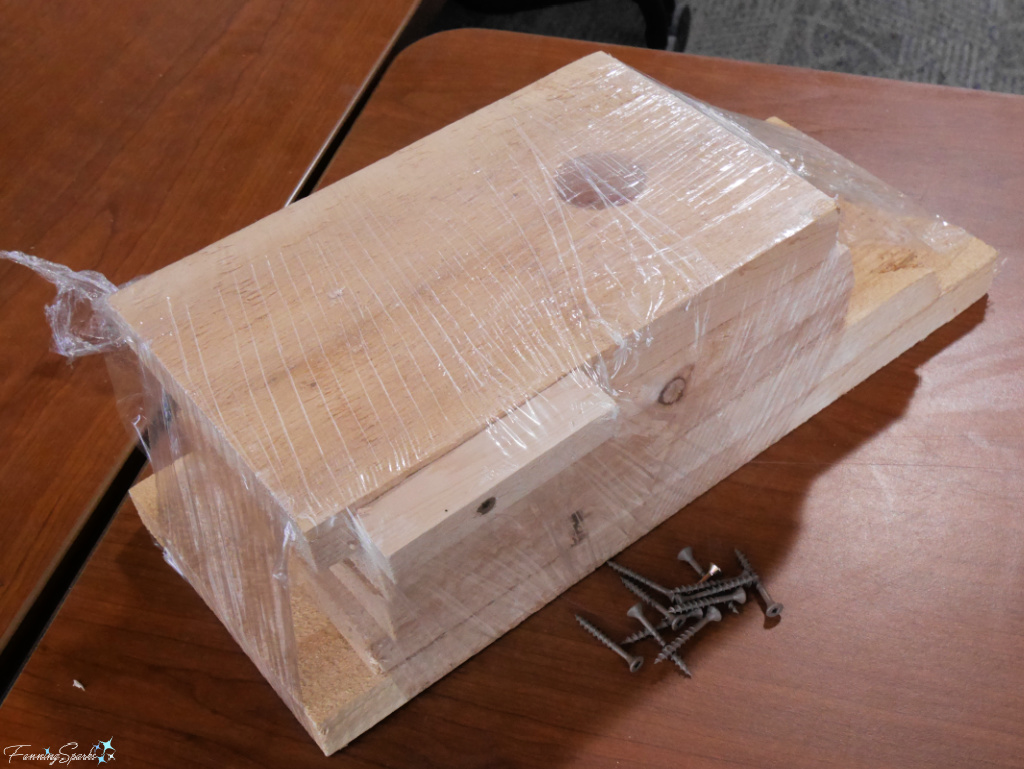
Assembling the parts was a straightforward activity. All the parts, except the right side, were simply butted up against each other and screwed into place with galvanized wood screws. The right side was designed to swing open for cleaning and checking inside the box. We placed the top edge of the right side with the angled cut facing out so the “swinging door” could operate smoothly. Then we attached it to the front and back with screws at the top only ― no screws were used at the bottom of the right side. The latch was attached along the right edge of the front, positioned about ½” up from the bottom edge, with a single screw.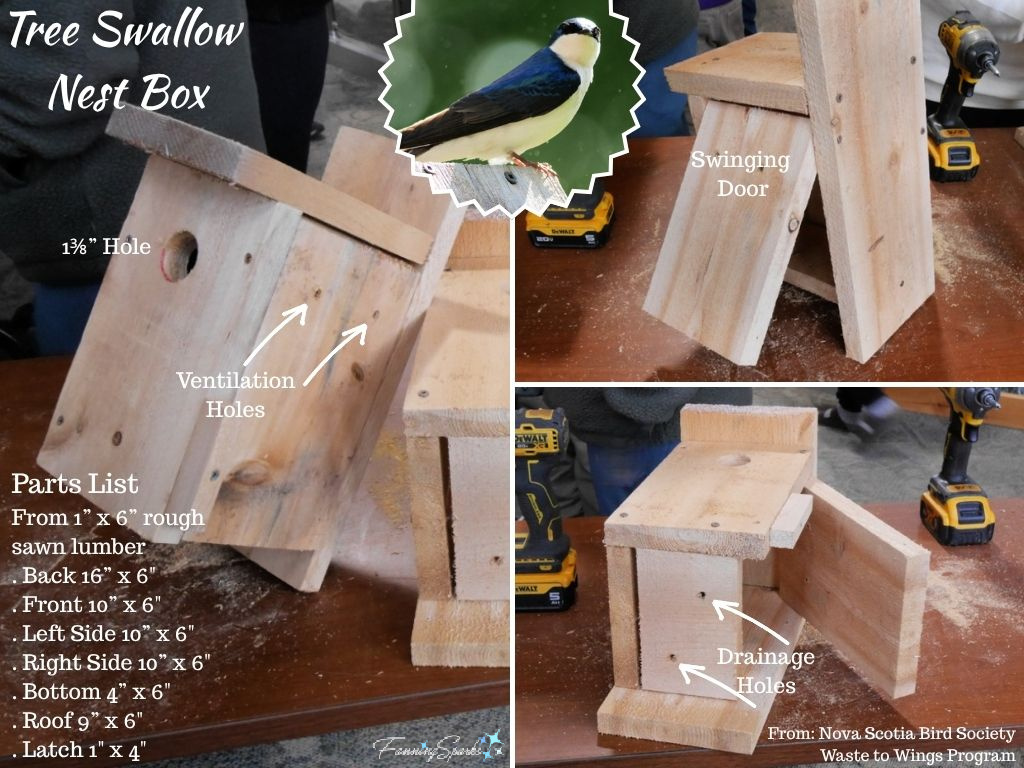 The final step, of course, was to install the nesting box where tree swallows will find it, want to move in and can safely raise a brood.
The folks at Treeswallows.com emphasize the importance of selecting a good site. “Due to chronic shortages of cavities some Tree Swallows will try to nest in boxes put in dangerous places, where they face predation or nest competition. You don’t want to attract them to sites like that!”, they write on their website. “These birds need nest boxes located where they can reproduce unharmed, and in or near habitat that supplies enough food for them and their young.”.
The ideal site, they advise, is “large open fields in rural areas near buggy wetlands”. Unlike other songbirds, tree swallows don’t hide from predators in dense vegetation, instead “they rely on their flying ability to get away [so] nest boxes that are well out in the open let the swallows spot incoming danger at a distance”.
In terms of orientation, the experts recommend the boxes face south, southeast or east. Unless there is a “strong prevailing wind at your project site”, in which case, you should “consider facing your boxes away from it, regardless of direction”.
Here’s an example of a tree swallow nesting box installed at the Wetland Centre at Shubenacadie Provincial Wildlife Park.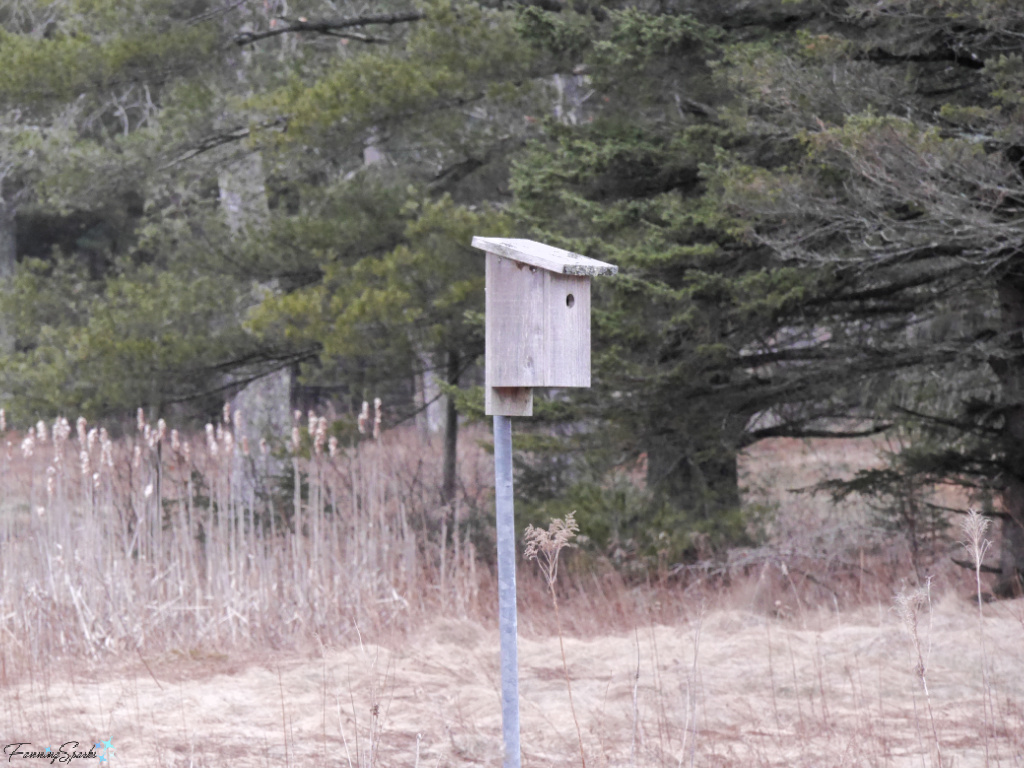
Treeswallows.com recommends mounting tree swallow boxes on poles ― not posts, trees or other structures. “Five and one-half to six feet from ground to entrance hole is a good height.” They share lots of great information on the types of poles to use and methods for mounting boxes to poles on their website.
Here’s a closer look at the mounting technique used at the Wetland Centre.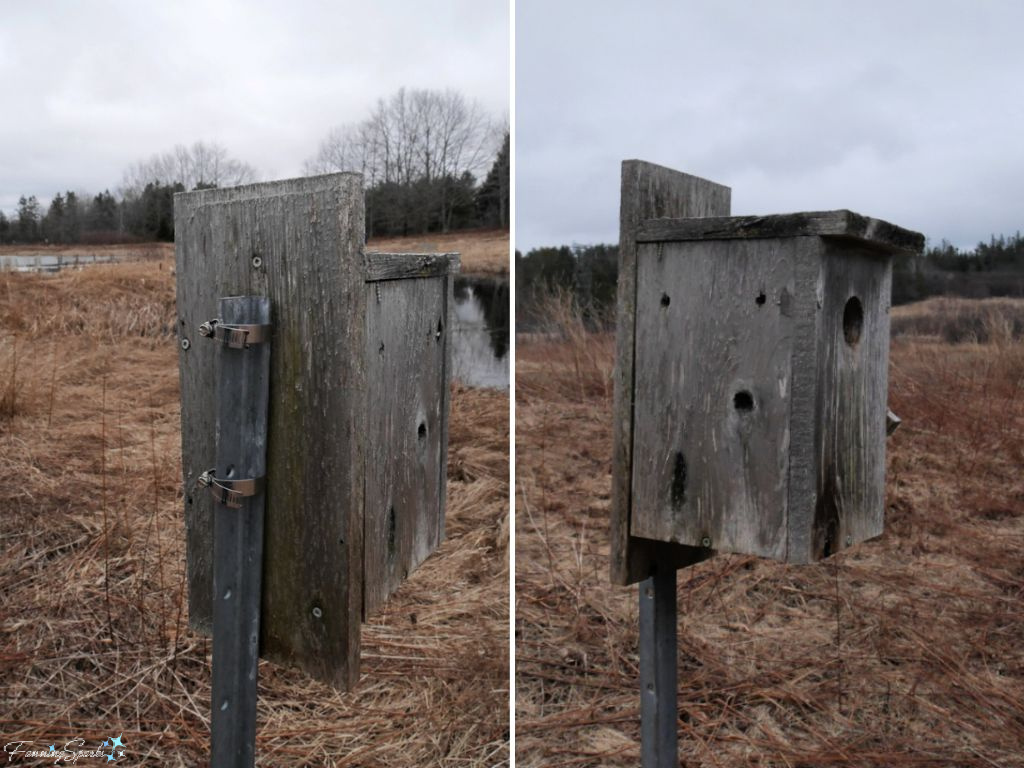
I’m grateful for all the great advice the experts share so generously. I did deviate slightly, however, by adding a small copper shield to protect the front opening. I’ve learned the hard way that determined predators, like squirrels or larger birds, can gnaw or peck through wood to widen the hole and take over a birdhouse. A copper shield can also be used to finetune the size of the opening. These are available for purchase, sometimes listed as birdhouse guards or portal protectors, but I made my own. I cut it from some 36-gauge, copper tooling foil which I had left over from a previous project (see Curly Copper Snowflake – DIY Tutorial).
Naturally, I couldn’t resist turning my copper shield into a fun feature!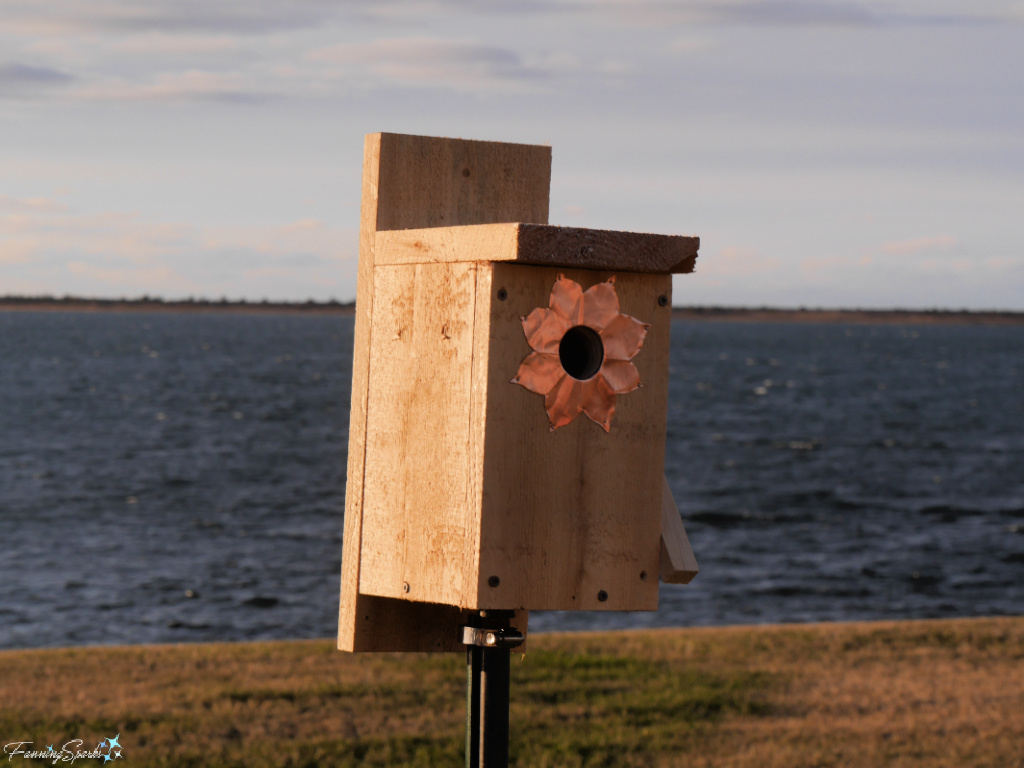
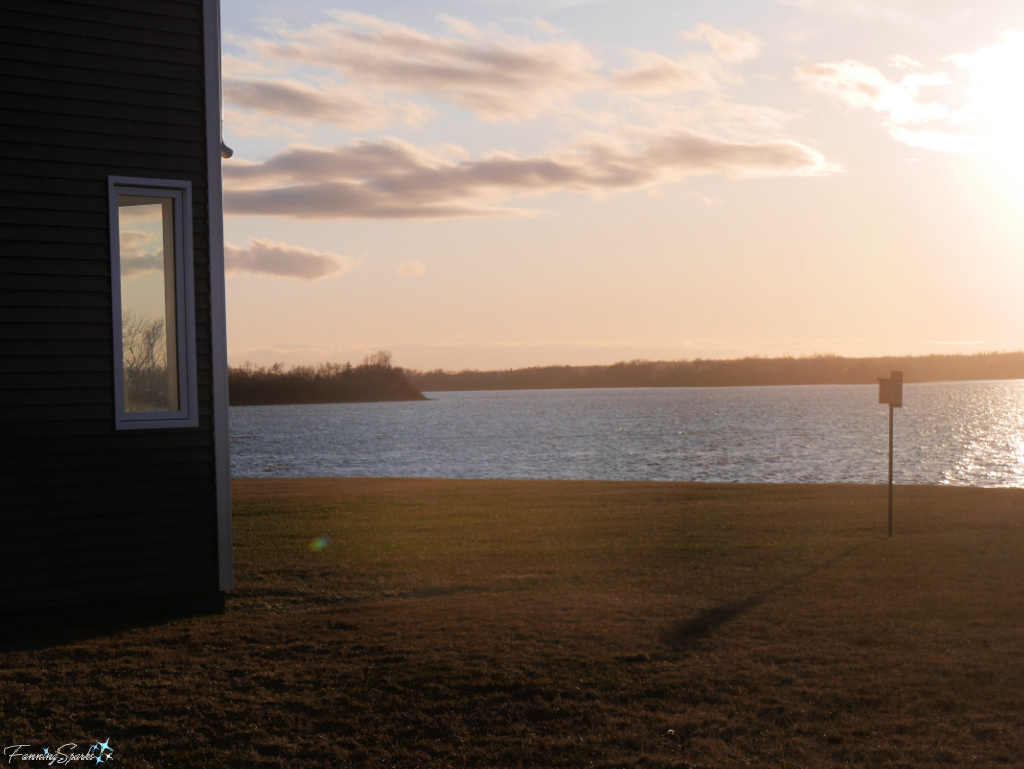
So, there you have it, our first tree swallow nesting box is open for business!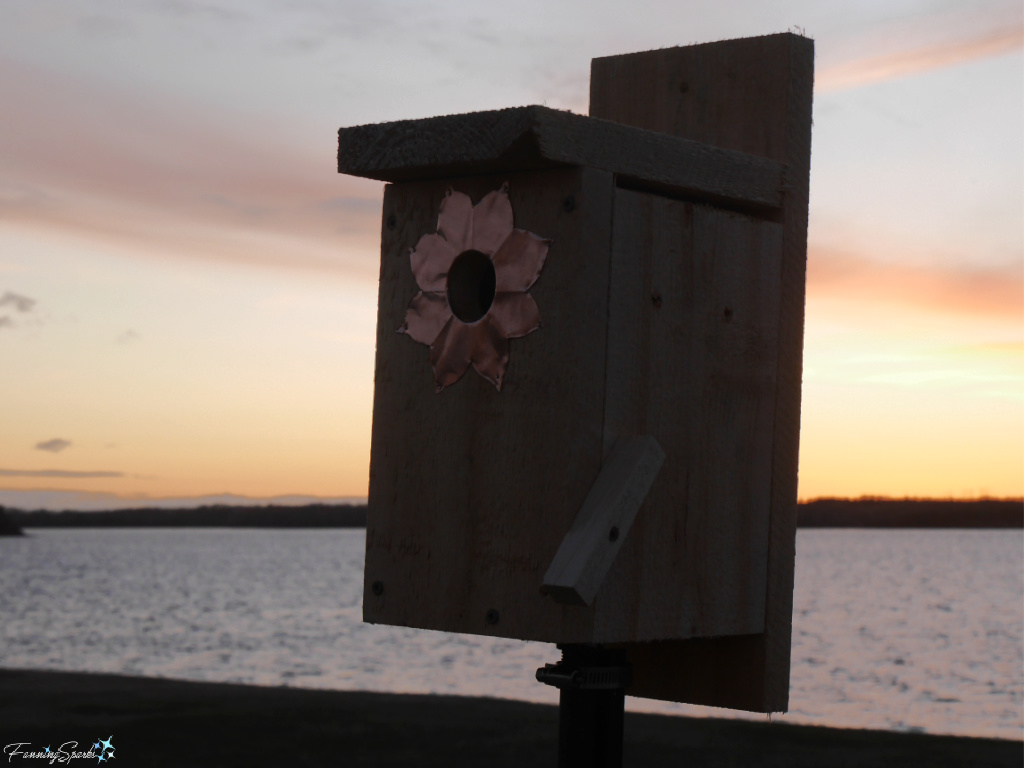
More Info
Previous blog posts mentioned in this blog post include:
. DIY Bluebird-Approved Birdhouse Tutorial
. Curly Copper Snowflake – DIY Tutorial.
The Swallow Box Building Workshop was held in the Wetland Centre at the Shubenacadie Provincial Wildlife Park. Many thanks to the co-sponsors the Nova Scotia Bird Society and Ducks Unlimited Canada. See the Nova Scotia Bird Society Instagram account for more information about the From Waste to Wings program.
The following resources were consulted in writing this blog post:
. TreeSwallows.com website is the go-to resource for all things tree swallow
. Ducks Unlimited Canada website
. Migratory Bird Survey by Dillon Consulting in 2019 for Northern Pulp Nova Scotia
. All About Birds website by the Cornell Lab of Ornithology
. State of Canada’s Birds Report issued in 2024 by Birds Canada and Environment and Climate Change Canada
. State of the Birds 2025 Report issued by the U.S. Committee of the North American Bird Conservation Initiative
. Halifax Woman Encourages DIY Nesting Boxes to Help Local Bird Species CBC News article by Giuliana Grillo de Lambarri Feb 2026
. website of eBird Atlantic Canada which is a collaborative project managed by Nova Scotia Bird Society, Nature Newfoundland and Labrador, Nature New Brunswick, Nature Prince Edward Island and Birds Canada.
Today’s Takeaways
1. The return of migratory birds and the start of nesting activities are sure signs spring has arrived.
2. “The rise and fall of bird populations tells us how they, and by extension their habitats, are doing. Birds reflect our impact on the environment, tell us where conservation action is working, and show us where we need to focus more effort.” State of Canada’s Birds Report
3. “A single box is a small action—but across backyards, schools, and community spaces, it creates real ecological impact”. Nova Scotia Bird Society’s From Waste to Wings Initiative


Comments are closed.