
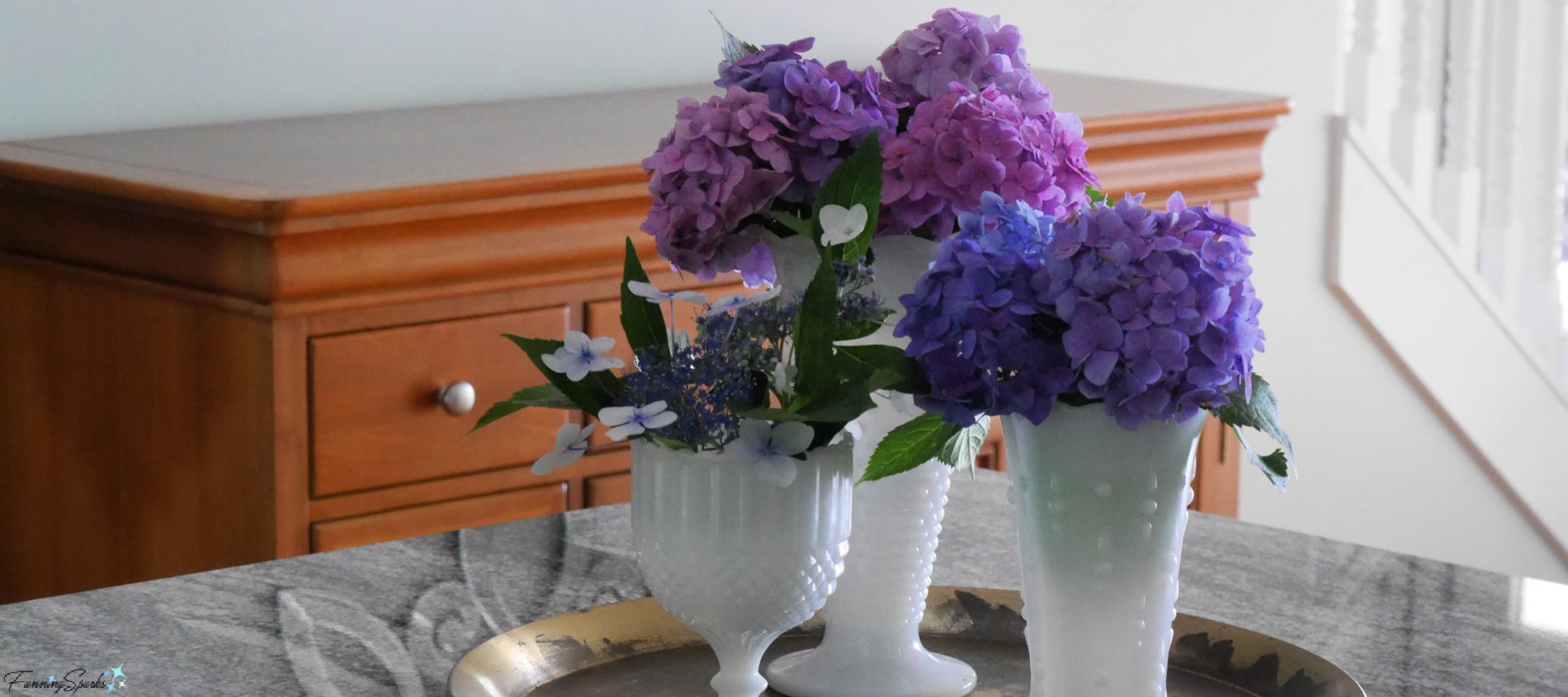
We’ve all been there―guests are about to arrive and we’re rushing to make our home look its very best. First, there was a flurry of decluttering, cleaning and primping. Then, there’s zhuzhing up with special touches like fresh cut flowers.
Fortunately, our hydrangeas were at the ready when I found myself in this situation recently. It was easy to snip some flowerheads and fill the house with pops of vibrant color. Hydrangeas for the win!
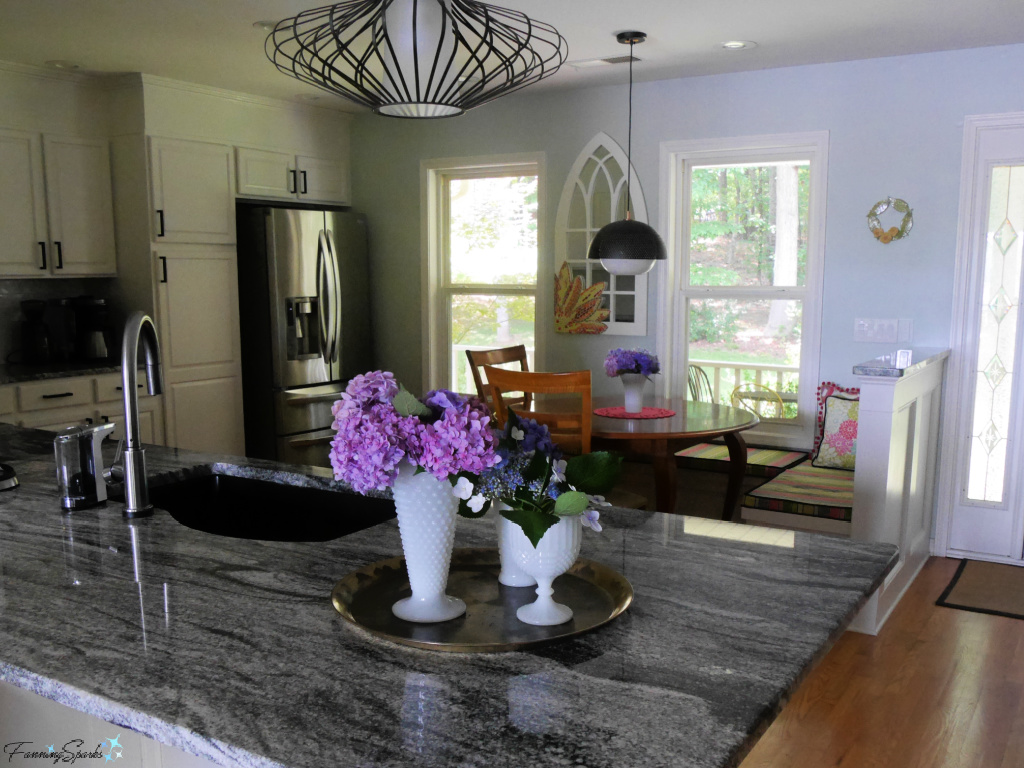
My favorite way to display cut flowers is in a grouping. The arrangement shown below is a case in point. There are three different milk glass vases, in varying heights, filled with a variety of hydrangea blooms all clustered together on a large, vintage brass tray. Grouping them in this way adds impact and drama.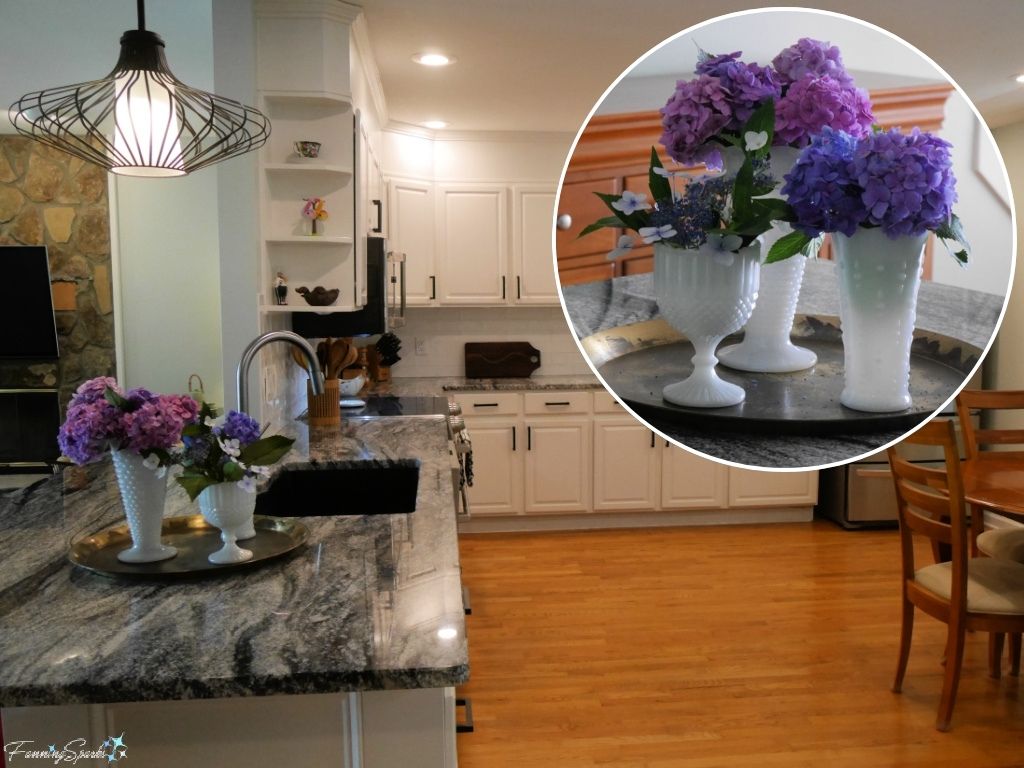
Along the same lines, this unusual ceramic vase―designed and made by yours truly―is meant to look like curling ribbon with three small vases incorporated into the swirls.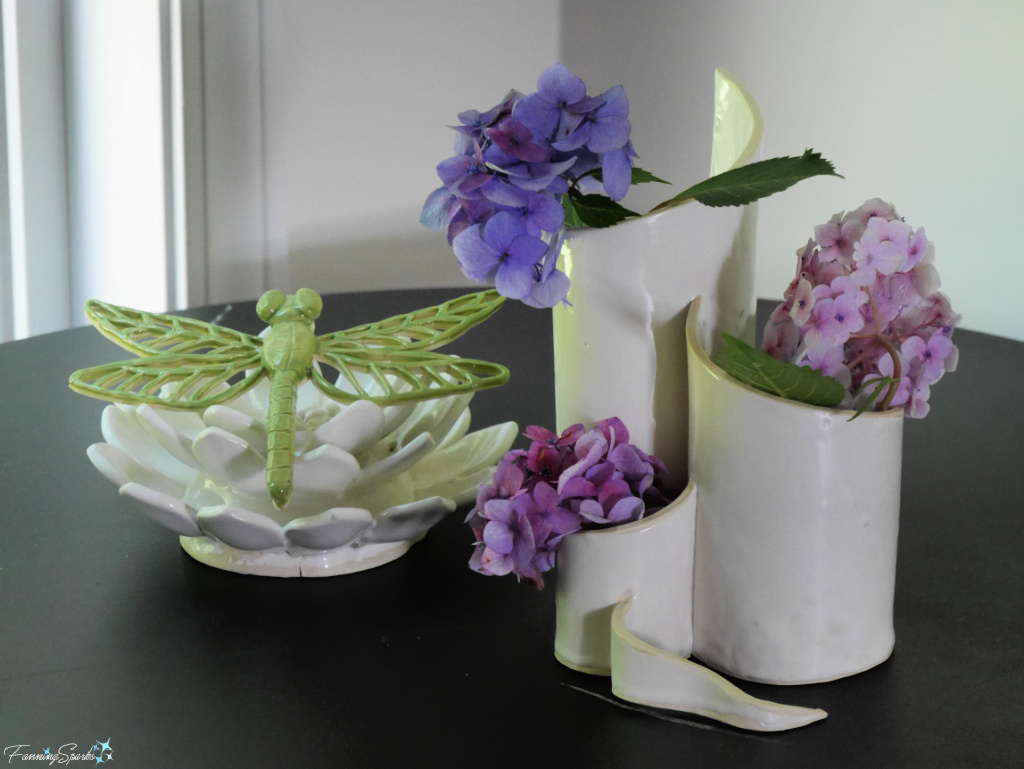 Simple vases of small bouquets and individual blooms were also sprinkled throughout the house―on the dining table in the kitchen, …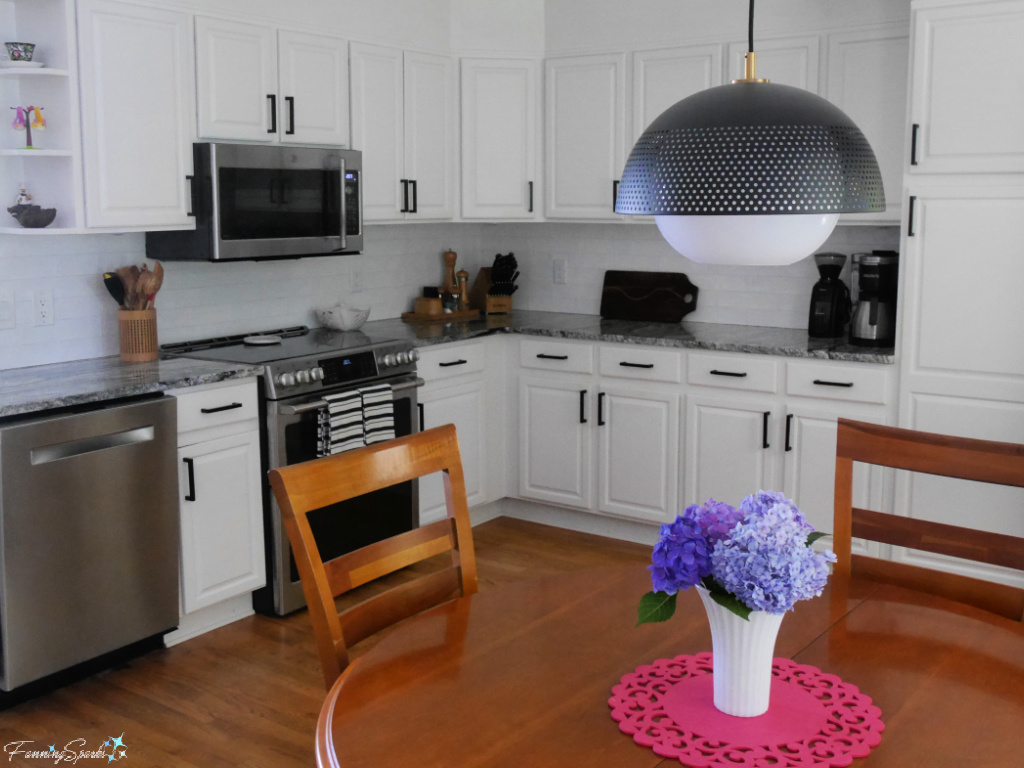
… on the coffee table in the living room,…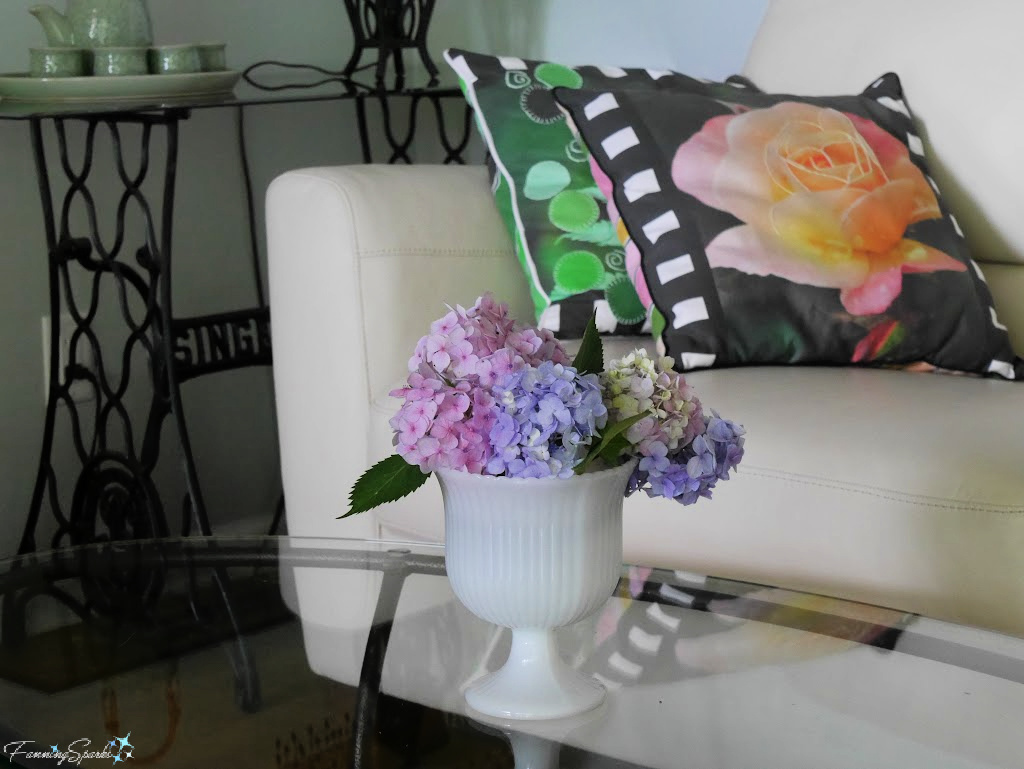
… on the desk and table in the studio,…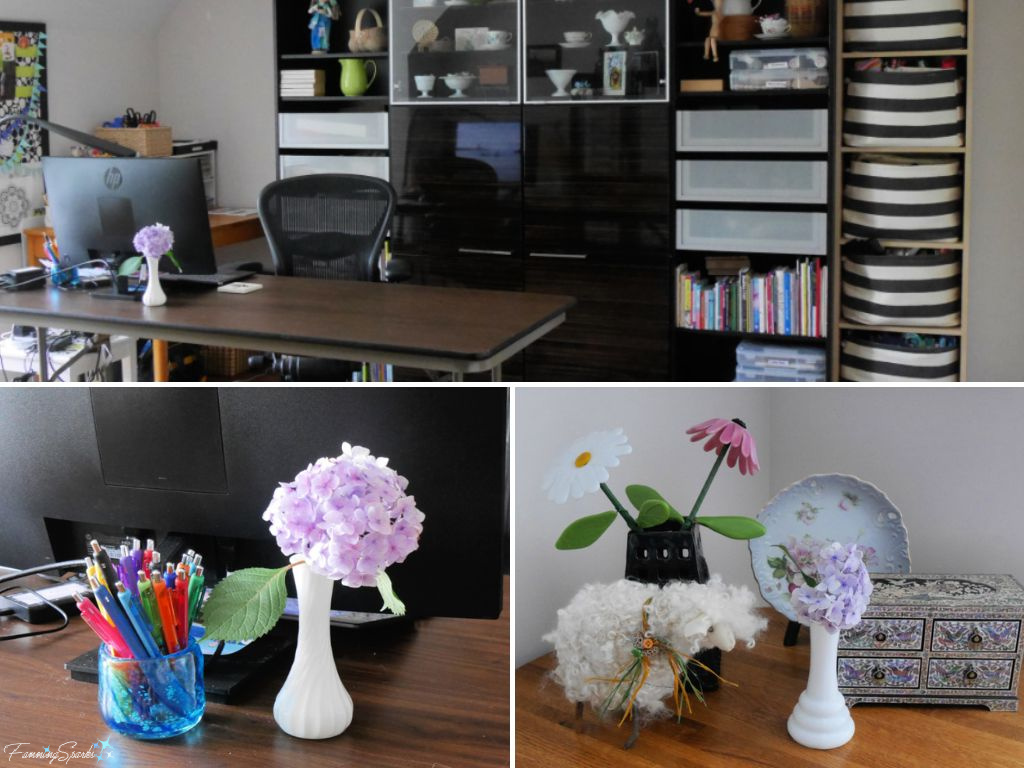
… and even on the bistro table on the front porch.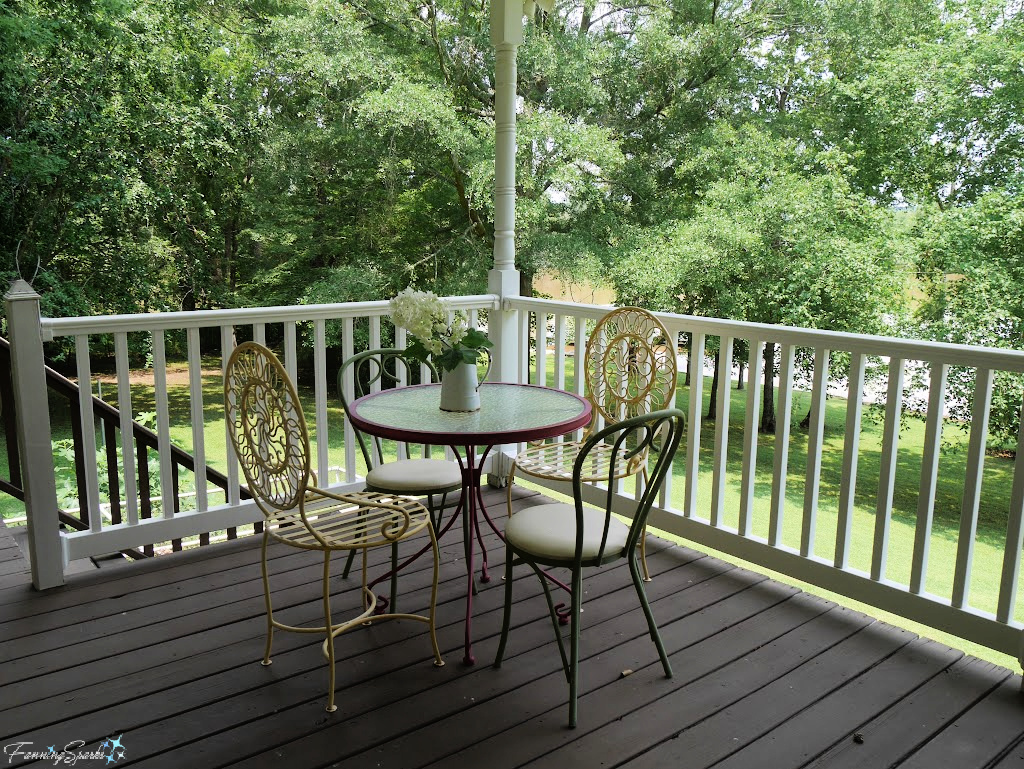
Hydrangeas are beautiful as cut flowers but they are also great in flower gardens and ornamental landscapes.
In her book, Hydrangeas, Glyn Church describes hydrangeas as the perfect “big bold flowering shrub”. She goes on to explain they are “easy to grow, easy to prune, flower endlessly, suppress the weeds, and are never attacked by pests and diseases”. I have to agree!
“With over 70 species, hydrangeas offer a range of sizes, flower forms, colors, and care requirements, making them a popular choice for gardens worldwide” reports Gardenia.net in their article, Hydrangea Types – How to Select the Right One?. The article goes on to describe the main types of hydrangeas including Bigleaf (Hydrangea macrophylla), Panicle (Hydrangea paniculata), Smooth (Hydrangea arborescens), Oak Leaf (Hydrangea quercifolia), Mountain (Hydrangea serrata) and Climbing (Hydrangea anomala petiolaris).
The Oak Leaf Hydrangea (Hydrangea quercifolia) is one of my favorites. This handsome hydrangea gets its name from its dramatic foliage which, you guessed it, resembles oak leaves. The flowerheads are shaped like cones which start out white and then turn to soft pink. This sturdy shrub can be expected to grow between 2 and 8 feet tall and wide.
Interestingly, Hydrangea quercifolia is native to the southeastern United States which, I suppose, explains why it thrives in our yard. Here’s a closer look at our Oak Leaf Hydrangea (Hydrangea quercifola ‘Snowflake’).
I’m also fond of Bigleaf Hydrangeas (Hydrangea macrophylla) and I’m not the only one. According to Wikipedia, Hydrangea macrophylla is “by far the most widely grown. It has over 600 named cultivars, many selected to have only large sterile flowers in the flowerheads”. These flowerheads are typically described as either “mophead” or “lacecap” hydrangeas―both are visible in this photo.
“Mophead flowers” explains Wikipedia “are large round flowerheads resembling pom-poms or, as the name implies, the head of a mop”. Here’s a closer look at some gorgeous mopheads from my Bigleaf Hydrangea “Endless Summer” (Hydrangea macrophylla ‘Endless Summer’).
Interestingly, the blooms pictured below are all the same variety of hydrangea, from the same yard, but the colors are noticeably different. That’s because “the flowers of many hydrangeas” as Wikipedia explains, “act as natural pH indicators, producing blue flowers when the soil is acidic and pink ones when the soil is alkaline.” This rings true as the soil in my flower beds varies significantly depending on the soil amendments we added.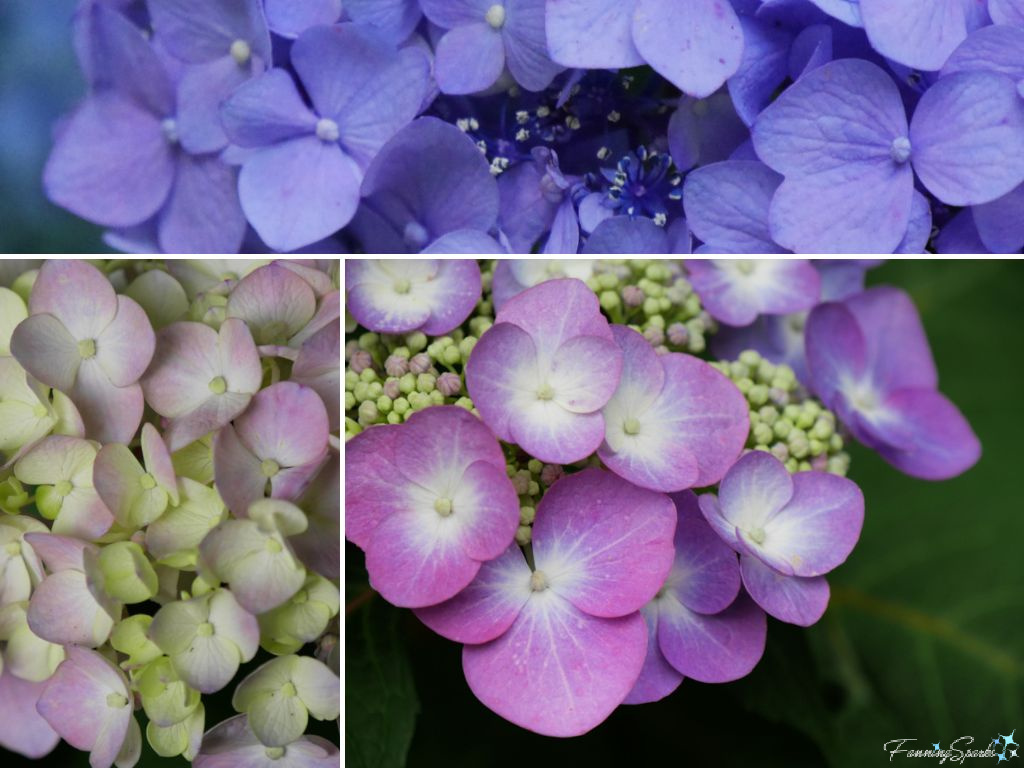
“The name ‘lacecap”, explains Church, “comes from the lace caps that servant girls used to wear in the stately homes of Europe.” It’s not difficult to imagine how this flower shape might be described as a “lacecap”.
“Hydrangeas are quite different from most flowers” writes Church. “The flowers open and go on and on and on all summer … and so the ‘show’ continues”. The reason for this remarkable difference is quite fascinating.
Church explains “most plants have true flowers to carry out the essential work of producing seeds and use the ornamental petals to attract insects to do the pollinating. … Hydrangeas don’t have petals [but they do] have two types of flowers. … Hydrangeas have one set of flowers to attract the insects… ―the infertile (sterile) flowers… and another completely different set to produce the seeds…― the fertile (true) flowers. … The ‘true’ flowers with all the sexual parts are very small.” Essentially the big, showy sterile flowers (technically, colorful “sepals”) attract the pollinators to the small, less-noticeable fertile flowers. This means that unlike most flowers which “drop their petals once they’ve been pollinated and begin the task of producing seeds”, the hydrangea’s sterile flowers continue to put on a show while its true flowers produce seeds unnoticed.
A closer look at the flowerhead of this lacecap hydrangea reveals a few, showy, sterile flowers around the outside rim of a mass of fertile, true flowers. This is another Bigleaf Hydrangea from my garden―known as “Blue Titmouse” (Hydrangea macrophylla ‘Blaumeise’).
The next photo features a special hydrangea I found at a specialty nursery. It is a Mountain Hydrangea―more specifically Hydrangea serrata ‘Miyama-yae-Murasaki’―with the common name of “Purple Tiers Mauve Lacecap”. It seems the mass of true flowers have already fallen from the center of this lacecap leaving behind only the strikingly beautiful, rich pink, multi-layered sepals.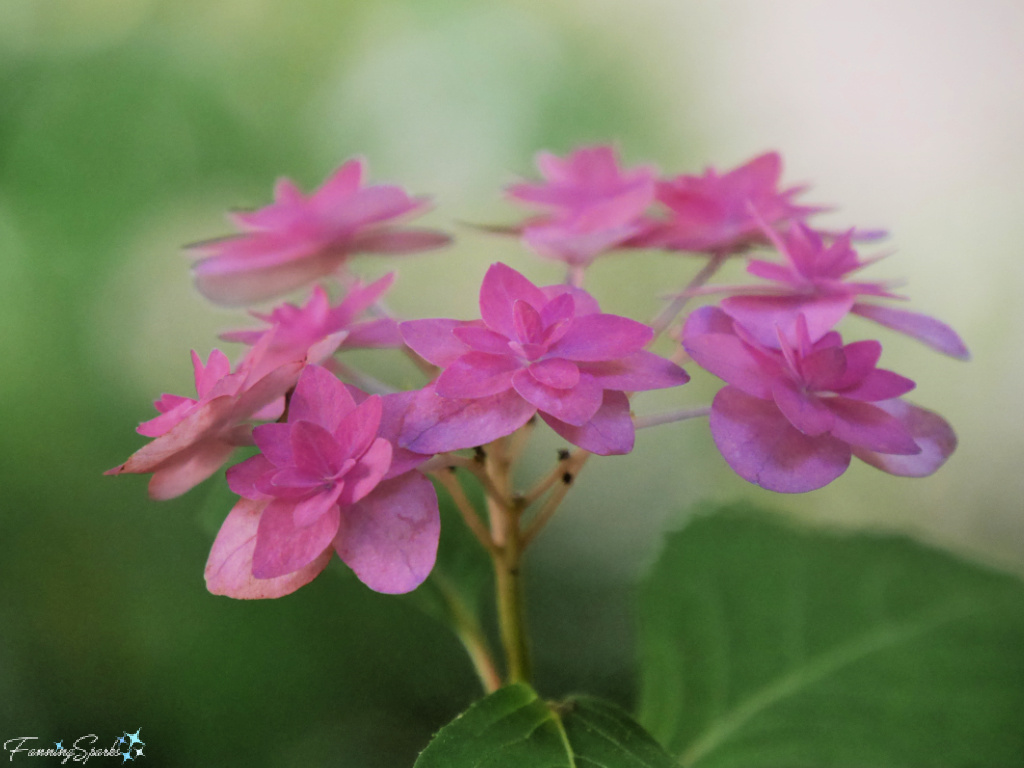
Another characteristic I appreciate about hydrangeas is that they’re easy to propagate. I started with only five different hydrangea plants and now there are more than three times that many mature hydrangeas sprinkled through our display beds. See my previous blog post From One to Many: Propagating Flowering Shrubs for my preferred technique. That post contained the following update on my hydrangea cuttings.
My hydrangea cuttings also look promising. Here’s a lovely variegated hydrangea blossom from last spring along with the last year’s cutting as it looks today.

Some varieties of hydrangeas are considered “compact” making them ideal for containers. I saw hydrangeas thriving in large urns in Susanne Hudson’s gorgeous garden during the Penny McHenry Hydrangea Festival. 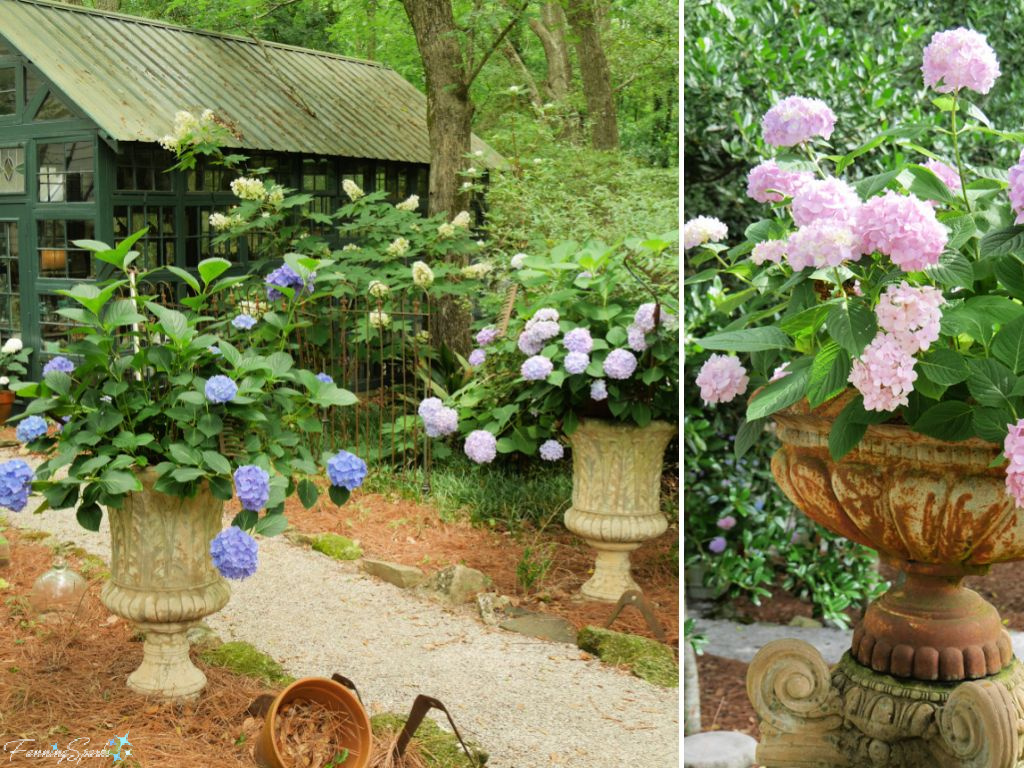
The Penny McHenry Hydrangea Festival celebrated all things hydrangea. The annual event, which ran for 16 years in Douglasville Georgia, was wildly popular. Sadly, according to the Festival’s website, 2024 was their last year.
I learned a great deal about hydrangeas at these Festivals. During an educational lecture, for instance, I recall Hudson describing hydrangeas, boxwood and autumn fern as her go-to trio for gardening plants. The combination was very successful in my own garden.
Compact hydrangeas can even be grown in window boxes as evidenced by these gorgeous examples from Charleston, South Carolina (see previous post Charleston’s Glorious Window Boxes).
Hydrangeas are excellent subjects for photography―I’ve used them for shutter therapy on more than one occasion! I’ve included a few examples of where these irresistible blooms made an appearance in previous blog posts.
This array of vibrant hydrangea blossoms, from Top 24 Photos from 2024, was spotted at the hydrangea flower competition during the Penny McHenry Hydrangea Festival.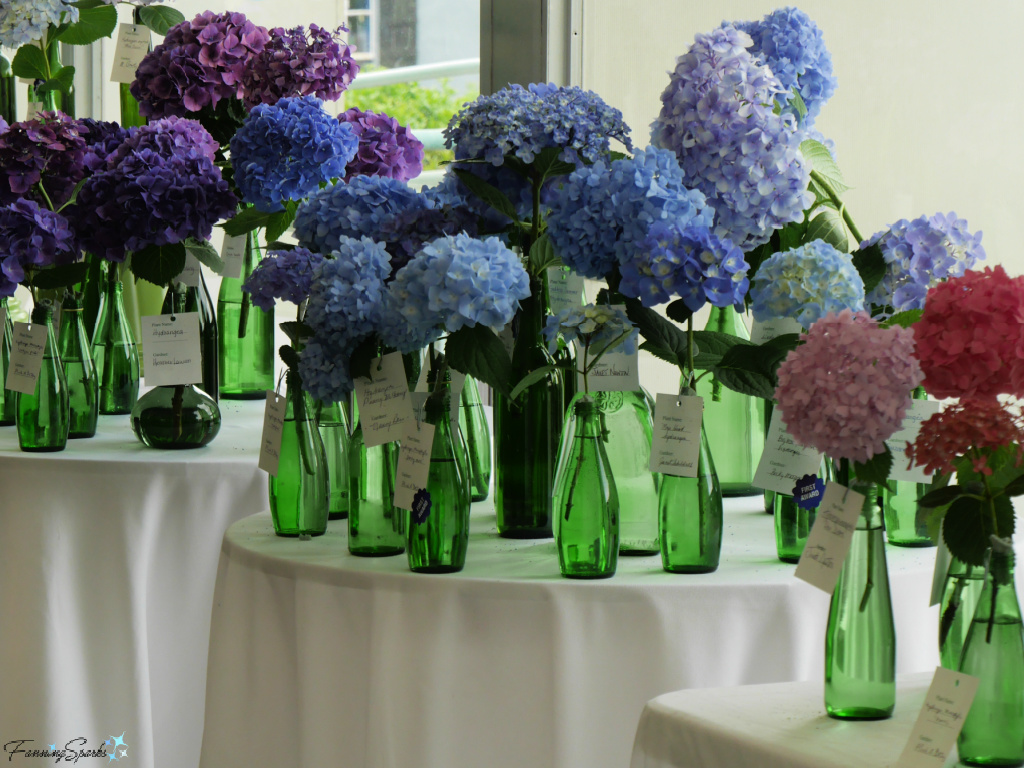
Predictably, hydrangeas were included in the Say It With Summer Flowers blog post which showcased the language of flowers for summer-bloomers. The hydrangea was assigned the emblem of a “Boaster” or a “Braggart”. The reason, according to author Henry Phillips, is “because its magnificent flowers are never succeeded by fruit, thus resembling the vaunting words of a braggadocio, which are not followed by suitable results”.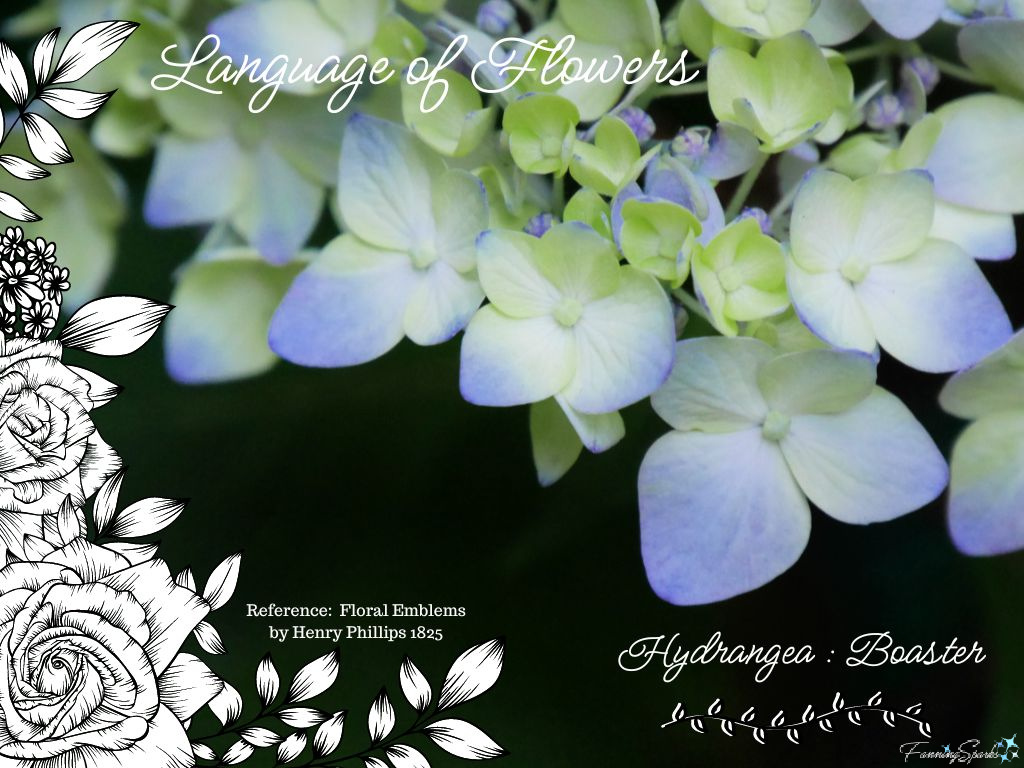
With a little luck, a hydrangea shrub will hold its flowerheads past the blooming season. Their delicate, paper-like, flowerheads dusted in snow, can be quite beautiful during the hibernal season. This photo was included in the blog post, Frigorific and Other Cool Wintry Words.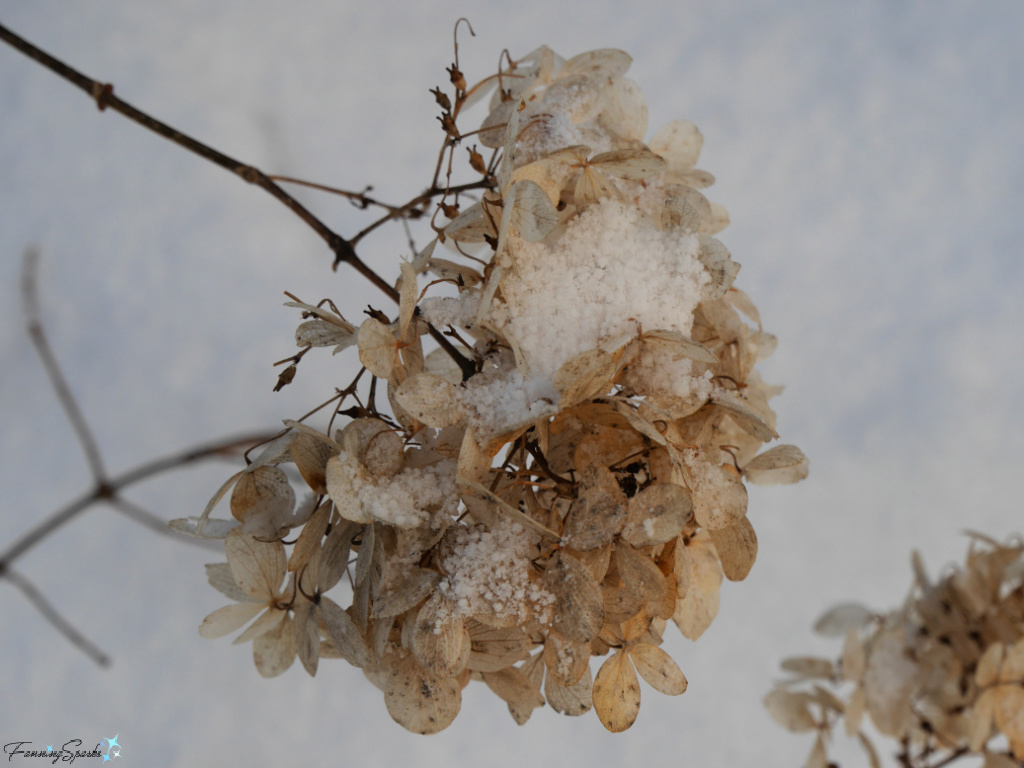
Hydrangea flowerheads don’t always need to be center stage―they can be equally striking in a supporting role. In this example from the blog post Reflecting on the Simple Bubble, an iridescent bubble landed gracefully on the white sepals of a Oak Leaf Hydrangea.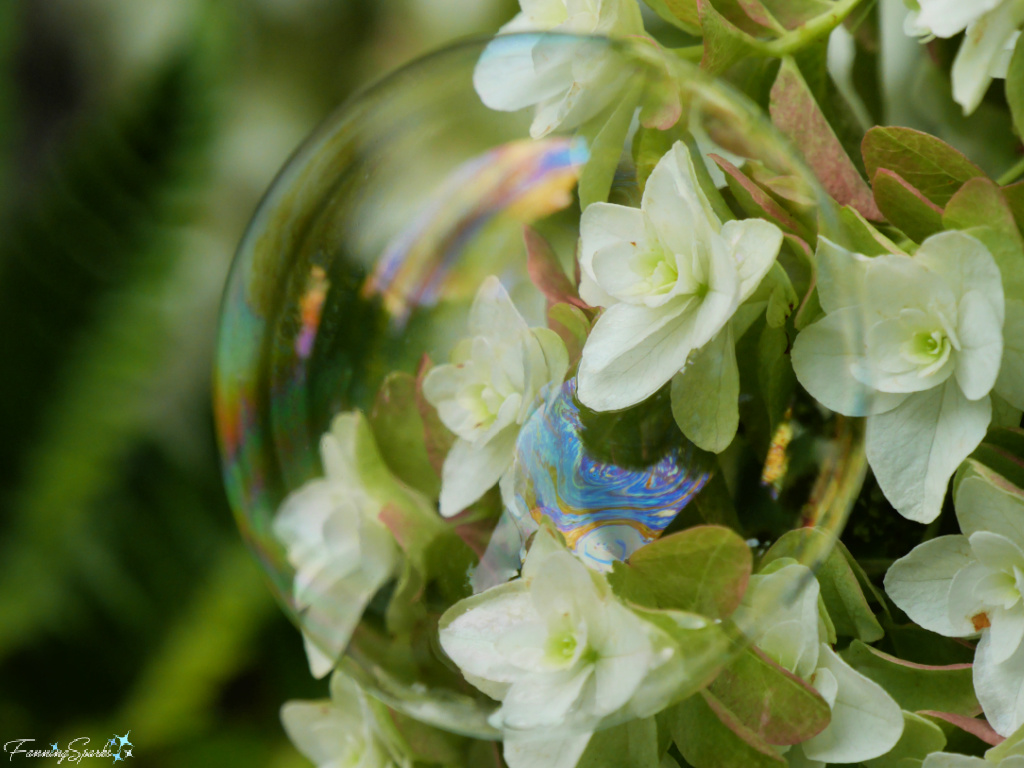
Blooming hydrangeas provided a nice background for the hero shot in the Alfresco Dining Beaded Cover – DIY Tutorial blog post.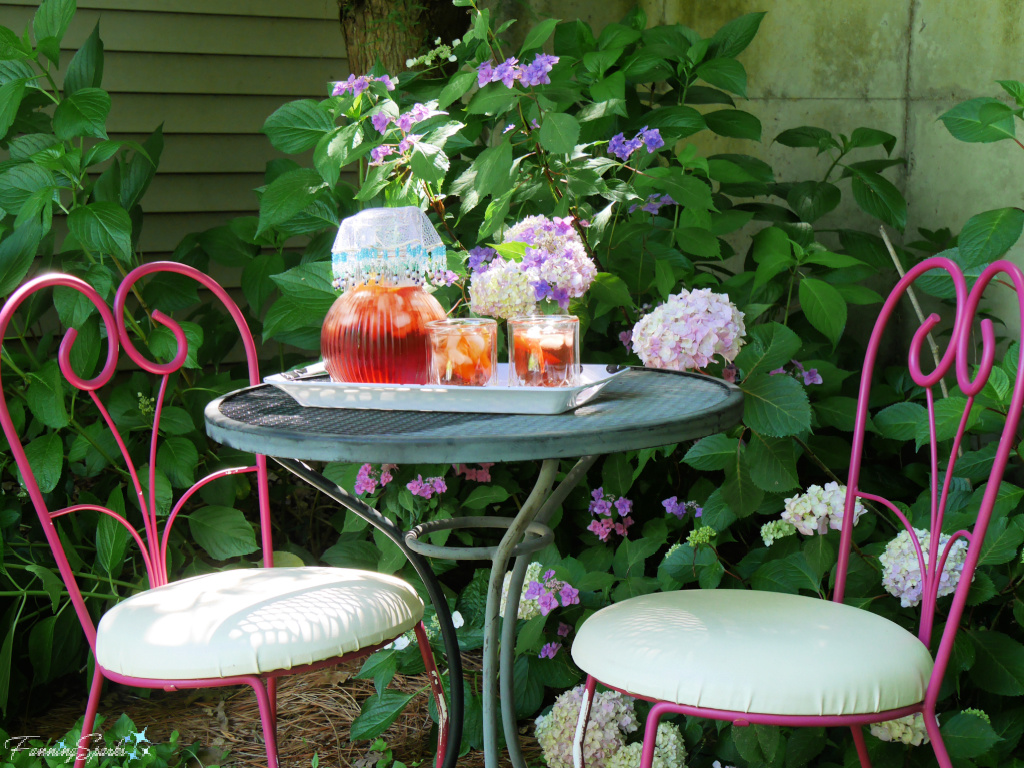
Most recently, I was able to pose my one-of-a-kind cloth art doll, affectionately named Snappy Sparks, amongst the hydrangeas. See the blog post, Meet Snappy Sparks.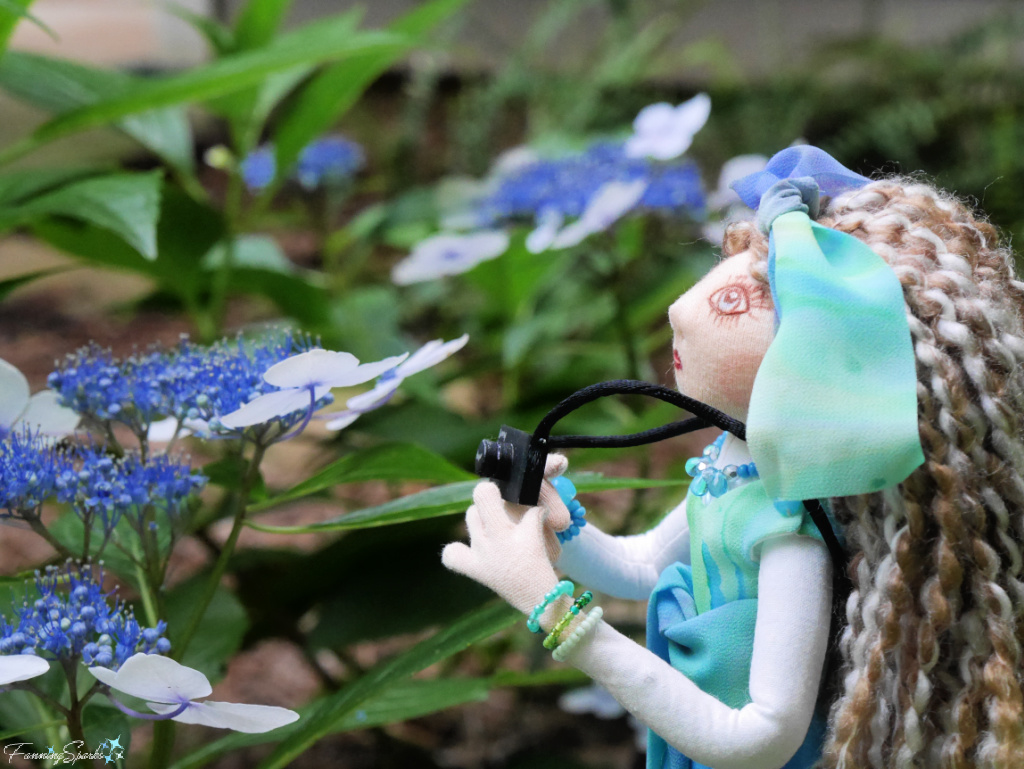
As if hydrangeas don’t have enough going for them, the blooms can also be used in maker projects. I’ve had great success pressing hydrangea sepals in my giant flower press (see Fern & Flower Press – DIY Tutorial). Here’s a fresh batch ready to be covered, pressed and dried.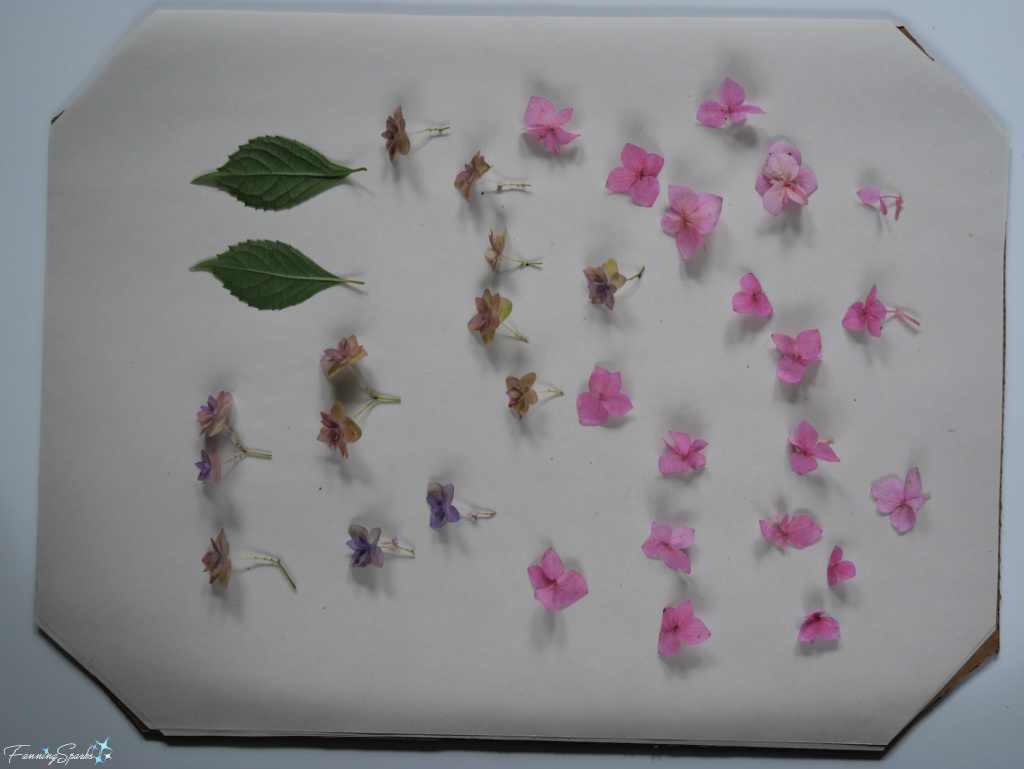
And here are some dried hydrangeas, along with cosmos and Rose of Sharon, being incorporated into a unique dried flower wall hanging. See Pressed Flower Girls Wall Art.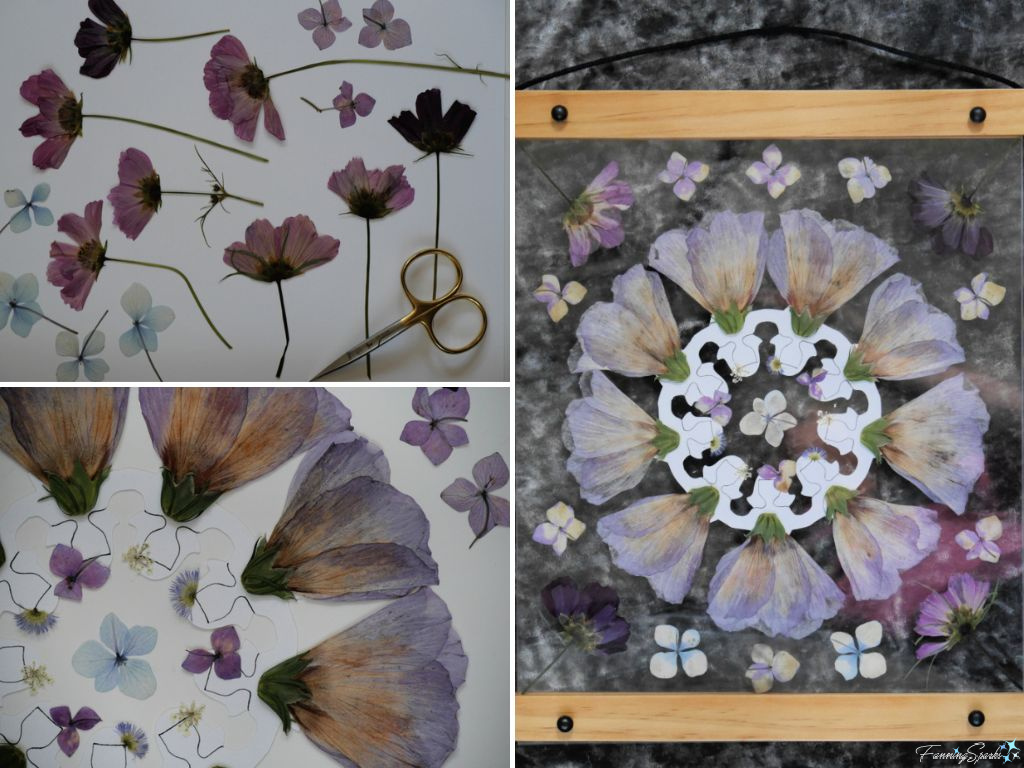
Dried hydrangea blooms, along with cosmos petals and coneflower seeds, were used to embellish this natural paper I learned to make from wheat straw. Check out the From Tulip Paper to Natural Fiber Papermaking blog post to see how it turned out.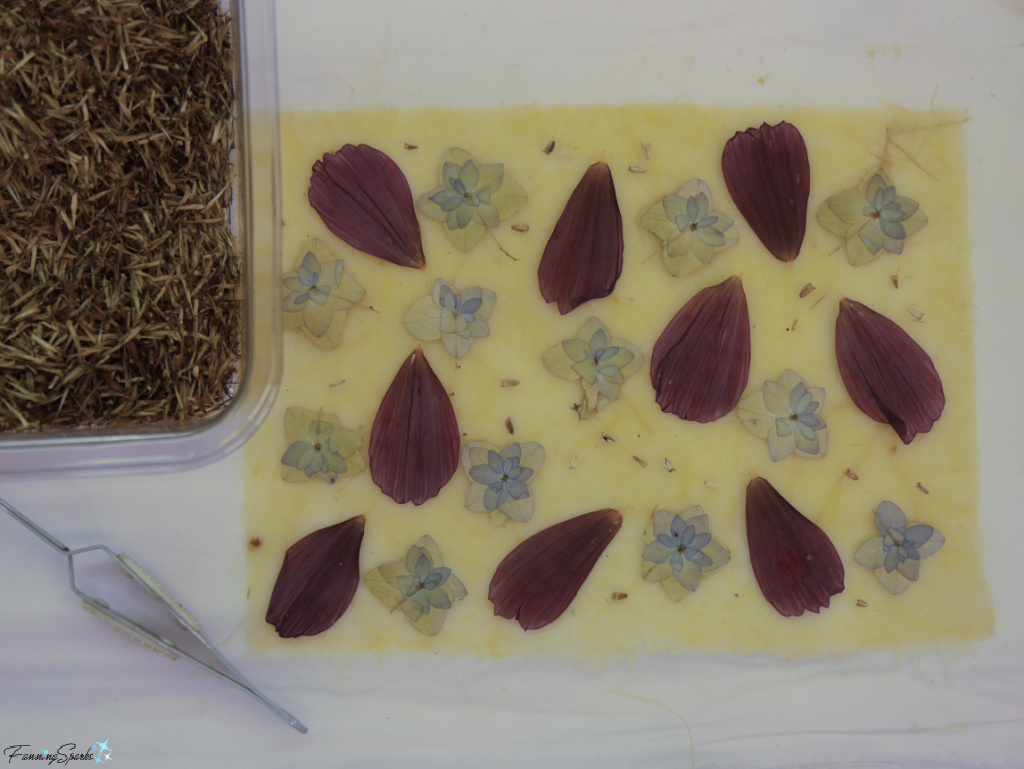
Hydrangeas blooms were also a great addition to my flower hammering project. See blog posts: Flowers and a Hammer and It’s a Wrap.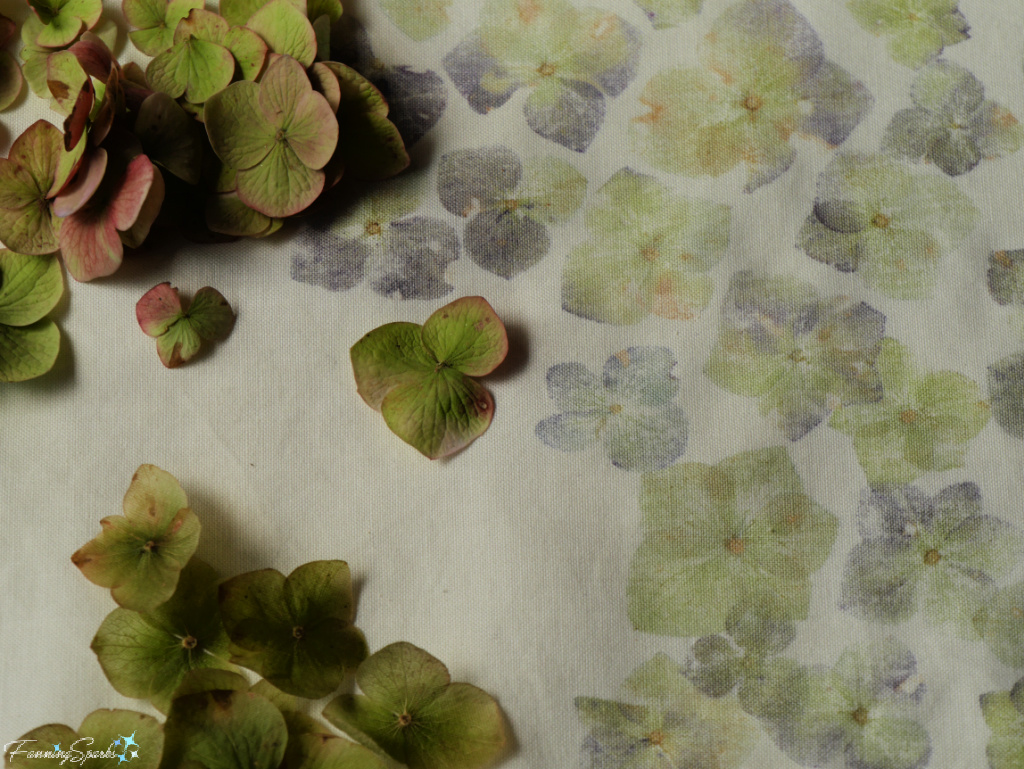
In conclusion, hydrangeas are great in the garden, great as cut flowers, great for photography, great for pressing, hammering and other crafts. It’s definitely, hydrangeas for the win!
More Info
Previous blog posts mentioned in this blog post include:
. From One to Many: Propagating Flowering Shrubs
. Charleston’s Glorious Window Boxes
. Top 24 Photos from 2024
. Say It With Summer Flowers
. Frigorific and Other Cool Wintry Words
. Reflecting on the Simple Bubble
. Alfresco Dining Beaded Cover – DIY Tutorial
. Meet Snappy Sparks
. Fern & Flower Press – DIY Tutorial
. Pressed Flower Girls Wall Art
. From Tulip Paper to Natural Fiber Papermaking
. Flowers and a Hammer
. It’s a Wrap.
The following books and articles were consulted in the writing of this blog post:
. Hydrangea Types – How to Select the Right One? article Gardenia.net
. Hydrangeas book by Glyn Church which is available here on Internet Archives
. Various Wikipedia entries.
Today’s Takeaways
1. “With over 70 species, hydrangeas offer a range of sizes, flower forms, colors, and care requirements, making them a popular choice for gardens worldwide.” Gardenia.net
2. Hydrangeas have an extended blooming season thanks to an unusual combination of big, showy sterile flowers and small, less-noticeable fertile flowers.
3. Hydrangeas are ideal for flower arranging, photography, pressing, drying, hammering and other crafts.

2 Comments
@Marian, Thanks! We’ve been enjoying the perfect combination of sun and rain so the gardens (and the weeds) are thriving. Peg
Wonderful use of flowers in your photo ready home. Certainly does add pops of colour.
Beautiful photos and great information on hydrangeas.
I am sad to think this may be a last glimpse of your gorgeous gardens.