The small Acadian village of Cocagne is nestled along the Northumberland Strait in New Brunswick, Canada. It’s an area of natural abundance; a “land of plenty”, which is what Cocagne means in French. It’s a beautiful part of the world. Inspired by this natural beauty Marcia Poirier, the artisan behind Wildabout Wampum, creates spectacular jewelry from quahog shells. Quahogs are edible clams that live on the eastern coast of North America. Admittedly, when I think of the unremarkable clam I do not immediately think of spectacular jewelry. At least, I didn’t before learning about Wildabout Wampum.

I recently had the pleasure of visiting Marcia’s home-based studio and meeting her in person. Marcia is friendly and welcoming. She’s full of energy and passionate about her art. She personally took us on tour of her studio and boutique. I love the story of how Marcia got started making these unusual treasures. As she tells it, Marcia and a friend were walking along the beach when she spotted a quahog shell with an unusual marking. Marcia picked it up and pointed out a heart shape in the purple layers of the shell. She tossed the shell and they went on with her walk. A few days later, Marcia’s friend surprised her by giving her a carving kit along with the very same quahog shell she had tossed away. Marcia went on to carve out that heart and then wore it as a pendant.
Original Heart Carved From Quahog Shell at Wildabout Wampum. @FanningSparks

Friends admired Marcia’s quahog heart pendant and asked her to make one for them. Marcia has been making hearts, and other beautiful jewelry, ever since. Isn’t that a great story?

Marcia eagerly shared her knowledge about quahogs explaining how the purple and white layers of the quahog shell are annual growth bands. The age of a quahog can be determined by counting the layers in the shell much like counting the rings in a tree.  The vibrancy of the purple layers is affected by various environmental conditions including the level of iron found on the ocean floor. Marcia has learned which areas produce the most intensely colored quahogs and exclusively sources her shells from those locations.

After selecting and preparing a quahog shell, Marcia transfers a design onto the shell. She selects and positions the design to maximize the natural layering of the shell. The design is carefully carved by hand using tiny power tools. The piece is then sanded by hand to a smooth, shiny finish.
Shell Hand Carved in Quahog Shell at Wildabout Wampum. @FanningSparks

After watching the artisans at work in the studio a visit to the Wildabout Wampum boutique is mandatory.
Wildabout Wampum Boutique in Cocagne, New Brunswick, Canada. @FanningSparks

The shop is well-stocked with a wide selection of pendants, earrings, bracelets and other items. This stunning whale tail pendant is a popular design.
Fish Tail Pendant Carved from Quahog Shell at Wildabout Wampum. @FanningSparks

Of course, I couldn’t leave Wildabout Wampum without selecting my very own one-of-a-kind memento. Isn’t it lovely?

Heart Pendant Carved from Quahog Shell I Purchased at Wildabout Wampum. @FanningSparks

Marcia’s success in turning quahog shells into beautiful jewelry is a remarkable story. But it doesn’t explain the name of her studio. Why “Wildabout Wampum”? After she started making her jewelry, Marcia learned that Native Americans, the Wampanoag Indians in the area now known as northeastern USA, carved beads from the purple sections of the quahog shell. These beads where used for trade and ceremonial purposes. The Natives used the beads as currency for trading. They also wove the beads into patterns to form “belts” for ceremonial purposes. The patterns indicated tribal history, inter-tribal treaties and even sanctified wedding vows. Today, wampum (like those shown below) still have a special significance to Native Americans.
Mystery solved! Wildabout Wampum doesn’t actually sell wampum but the name is a clear nod to this honorable heritage.
Strands of Wampum Beads Carved from Quahog Shells at Wildabout Wampum. @FanningSparks

While I love wearing my Wildabout Wampum heart pendant on a chain, I couldn’t help but wonder how it would look on a woven statement necklace. I found yarn in nice complementary colors and then followed the step-by-step instructions from my post DIY Woven Statement Necklace Tutorial. I made a few refinements such as leveraging a blank metal jewelry connector for the top bar and using decorative yarn for the top row of fringe. The woven necklace provides the perfect backdrop for the gorgeous quahog shell heart. Now, I have two ways to wear my Wildabout Wampum heart.

FanningSparks DIY Woven Statement Necklace Showcasing Wildabout Wampum Heart Pendant. @FanningSparks

I’m always intrigued by how traditional arts and crafts can be re-imagined in contemporary ways. I seek out examples of how materials and/or techniques have been changed to bring new life to an old practice or product. This is a perfect example.  Thanks to Marcia Poirier, the original art of carving wampum has evolved into hand-crafting beautiful quahog shell jewelry.

More Info

Learn more about Wildabout Wampum on their website.  Be sure to check out Marcia’s video “The Art & Design of Marcia Poirier” and the galleries of her collection.

The Tourism New Brunswick website has additional information on Cocagne, New Brunswick, Canada.

Here’s the link to my post on the DIY Woven Statement Necklace Tutorial.  It really is an ideal DIY project.  It’s fairly easy, it’s inexpensive, no special tools are needed, and it’s fast. But the best thing about this project is its versatility.  You can change the colors, embellishment, size or design to make your own one-of-a-kind work of art!

Today’s Takeaways

  1. Keep your eyes open for unexpected sources of inspiration.
  2. Consider ways to transform the ordinary.
  3. Seek out opportunities to learn about the artisans and craftspeople in your community.

Pin for Later

You may want to pin this post to your Pinterest board for later reference.  Please pin this image.

FanningSparks DIY Woven Statement Necklace with Wildabout Wampum Heart Pin. @FanningSparks

Peg - FanningSparks Author

A pyramid trellis, or tuteur, is the perfect way to add height to a garden space.  Unlike a traditional trellis which requires a wall or other support, the pyramid trellis can be placed anywhere.  A pyramid trellis can play a starring role with interesting design, materials and colors.  Or it can play a supporting role and hold up climbing vines and flowers.  Either way, a pyramid trellis can add character and interest to the garden.

DIY Pyramid Trellis Painted Green and Shown with Wild Indigo. @FanningSparks

A pyramid trellis is an easy project you can do yourself.  Choosing a design that doesn’t require complex multi-angle cuts is the key to simplifying this project.  It’s also a great opportunity to make something that’s unique and one-of-a-kind.  Vary the materials, the dimensions and the colors to make it your own.  I’ve made 4 pyramid trellises, 3 for myself and 1 as a gift.  Today, I’m going to show you how to make your very own pyramid trellis.  This is a substantial structure; it is nearly 6’ high and nearly 2’ square at the base.  I created this step-by-step tutorial while making the below pyramid trellis as a surprise for my beloved sister.

DIY Pyramid Trellis Painted White Shown with Purple Coneflowers. @FanningSparks

Materials/Supplies Needed

Lath Strips: 12 – strips of 7/32” x 1 ½” x 8’ long PVC Lattice Molding
The first three pyramid trellises I made were constructed from 6’ wood lath strips.  I was able to buy these at my local Home Depot in Georgia.  However I made the fourth pyramid trellis while visiting my sister in Nova Scotia and was only able to find wood lath strips in 4 foot lengths.  I substituted 8’ PVC Lattice Molding for the wood lath.  The PVC was considerably more expensive than the wood but comes prefinished and is very easy to work with.  I’ll be showing the PVC version in this tutorial.

Finial: a decorative top about 1  foot high and no more than 3″ square at the base.
This is the fun part!   Use your imagination to finish off the top of your pyramid trellis.  I found the perfect resin finials at Hobby Lobby when I made my first three pyramid trellises (shown on green trellis in above photo).  But they were no longer available and I had to get creative for this most recent version.  I used a furniture leg of turned wood topped with a curtain rod finial.  More details in the below tutorial.

Screws: 32 – size #4 ¾” flat wood screws
Screws: 4 – size #8 1 ½” flat wood screws
Screw Hooks: 4 – 1 ⅞”   The screw hooks are big enough to slip over a piece of rebar which can be used to anchor your trellis.
Staples: 1  ⅜” long preferably rust resistant
Wood:  1 – 1″ x 4″ x 8″ long pine or other softwood
Tape: Masking or painter’s tape
Paint: Exterior paint in your desired color.  Since I left this trellis pyramid white, I only needed to paint the finial and the anchors and to cover up the staples and screws.
Sandpaper:
Templates: Download the DIY Pyramid Trellis – Complimentary Download – Sept 2018 .  See More Info below for an outline of the contents.

Supplies and Materials for DIY Pyramid Trellis. @FanningSparks

Tools / Working Space Needed

Jigsaw with an appropriate blade for cutting PVC or wood lath.  Alternatively, use whatever saw you have available and are comfortable using.
Drill with appropriate bits for the screws and screw hooks.
Staple Gun:   An electric staple gun is ideal but a manual staple gun would also work.
Paint Brush and any other painting supplies needed.
Clamp
Tape Measure
Pencil
Work Surface:  58” by 25”
Barn: You may also want to borrow your sister’s cool barn to work in but obviously that’s optional.

An Empty Barn is the Ideal Working Area. @FanningSparks

Assembly

At a high level, the construction process is quite straightforward.  Cut 40 pieces of wood lath to the specified lengths.  Lay the parts on a large flat surface to staple together into 4 identical sides.  Stand up the 4 sides into a square and connect.  Cut and attach the parts for the finial and the anchors.  Here are the detailed step-by-step instructions.

Step #1 Cut Lath Strips

There are several guides included in the DIY Pyramid Trellis Download file to assist you with this step.  Print the Templates for Angled Cuts and the Templates for parts H, I, J, K on heavy paper.  Ensure they printed to the intended size and cut out.  If the template pieces are not the intended size, you may need to adjust your printer settings (see instructions on the cover page in the download file).
Review the Cut Plan and Part List.  The Part List shows the specifics of each part to be cut including the length, quantity and angled cut instructions.  Note the “How to Cut Ends” column.  Some ends are straight, others are cut at a 10°angle and others are cut into a picket shape with 45° angles.  The ends may be parallel or non-parallel.  The angles of the Legs (Part A) must be parallel.  The angles of the Crosspieces (Parts B-E and H) must be non-parallel.  See the Angled Cuts Guidance for diagrams of parallel and non-parallel cuts.  Take care to cut all ends as indicated.
The Cut List shows which parts to cut from each 8’ length.  It is color-coded to match the Part List.

Mark each piece with the part letter.

Sand all cuts.  You should have 40 parts at this stage.

Cut Parts for DIY Pyramid Trellis. @FanningSparks

Step #2 Prepare Work Surface

Select a large, flat work surface at least 58” by 25”.  Use masking or painter’s tape to mark a triangle on the surface as follows.   Choose one 25” edge to be the bottom of the triangle.  Mark the center of this edge.  Measure and mark 10” to the left and right of center.  Label these as A.  Measure and mark 56 ⅞” up from the center of the bottom edge.  This will be the peak of your triangle.  Next mark the 4 crosspieces.  Measure up from the bottom edge and mark as follows:
At 4 ⅛” from bottom, mark B.
At 18” from bottom, mark C.
At 28 ⅝” from bottom, mark D.
At 38 ¼” from bottom, mark E.

Run pieces of tape from each side of the bottom of the triangle (marked A) to the peak.  It’s not necessary to have these lined up perfectly since the lath strips will be straight.  Place a mark at each of the above points along both sides of the triangle.  Your work surface should look like this:

Marking the Work Surface for the DIY Pyramid Trellis. @FanningSparks

Step #3 Assemble Pyramid Sides 

Align the lath strips with the markings on your work surface.  Note you’ll be placing the front side of your lath strips down on the work surface and working on the back sides. Start with the legs which are the outside angles of your triangle.  Place one Part A along the right side. At the bottom of the triangle, align the inside edge of Part A at the 10” mark and ensure the angles match.  At the top peak of the triangle, align the inside edge of Part A with the inside edge sitting on the center mark.  You may wish to tape the part to your work surface to keep it in place.  Repeat this same procedure with another Part A on the left side of the triangle.

Attach the top crosspiece Part H.  The short edge should align with the top of the two Part As.  The sides of crosspiece H should be indented by the thickness of your lath.  Use a scrap piece of lath to check this alignment as shown below (note the photo doesn’t show Part H).  Staple Part H in place.

Indenting the Edge During Assembly of DIY Pyramid Trellis. @FanningSparks

Attach the bottom crosspiece Part B aligning the top edge with your 38 ¼” mark.  The sides of Part B should be indented in the same way as Part H.  Staple in place.

Attach the remaining 3 crosspieces – Parts C, D and E – in this same manner.

To attach the pickets, remove the partially assembled pyramid side from the work surface.  At the bottom of your triangle, measure 4 ⅞” from the center line to the right.  Taking care to align with the bottom edge of your work surface, place a piece of tape at the 4 ⅞” spot, mark and label G.  Repeat this step to the left of center.

Place the pickets on your work surface.  Align the long center picket – Part F – with the center marks keeping the bottom end one-tape-width up from the bottom edge.  In the finished pyramid trellis only the legs – Parts A – touch the ground.  As shown below, align the center of one of the short pickets – Part G – with the 4 ⅞” G mark keeping the bottom end one-tape-width up from the bottom edge.

Centering the Picket During Assembly of DIY Pyramid Trellis. @FanningSparks

The picket should be parallel to the long center picket (part F).  Repeat this step with the other short picket – Part G.  Place the partially assembled pyramid side back on the work surface with the front side facing down (the same way as it was constructed).  In this way, all staples enter from the back and will not show on the front of the pyramid trellis.   Ensure the pickets remained in position.  Staple all 3 pickets in place.

At this point, your pyramid side should look like this on the work surface…

One Side of DIY Pyramid Trellis Assembled. @FanningSparks

…and like this when standing:

First Assembled Side of DIY Pyramid Trellis. @FanningSparks

Assemble the other 3 pyramid sides following step 3.

Step #4 Paint Pyramid Sides

Clean up the parts by removing labels and erasing marks.  If your wood isn’t finished, this is the time to paint.  It’s much easier to paint the pyramid sides before they’re fastened together.  At this point, you should have 4 finished sides like this:

Four Sides of DIY Pyramid Trellis Assembled. @FanningSparks

#5 Assemble Pyramid

The next step is to attach the 4 sides into a pyramid.  Use tape to temporarily hold the sides together while you’re working.

Taping the Sides to Stabilize During DIY Pyramid Trellis Construction. @FanningSparks

The trick is to alternate the sides so they overlap… one end is over and the other end is under.  See the Pyramid Assembly Detailed Diagram in the DIY Pyramid Trellis Download file for details.  Use small wood screws (#4 ¾” long) to fasten at every crosspiece and leg juncture.  Be sure to drill pilot holes first.  Optionally, you may wish to staple the sides together before screwing them.

Your pyramid should be quite firm at this point but the next two steps will strengthen it substantially.

Step #6 Finish the Top

Use templates I and J from the DIY Pyramid Trellis Download file.  The small square (Part J) should fit snuggly inside the top of your pyramid.  The large square (Part I) should sit on top of the pyramid and align with the sides.  Make any necessary adjustments to the templates. Use the templates to cut two squares from the 1″ x 4″ x 8″ wood.

Mark the center of the two squares.  Center the small square on the large square and attach with #8 1 ½” wood screws as shown below.

Attaching Top 2 Squares for DIY Pyramid Trellis. @FanningSparks

The next step is to add your finial.  As noted in the Materials/Supplies Needed list above, this is where you get to be creative and put your personal mark on your pyramid trellis!  The actual parts you use for the finial will dictate how to attach it.  With my first pyramid trellises, I drilled a hole in the top squares and inserted a dowel to hold the finial.  On the pyramid trellis in this tutorial, I used wood screws to attach the curtain finial to the turned furniture leg and then screwed that into the top squares.

Parts for Finial on DIY Pyramid Trellis. @FanningSparks

It looked much better after assembly and a little paint:

Finished Finial for DIY Pyramid Trellis. @FanningSparks

Insert the top squares (and your finial) into the top of the pyramid, pre-drill and screw in place through the top crosspiece.

Step #7 Add Anchors

This is the final step.  To be honest, my first pyramid trellises don’t have anchors.  I learned the hard way, wind will blow over these pyramid trellises if they’re not tied down.  Adding anchors to the bottom of the legs makes it easier to ground them.  The idea is to insert small triangular supports with screw hooks in the bottom of each corner where the legs come together.  After placing your pyramid trellis in the garden, slip pieces of rebar through the screw hooks and drive the rebar into the ground.

Use template K from the DIY Pyramid Trellis Download file to cut 4 triangles from the 1″ x 4″ x 8″ wood.  Paint if needed.  The anchor pieces will look like this.

Anchor Parts for DIY Pyramid Trellis. @FanningSparks

Insert a screw hook into the long edge of each triangle.  Be sure to pre-drill so the wood doesn’t split.  Then slip the anchor piece into the bottom corner where the legs come together, pre-drill and screw in place.

Anchor Part with Screw Hook on DIY Pyramid Trellis. @FanningSparks

That’s it! Your pyramid trellis is done!  But the fun’s not over yet; now you get to decide where to put it!  Or in this case, my sister gets to decide.

DIY Pyramid Trellis Completed. @FanningSparks

More Info

Be sure to download the DIY Pyramid Trellis – Complimentary Download – Sept 2018 for the guides mentioned in the above instructions.  The following are included:
1. Angled Cuts Guidance
2. Templates for Angled Cuts
3. Templates for Parts H, I, J, K
4. Cut Plan and Part List
5. Pyramid Assembly Detailed Diagram (for Step #5)

Special thanks to the folks at This Old House for the post How to Build a Pyramid Trellis which inspired the version I shared today.

Today’s Takeaways

  1. A pyramid trellis can add character and interest to the garden.
  2. A pyramid trellis is an achievable project to do yourself.
  3. This pyramid trellis can be customized.  Change the color, size, design and finial to make it your own.

Peg - FanningSparks Author

When it comes to decorating my home, one of the steps I enjoy the most is selecting textiles.  There are numerous surfaces that allow me to incorporate color, pattern and texture with fabric and other textiles.  Some examples are upholstery, pillows, seat covers, bedding, blankets, quilts, shades, curtains, tablecloths, runners, towels, rugs and mats.  The best part is the countless options from which to choose.  Whether I shop for ready-made or create my own, this is the perfect opportunity to add personality to our home.

In my previous post, Color Palette by Mother Nature, I shared the idea of looking to nature for color inspiration.  Today, I’d like to take a similar approach with patterns.  We’ll look at several different types of patterns including animal prints, stripes, floral, foliage, geometric and abstracts… all courtesy of Mother Nature.  A pattern is defined as a discernible regularity where elements repeat in a predictable manner.  In the world of interior design and decorating, pattern is used to foster cohesiveness and add interest.  Typically, patterns work closely with color and shape to add continuity to a living space.

Let’s begin with the popular pattern category of animal prints.  I’ll share a few of my all-time favorite photos taken while on safari in South Africa to illustrate these splendid patterns.  This beautiful leopard had the perfect lookout perch.  There’s much to say about this photo (see More Info below) but we’ll just admire those gorgeous leopard spots for today.

Beautiful Leopard on the Lookout. Sighted during African Safari. @FanningSparks

Watching the elegant giraffe lean over to drink is an unforgettable experience.  The giraffe’s spots are another outstanding example of an animal pattern.

Elegant Giraffe Drinking. Sighted during African Safari. @FanningSparks

Stripes are a classic pattern.  The zebra’s distinctive black and white stripes are the perfect illustration.

Distinctive Zebra Checks Us Out. Sighted during African Safari. @FanningSparks

While not nearly as dramatic, this birch bark is another example of the beauty of stripes.

Interesting Birch Bark Patterns. @FanningSparks

Florals are beloved patterns in surface design.  These purple coneflowers repeat to create a lovely floral pattern.

Grouping of Purple Coneflowers. @FanningSparks

Here a single bearded iris bloom showcases a subtle mix of branching patterns.

Bearded Iris called Autumn Tryst. @FanningSparks

Foliage inspires another category of patterns.  Ferns and succulents, in particular, are very much in vogue.  Here a graceful fern casts intriguing shadows on the moss covered ground.

Ferns Cast Shadows on Moss. @FanningSparks

In this close-up, the veins of a hosta leaf illustrate a pleasing branching pattern.

Veins in Hosta Leaf. @FanningSparks

Here’s another example of a foliage pattern.  The distinctive branching pattern, repetition of the curly edging and the bumpy leaf structure all combine to transform the lowly cabbage into a thing of beauty.

Beautiful Patterns in Cabbage. @FanningHead

Often the repetition of a simple shape forms a pattern.  These shapes can be geometric or organic.  Here the simple oblong shape of a catkin repeats to form a handsome geometric pattern.

Early Spring Catkins Create Lovely Pattern. @FanningSparks

The disk florets in the center of this sunflower create an intricate geometric pattern.  The repetition of the flower petals (more correctly the ray florets) provide another lovely pattern.  I love how that one little wayward petal disrupts the pattern and shakes things up!

Closeup of Soft Yellow Sunflower. @FanningSparks

The triangular scales on this pine cone form a familiar geometric pattern.

Closeup Showing Geometric Pattern of Pine Cone. @FannngSparks

The delicate spiral shape of this fern frond provides another example of a repeating pattern.

Spiral Frond of the Christmas Fern. @FanningSparks

The raindrops on this Lady’s Mantle leaf form an interesting, circular pattern.

Raindrops on Lady's Mantle Leaf. @FanningSparks

The final pattern category I’d like to include is abstracts.  By definition, abstract is non-representational and does not depict a person, place, or thing in the natural world.  So it would be difficult to draw upon Mother Nature for examples.  But given that we’re simply looking at types of patterns for interior design, I’ll use a looser definition and take the liberty to include these two examples.  The below photo is polished granite with the look of movement.  This is actually our new kitchen countertop in Viscount White.

Granite with Movement on Kitchen Countertop. @FanningSparks

Our final photo is another example of an abstract pattern.  It’s actually clouds at sunset but resembles a watercolor.

Cloudy Sky At Sunset. @FanningSparks

More Info

Color and pattern work together to add life to a room.  See the post, Color Palette by Mother Nature, for more information about inspiring color palettes.
Jan 22, 2019 Update: Check out Texture by Mother Nature for even more decorating inspiration from nature.
May 19, 2020 Update: Form by Mother Nature is the latest post in this series.

In addition to color and pattern, there are 5 more interior design elements.  They are space, line, forms, light and texture.  The Interior Design Academy explains the 7 elements of design must work in harmony to create an aesthetically pleasing interior.

To see more photos and learn about my African safari, see my post on Majestic Lovable Elephants.

I learned an interesting fact about patterns in nature while researching this post.  Scientists have found that the endless variations seen in nature can actually be traced back to a few simple themes and rules. For instance, the familiar form of Queen Anne’s Lace, is referred to as a branching pattern with an explosion shape.   This pattern illustrates how nature has found the most efficient way to reach all points in a large area while moving the shortest distance.  The dense array of florets in the Queen Anne’s Lace flower head attracts the most insects possible.

Side View of Queen Anne's Lace. @FanningSparks

Today’s Takeaways

  1. Consider broadening your scope and looking at all options before narrowing down to a selection.
  2. Consult Mother Nature for pattern inspiration. Take time to observe the variety of patterns in nature.
  3. Use pattern in your surroundings to foster cohesiveness and add interest.

Peg - FanningSparks Author

There’s something magical about the time between first light and sunrise.  The sky shifts from darkness to light as the world slowly wakes up.  Light is soft and diffused.  Skies turn pink and gold.  The pace is measured and unfolds slowly.  It’s peaceful and calm.  Everything is quiet and still in anticipation.

In the world of film and video production, this time period is called the “magic hour” because of the way the natural light is diffused.  Since the sun hasn’t yet risen, there are no shadows and subjects can be beautifully lit with soft light.  Magic hour is followed by the “golden hour” which occurs directly after the sun rises.  During golden hour the light is rich and warm and the world has a soft glow.  Golden hour is a favorite time for photographers shooting in natural light.  The sequence is reversed in the evening when the sun sets.  To be 100% accurate about it, neither period is exactly an hour long since the timing varies from location to location and season to season.

When traveling around the world, I often make an effort to view my surroundings during the early morning hours.  The below photo, one of my favorites, was taken before sunrise at the Notre-Damede la Garde in Marseille France.  I’ll never forget walking up the hill to the basilica in the bitter cold darkness of a January morning.  But the panoramic view of the city and port as the early morning sky slowly lit up were worth every bit of discomfort.  It was glorious!

Cross at Notre-Dame de la Garde in Marseille France during first light. @FanningSparks

More recently, I had the pleasure of watching the world shift from darkness to light at Peggy’s Cove in Nova Scotia, Canada.  Our visit took place in August so the weather was perfect but it did require a mighty early start.  We set out at 4:30 am to catch first light (special thanks to my sister, nieces and nephew for sharing the adventure!).
Peggy’s Cove, being on the coastline, is often foggy but it was beautifully clear that morning.   We found the perfect vantage point and settled in for Mother Nature’s performance.  She did not disappoint!  It was another glorious show!

Magic Hour at Peggy's Cove. @FanningSparks

Peggy’s Cove is known for its rugged beauty.  The quaint fishing village is surrounded by huge granite boulders facing the Atlantic Ocean.

Huge granite boulders surrounding Peggy's Cove viewed at first light. @FanningSparks

The classic red-and-white lighthouse, officially called Peggy’s Point Lighthouse, is an iconic Canadian image.  It’s a popular destination and the site is often crowded with visitors.  Avoiding those crowds is another advantage of visiting Peggy’s Cove in the early morning.  In fact, we had this beautiful place to ourselves.
You can see the difference between the magic hour and golden hour lighting in the two photos below.  The first photo was taken with first light during the magic hour. The second photo was taken after sunrise during the golden hour.

Magic hour, before sunrise, at Peggy's Cove. @FanningSparks

Golden hour, after sunrise, at Peggy's Cove. @FanningSparks

It appears building cairns, especially inuksuit, has become very popular at Peggy’s Cove.  An inukshuk, traditionally made by Inuit people, is a man-made structure of rough stones stacked in the form of a human figure.  An inukshuk is commonly thought to communicate “Now the people will know we were here”.

Peggy's Point Lighthouse and an inukshuk during golden hour. @FanningSparks

Inukshuk during magic hour at Peggy's Cove. @FanningSparks

Inukshuk on the granite boulders of Peggy's Cove during magic hour. @FanningSparks

Cairn at Peggy's Cove during golden hour. @FanningSparks

More Info

Peggy’s Cove is renowned for its rugged beauty and is a popular destination.  As a native Nova Scotian, I’ve visited the area many times and can honestly say it never disappoints.  If you ever have a chance to visit Nova Scotia, I highly recommend you stop by Peggy’s Cove.  For more info see the Peggy’s Cove Coastal Region website.

Magic Hour, an app by elfinda apps, calculates the time of sunrise and sunset and the adjacent magic/golden hour by location and date.  As you can see in the below screenshot from the Magic Hour About page, magic/golden hour is typically when the sun is between 6 degrees below the horizon to 6 degrees above.

How We Find Magic Hour - Magic Hour App About page screenshot.   @FanningSparks


Today’s Takeaways

  1. Consider visiting popular destinations during the early morning hours.
  2. Make time to experience Mother Nature’s performance between first light and sunrise.  Research the best times for your location and season.
  3. Consider taking photos during the magic or golden hour for beautiful diffused light.

Peg - FanningSparks Author

Today, I’d like to take you on a virtual tour of our new casual lakefront home.  We’ve been busy moving, settling in and turning this new-to-us house into our home.  We’ve completed the first major projects but still have many updates and changes planned.  But before we get into all of the improvements I’d like to show you the house as it existed when we bought it.  This is the “before” of what I hope will be an ever-evolving “after”.

Let’s start with the setting since that was the biggest factor in our decision to buy this property.  The house is situated on a large treed lot on the shores of Lake Oconee in the state of Georgia, USA.  Well… technically we’re located on the shores of the Oconee River which feeds into Lake Oconee.  The wooded area we see across the water (shown in the photo below) is part of the Oconee National Forest.   It’s a lovely quiet area surrounded by nature.  We love it!

View of Lake Oconee from yard. @FanningSparks

The house itself is a Cape Cod style.  Here’s the front of the house. The pretty front porch runs across the front of the house.  There are lots of opportunities for landscaping and flower gardening.  The garage is accessed at the basement level on the right.

View of Heidi Trail house from street side. @FanningSparks

The house has a simple, casual feel.  It was previously used part time as a vacation home.  The first thing we noticed when we entered the house was the view of the lake.  The below wall of windows is in the living room directly opposite the front door.  There are hardwood floors and a rustic fieldstone fireplace.

Living room showing window wall. @FanningSparks

The kitchen, while a little dated, is spacious and has a convenient L-shaped layout.

Kitchen showing cabinets. @FanningSparks

The lakeside porch is spacious and a wonderful place to relax.

View of lakeside porch. @FanningSparks

Here’s that same porch (second floor) as you look at the house from the lakeside yard.

View of Heidi Trail house from lake side. @FanningSparks

Heading back inside, the roomy master bedroom also has a view of the lake.  It has a nice large bathroom with garden tub and separate shower.

Master bedroom showing window wall. @FanningSparks

The second floor is accessed from stairs off the living room.

Stairs off living room lead to second floor. @FanningSparks

There are two bedrooms and a bathroom on the second floor.  Both bedrooms have dormers and sloped ceilings as is typical of a Cape Cod style house.  We plan to use one of these rooms as our guest room/office and the other as my studio.

Upstairs bedroom showing dormer windows. @FanningSparks

The basement has one large finished (although unheated/uncooled) room with a walkout to the back yard.  The 2-car garage is on this same level.

Garage showing 2 bays, built in shelving and window wall. @FanningSparks

There’s a large dock a few steps away across the lakeside yard.   It faces east and provides the perfect place to watch the sun rise as I start my day.

Enjoying sunrise from the dock. @FanningSparks

I hope you’ve enjoyed this quick walk-through of our new casual lakefront home.  I’m eager to share some of the changes we’ve made and those we’re still dreaming about making.

More Info

Moving into a new house often involves painting interior house surfaces such as walls, trim and cabinets.  This has certainly been the case with our recent move.  We’ve painted the kitchen cabinets, painted the master bedroom, and painted walls and trim around new doors and windows.  In the post, Glide It On and 14 More Painting Tips, I share the top 15 things I learned during my recent painting marathon.
We recently made some minor improvements to increase the comfort and enhance the appearance of our small guest bathroom.  We switched to a curved shower rod and mounted it up high.  Then re-purposed an existing shower curtain to fit.  Nothing earth shattering… just a few small changes which had a big impact.  See the post, Small Change > Big Impact in Guest Bath, for the full story.
Update Nov 1, 2020:  We’ve made improvements gradually.  I’ve shared a few in the following posts:
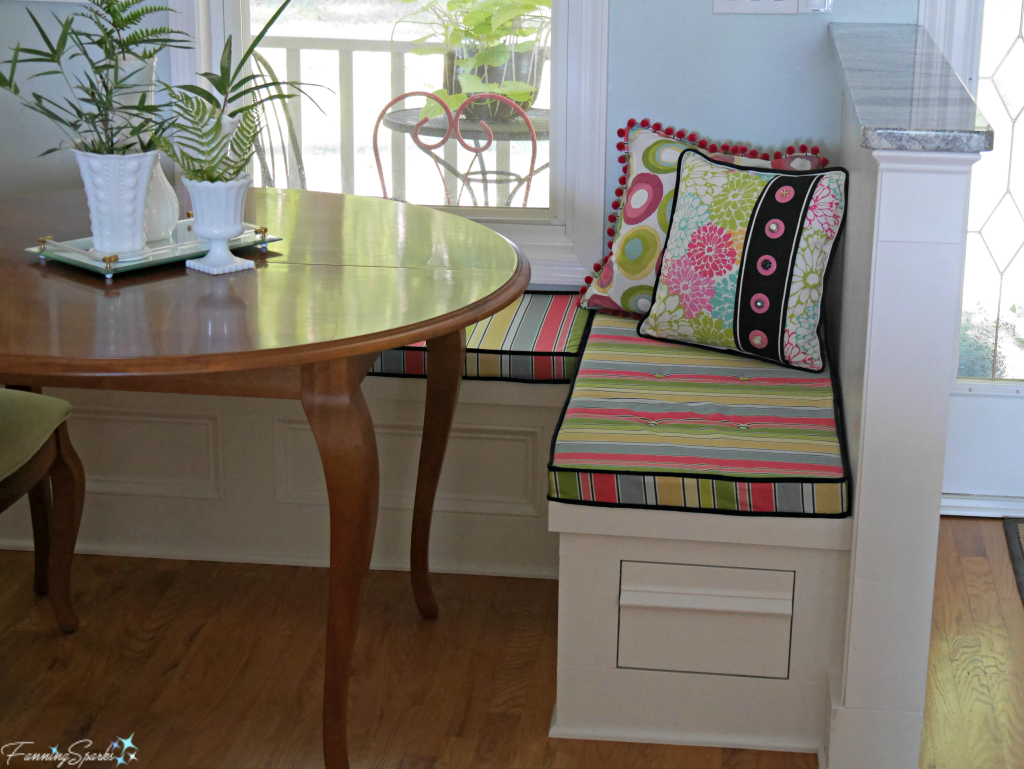
. The post, Our Pony Wall and Banquette Combo, shows how we modified the entryway and kitchen areas.  In the post, Our New Architectural Jewelry, I share the new light fixtures we added.
. I’ve had fun making mosaic mirrors for the bathrooms.  You can see the results in the posts: Pair of Mosaic Mirrors Completed and My Mandala-Inspired Oval Design.
. Our garage workshop underwent a facelift.  Check it out in 10 Tips from our Gussied Up Workshop.
. Considerable effort has gone into enhancing our outdoor spaces.  Check out Zinnias Rock! And More Cutting Garden Tips and Our Garden Prepares to Leap.

Today’s Takeaways

  1. Searching for a new house can be daunting especially if you have a long list of “must have” criteria.  Be sure to prioritize and force yourself to identify the critical few.
  2. Don’t rush house hunting.  Keep an open mind and be willing to consider alternatives.
  3. Once you’ve found the “one”, you may wish to create a set of before photos for a visual record of your home’s progression.

Peg - FanningSparks Author