
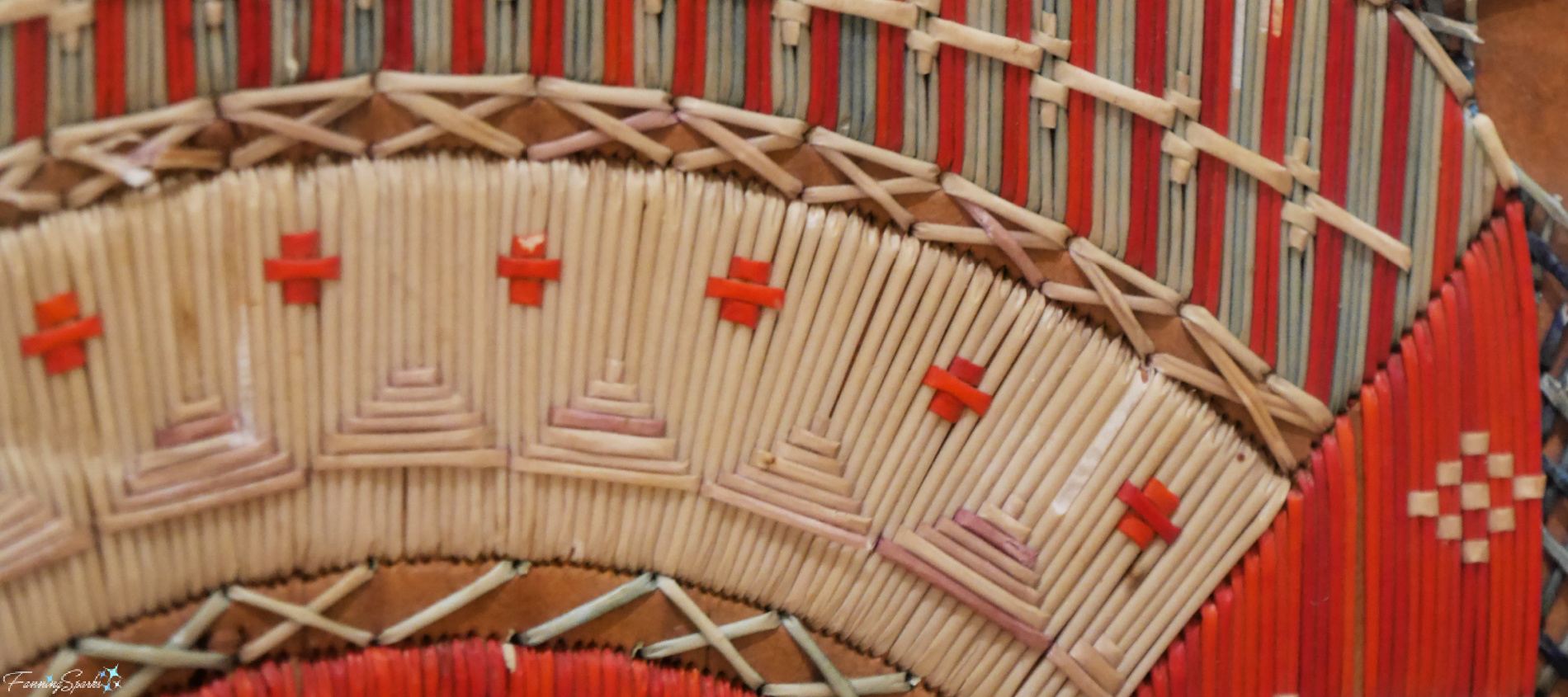
Porcupine quillwork is a unique art form in which quillers use porcupine quills to embellish storage containers, textiles and other objects. Quilling has been practiced by the Indigenous peoples of North America for centuries.
The Mi’kmaq, the first people of Nova Scotia who have been living in their homeland of Mi’kma’ki for more than 11,000 years, are well known for their “quilled bark” created with porcupine quills on a birch bark base.
A fine selection of Mi’kmaw quillwork can be viewed at the Millbrook Cultural & Heritage Centre in Nova Scotia.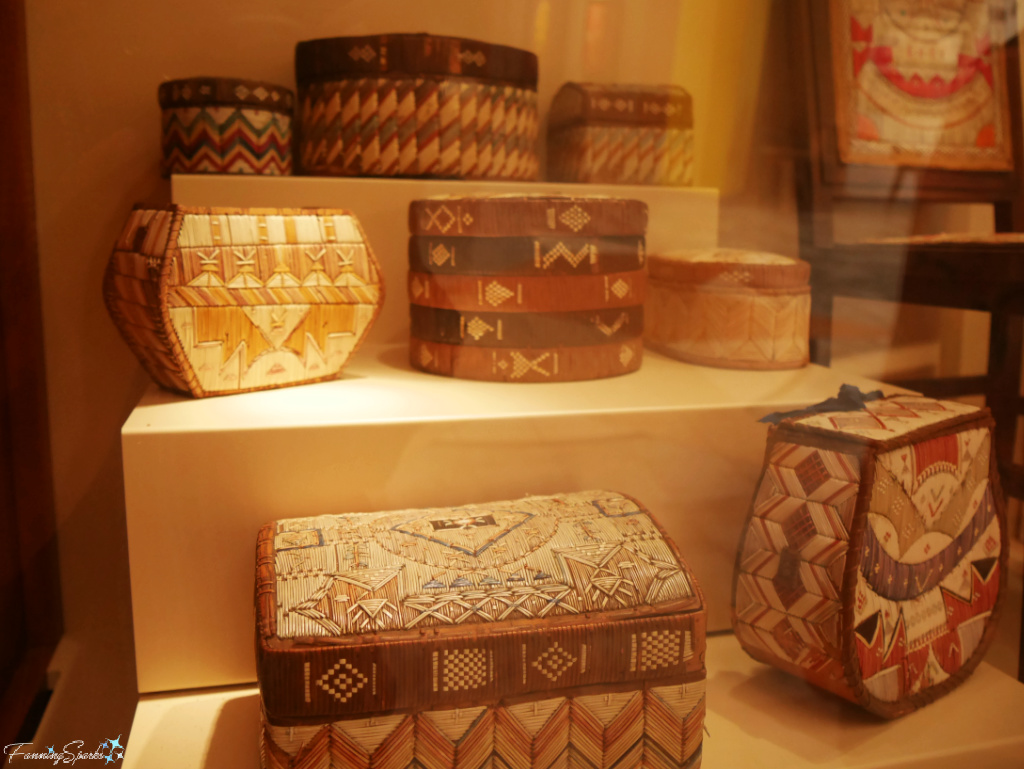
“Early quillwork on baskets and storage containers utilized seemingly simple but technically difficult designs; but this changed throughout the nineteenth century to reflect the influence of European embroidery. Quillwork shifted from items used by Mi’kmaw to trade goods such as calling card cases, panels for chair backs and seats, and other curios deemed pleasing to settlers.” writes Cheryl Simon in Artist Known: Revitalizing Mi’kmaw Porcupine Quillwork.
“As early as the eighteenth century, Mi’kmaw women saw that their artwork found a ready market with European settlers.” states the exhibit sign at the Millbrook Cultural & Heritage Centre. “One of the most impressive ways that they carried traditional designs forward into a new style, and also devised a new means of livelihood, was by creating beautiful mosaics of dyed porcupine quills laid side by side, their ends tucked into holes in birchbark.”
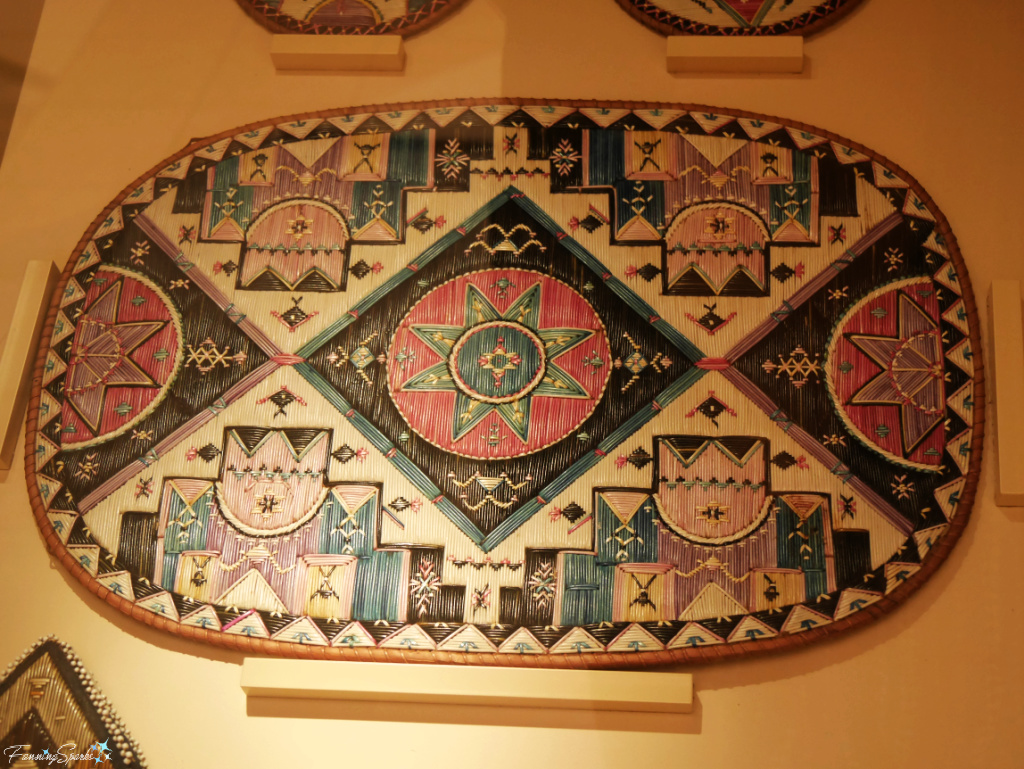
Prior to the introduction of aniline dyes around 1865, organic materials such as bloodroot, gold-thread roots and alder bark were used to dye porcupine quills with subtle, natural colors. The aniline dyes offered more vivid oranges, purples, magentas and pinks.
The quills in the placemat pictured below were coloured with aniline dyes. Interestingly, “after these dyes were adopted for use in quillwork, Mi’kmaw designs became simpler, often employing strong, eye-catching colours against a white background rather than the elaborate overlay quilling techniques seen in the early nineteenth century”.
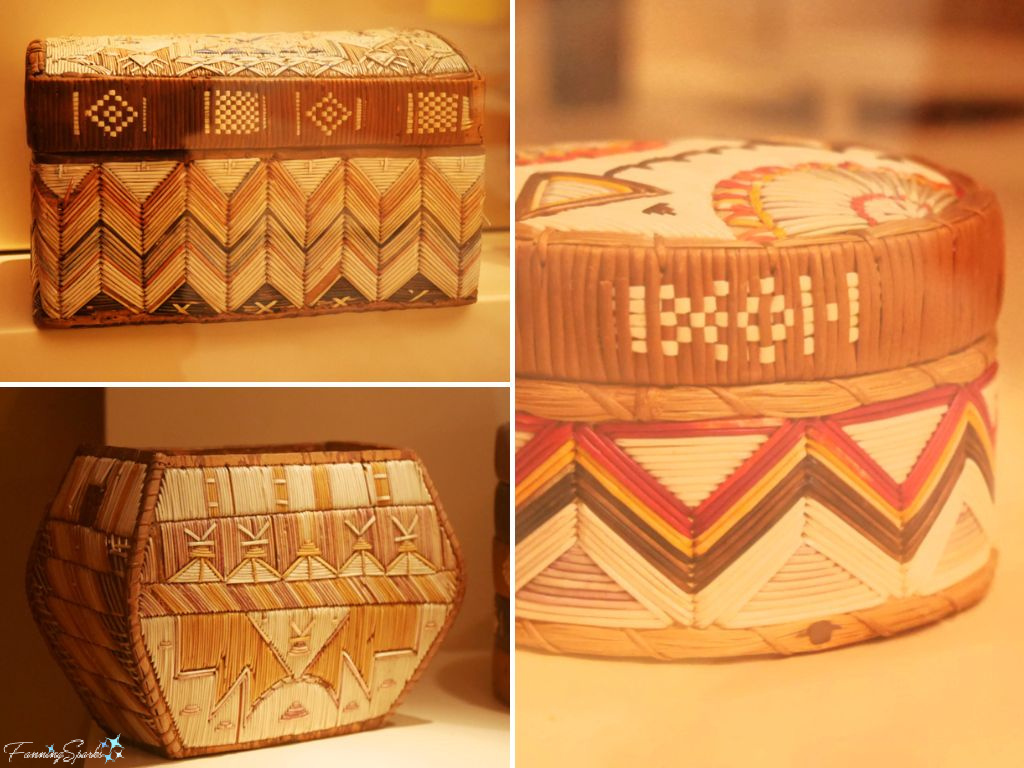
The exhibit sign goes on to explain “The lidded box was the most common form. The earliest known boxes had sides created by wrapping rings of birchbark with spruce root, then slipping these rings over an inner liner. Often the root was dyed red or black. Sometimes porcupine quills were woven through the root wrappings. Quill mosaics were incorporated into the box lids. Later boxes had quillwork on the sides as well as the lids.”
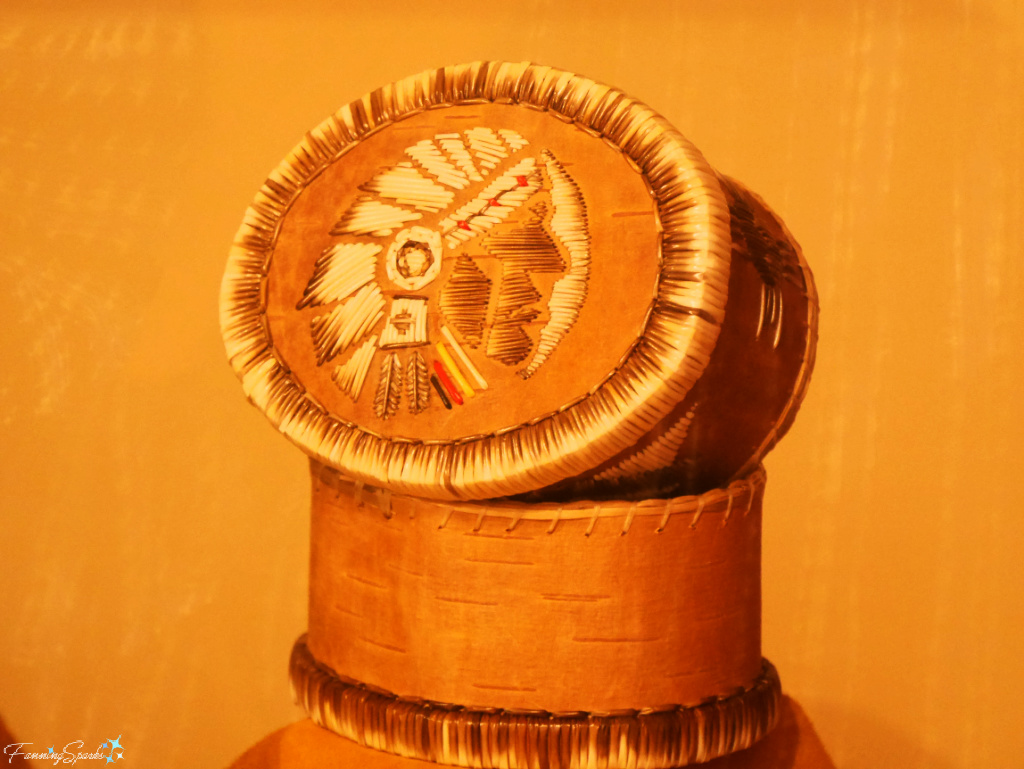
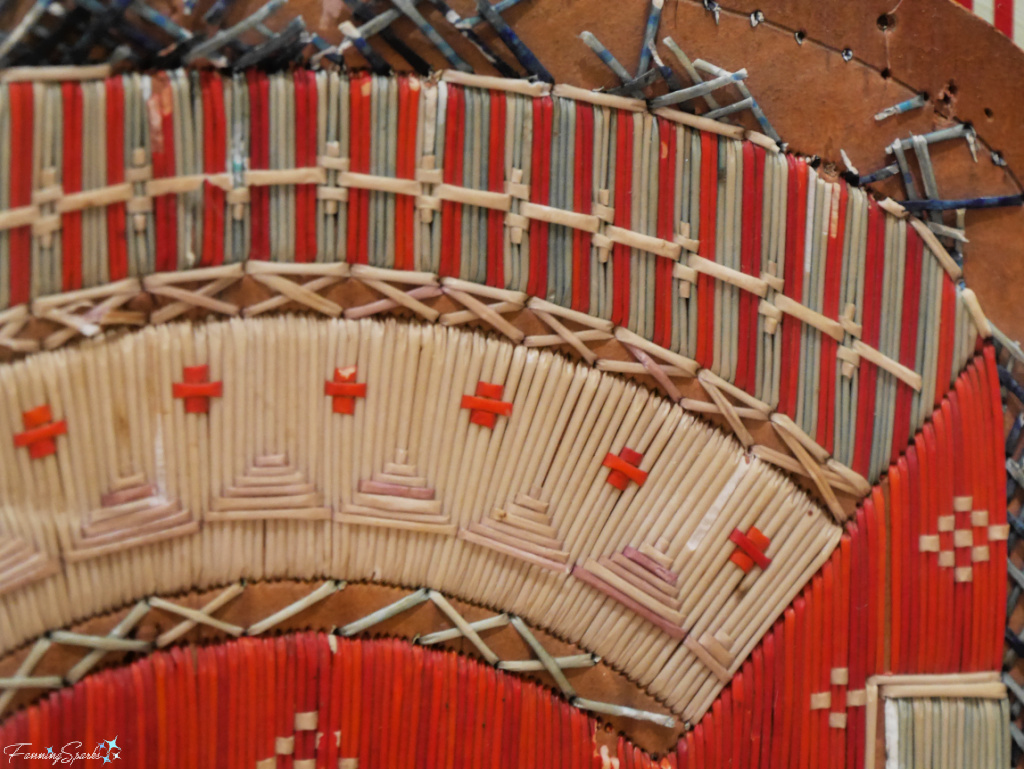
Shown below is an incredible example of what the Millbrook Cultural & Heritage Centre called “beautiful mosaics of dyed porcupine quills laid side by side”. I had the pleasure of seeing this stunning piece―a quillwork chair back―at the Art Gallery of Nova Scotia a few years ago. The chair back panel is made with porcupine quills, birchbark and spruce root.
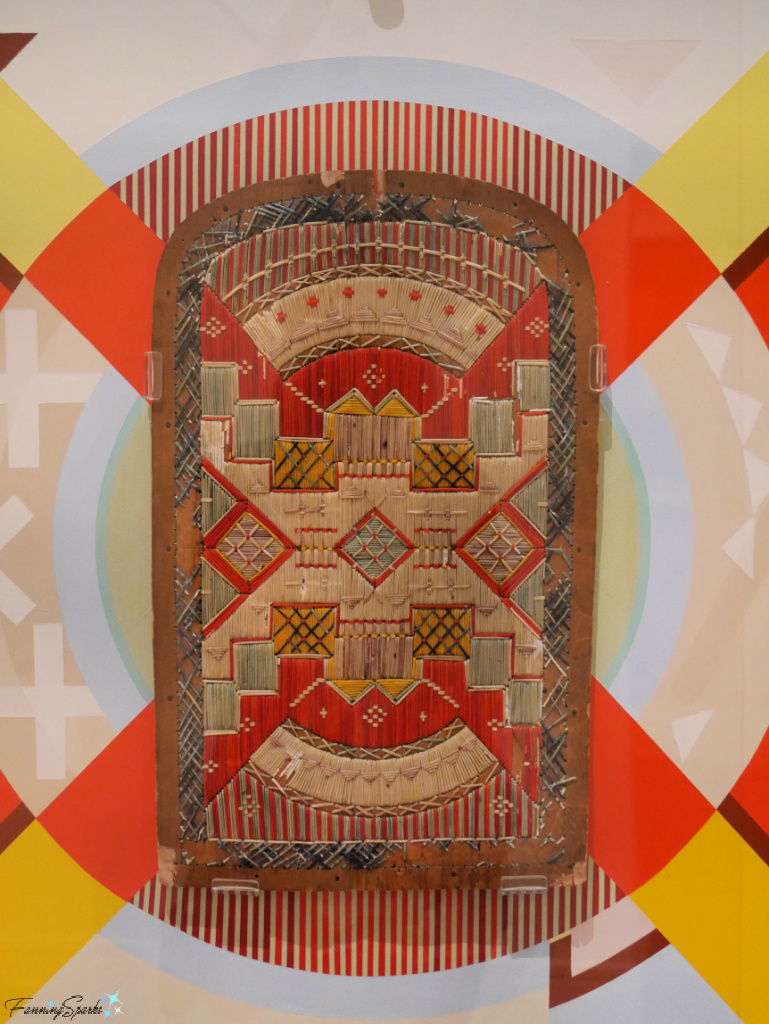
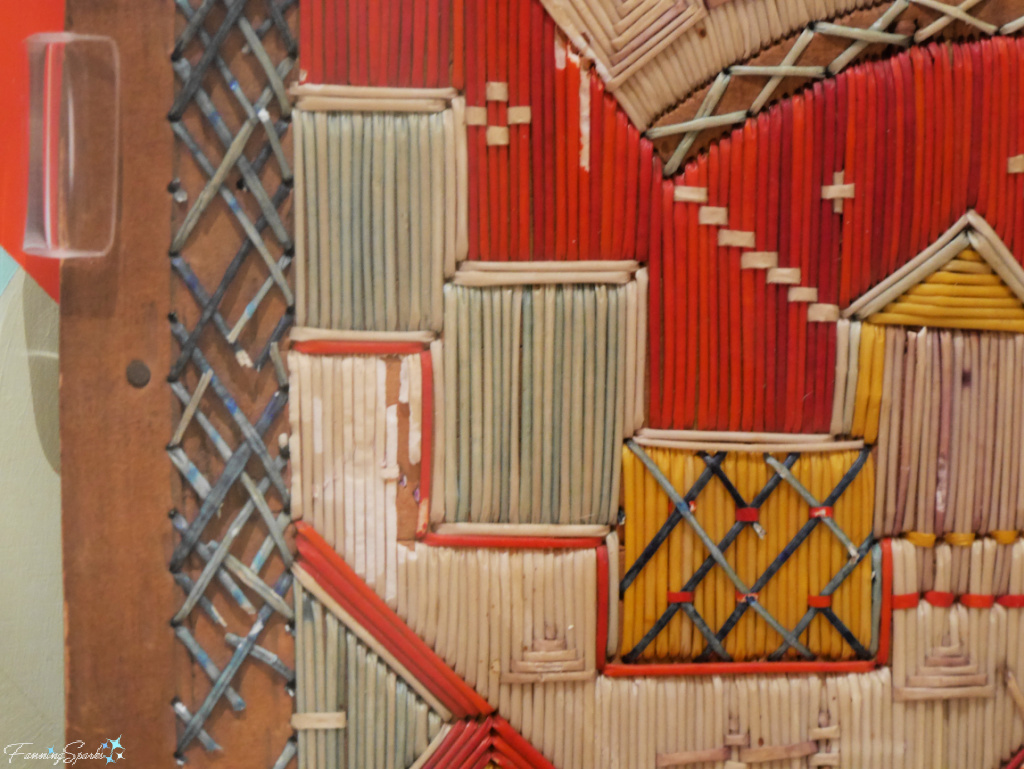
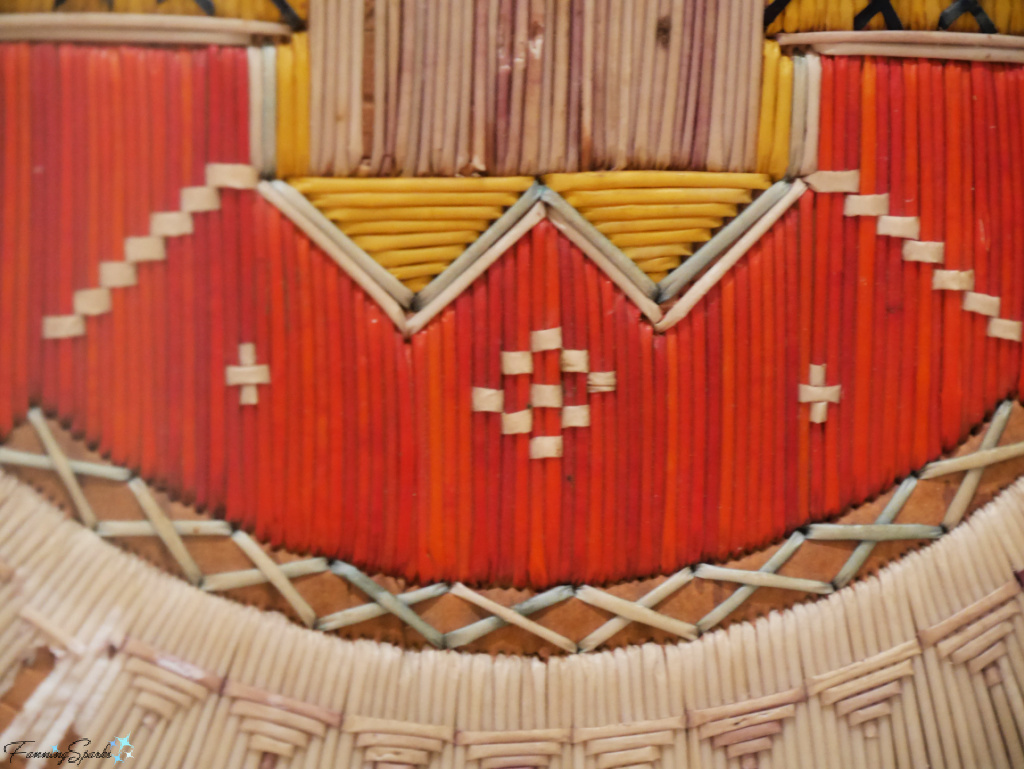
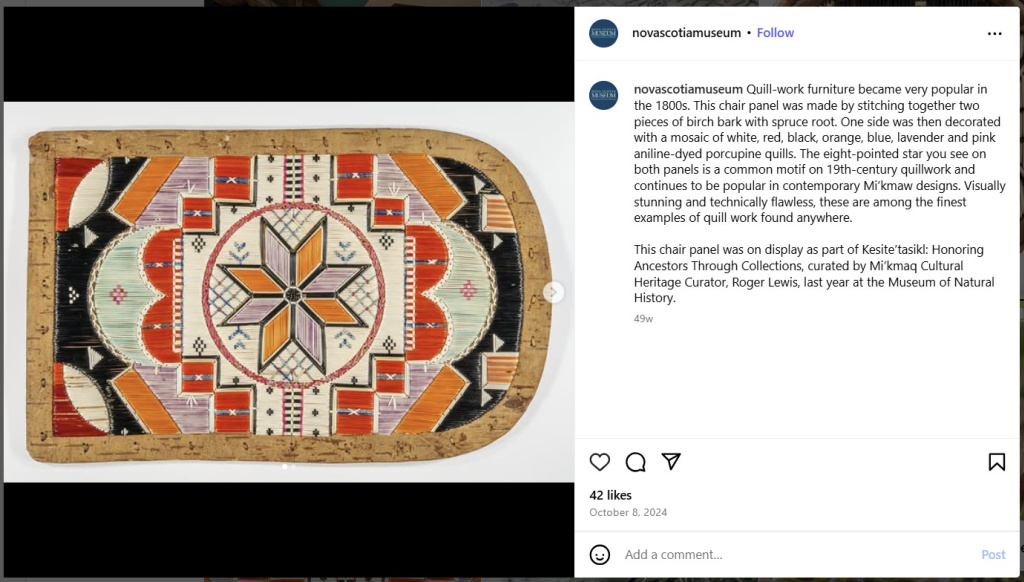
The Nova Scotia Museum also has a quillwork chair panel in their collection. They shared the below photo and provided this explanation on a previous Instagram post “Quill-work furniture became very popular in the 1800s. This chair panel was made by stitching together two pieces of birch bark with spruce root. One side was then decorated with a mosaic of white, red, black, orange, blue, lavender and pink aniline-dyed porcupine quills. The eight-pointed star you see on both panels is a common motif on 19th-century quillwork and continues to be popular in contemporary Mi’kmaw designs. Visually stunning and technically flawless, these are among the finest examples of quill work found anywhere.”
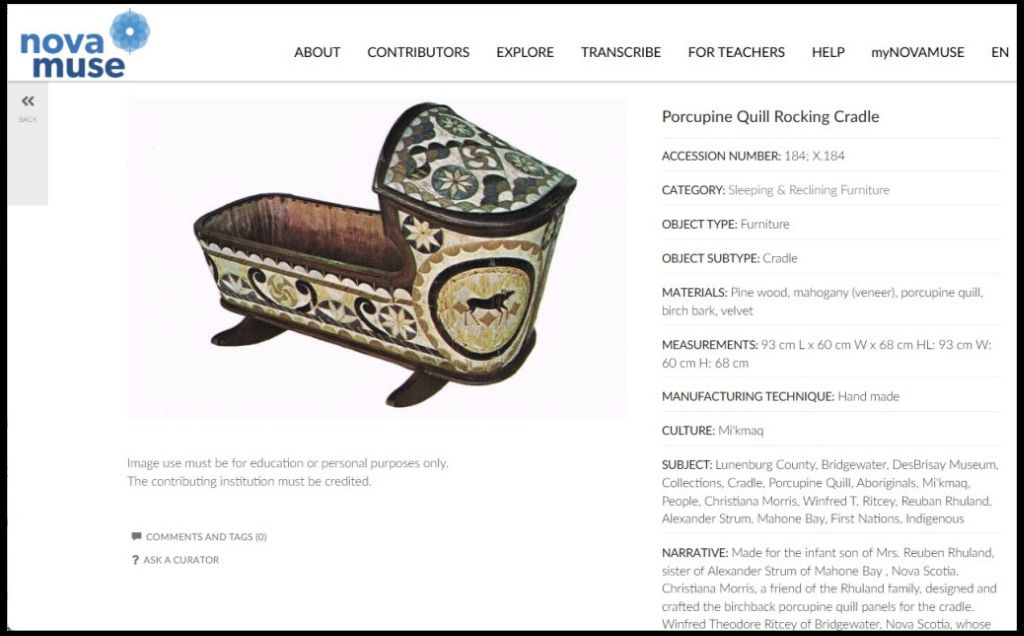
The NovaMuse website, a digital library of the collections of 55 museums from across Nova Scotia, also includes a few outstanding examples of quillwork. Most noteworthy is a spectacular quillwork rocking cradle which is housed at the DesBrisay Museum in Bridgewater.
A vintage souvenir postcard created by the Museum proclaims “This Child’s Cradle, made about 1868, is the best example of Mi’kmaq porcupine quillwork known to exist. The framework of pine was made by Alexander Strum of Mahone Bay, N.S. Christianne Morris, a Mi’kmaq woman at one time living near Bridgewater, N.S. made panels for the Cradle of birchbark covered with a mosaic of porcupine quills in traditional colours, derived from herbs and bark. The ends of each quill are inserted into holes made in the birchbark, causing the quills to lie flat on the bark. The Cradle is said to be an exact replica of one made by her for the infant Prince of Wales, later Edward VII, about 1841.”
The NovaMuse website also provides this insight “By the early nineteenth century, quillwork was being exported to the United States, Great Britain, and the West Indies; by 1850, quillwork pieces were displayed at international and provincial exhibitions. The craft, however, is very time-consuming and strenuous on the eyes so by the 1900s it was no longer a viable source of income; by 1950, there were few individuals who remembered the techniques.”
Thankfully, this trend is reversing. “Over the past 15 years, Mi’kmaw porcupine quill art has been undergoing a revitalization in Epekwitk [PEI], resulting in a thriving community of quill artists.” writes Simon in her recent article.
Here’s an example of Simon’s splendid work from Facebook.
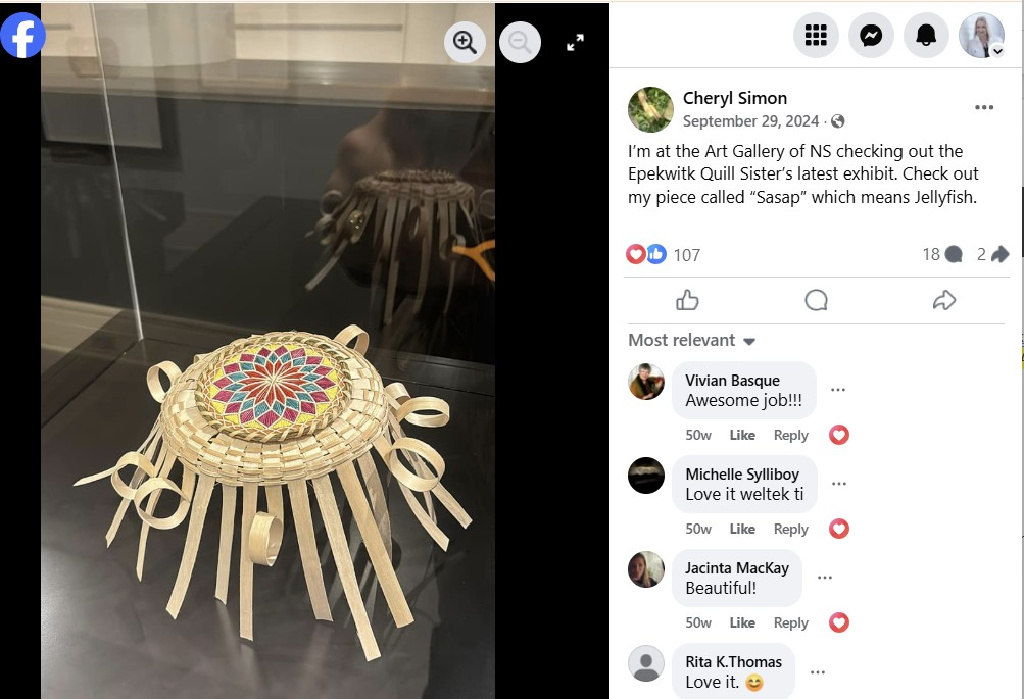 Cheryl Simon is “a Mi’kmaq e’pit (woman) from Epekwitk (PEI), currently residing in Halifax, who works with porcupine quills, birchbark, spruce root and sweetgrass” explains the Art Gallery of Nova Scotia website. “Cheryl fell in love with Mi’kmaq quillwork as a little girl studying her mother’s collection of quill boxes. She started learning and studying the insertion technique and design upon moving back to Mi’kma’ki in 2007, and launched her business, Mi’kmaq Quill Art in 2011. Cheryl is committed to community education of the art form and has been teaching quillwork workshops for over ten years. She took on her first apprentice in 2015 and opened a short-term studio in Epekwitk in 2016 to begin a program of instruction for three more apprentices. … She feels that quillwork requires strong connections and is proud that the community of quillers is expanding to include the younger generations.”
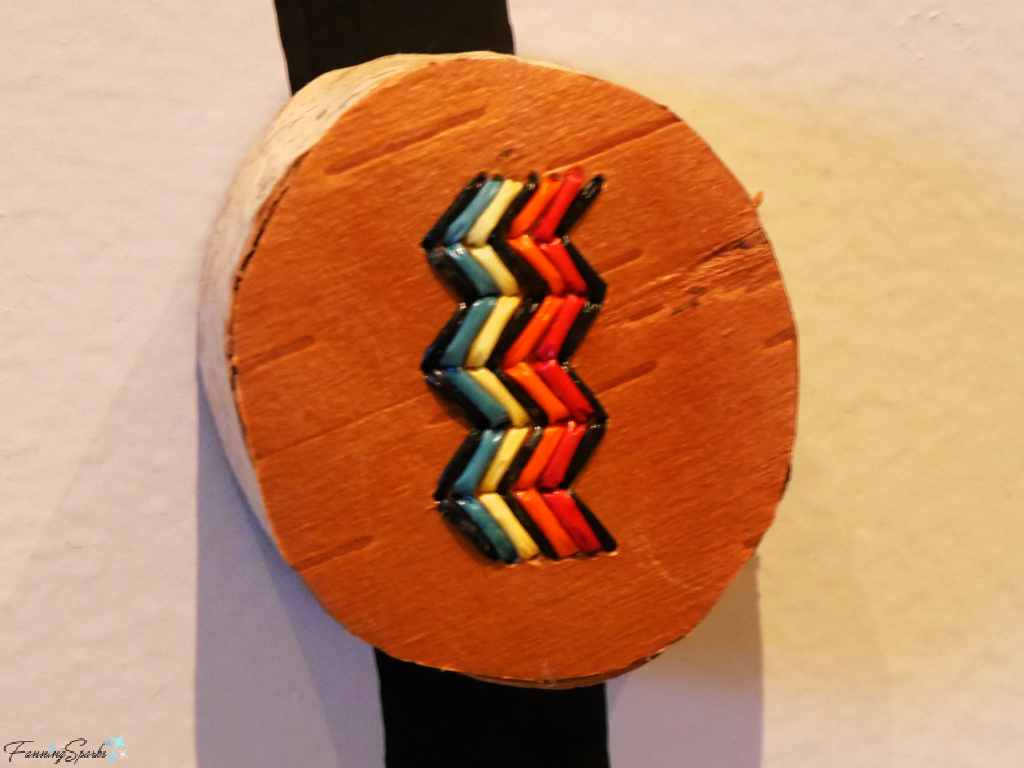
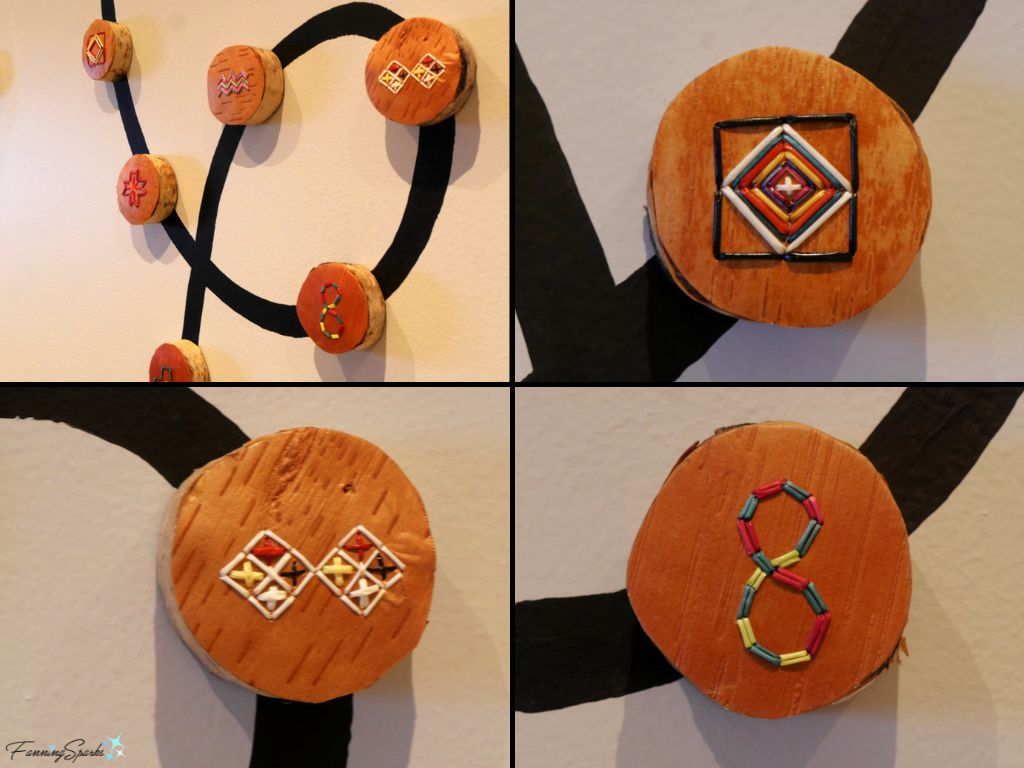
Simon worked with “members of the Sircle of Sisters program at the Mi’kmaw Native Friendship Centre” to create a collection of quillwork currently on display at the Art Gallery of Nova Scotia. The quillwork is spotlighted in the (Tea)chings space within the exhibition Ta’n a’sikatikl sipu’l | Confluence.
A series of 25 quilled pucks follow “the curves of the Mi’kmaw hieroglyphic symbol for “L’nu”, the word Mi’kmaw use to describe Indigenous Peoples”.
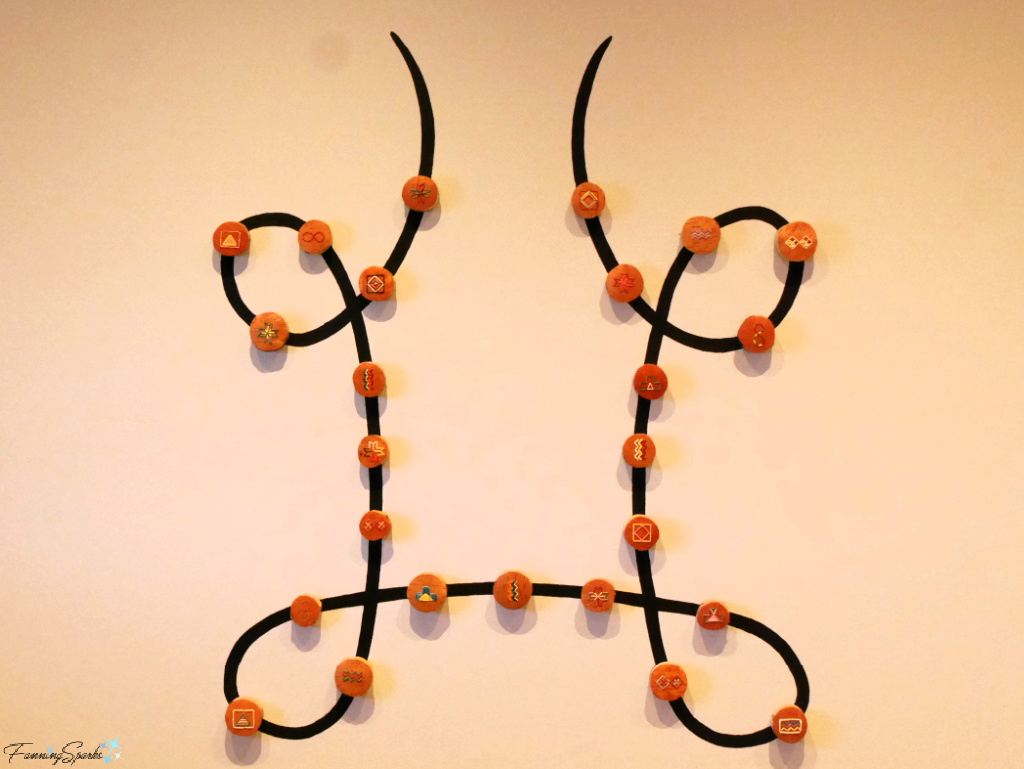
“While each design was quilled by individual participants, the intention of the piece is collaborative to reflect how individuals contribute to the rich diversity of a nation.”
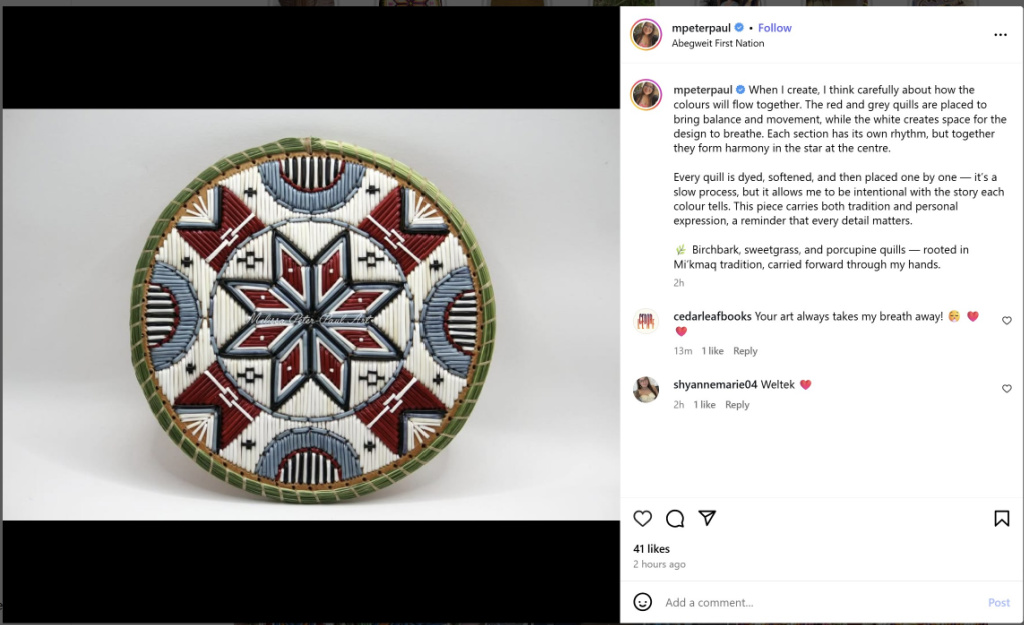
One of the many people Simon has introduced to the Mi’kmaw art of quilling is her cousin Melissa Peter-Paul. Peter-Paul is now a professional Mi’kmaw quill artist herself. Here’s a peek at her work from her Instagram page.
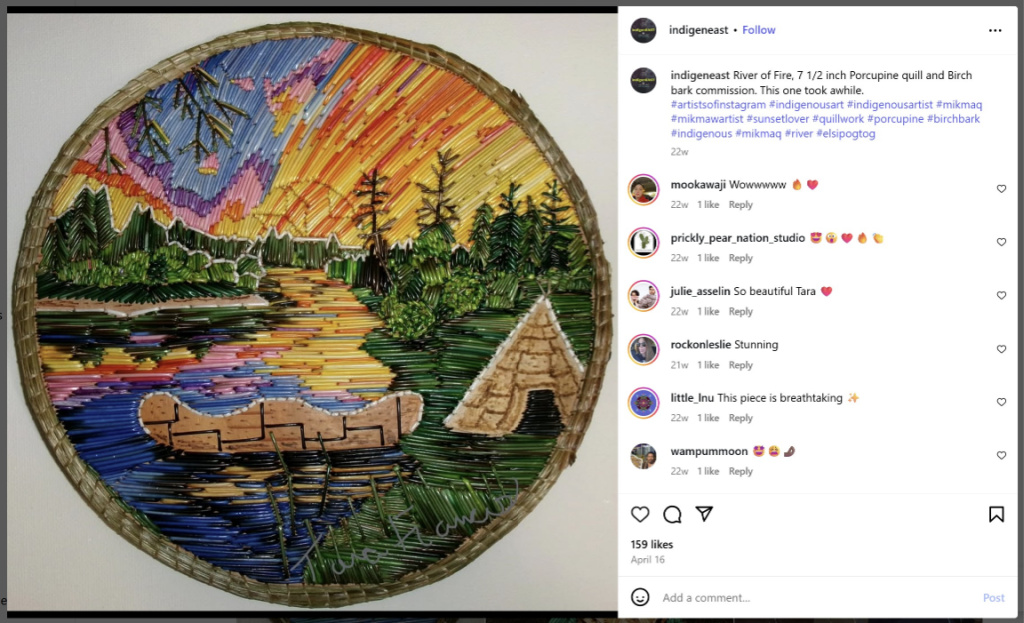
Tara Francis, of IndigenEast, is another Mi’kmaw Artist who shares her unique art including quillwork, silk scarves, silk paintings and acrylic paintings on Instagram.
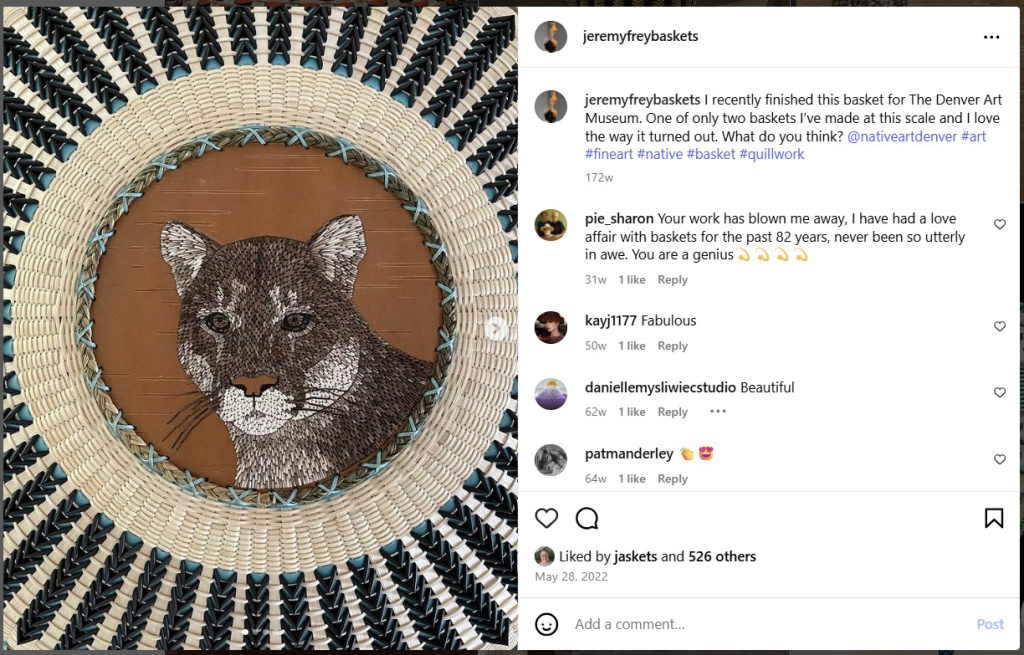
Jeremy Frey, of Jeremy Frey Baskets, is an award-winning basket maker from Maine. He is considered one of “the foremost Passamaquoddy craftspeople of his generation”. Frey sometimes embellishes his spectacular baskets with equally spectacular quillwork.
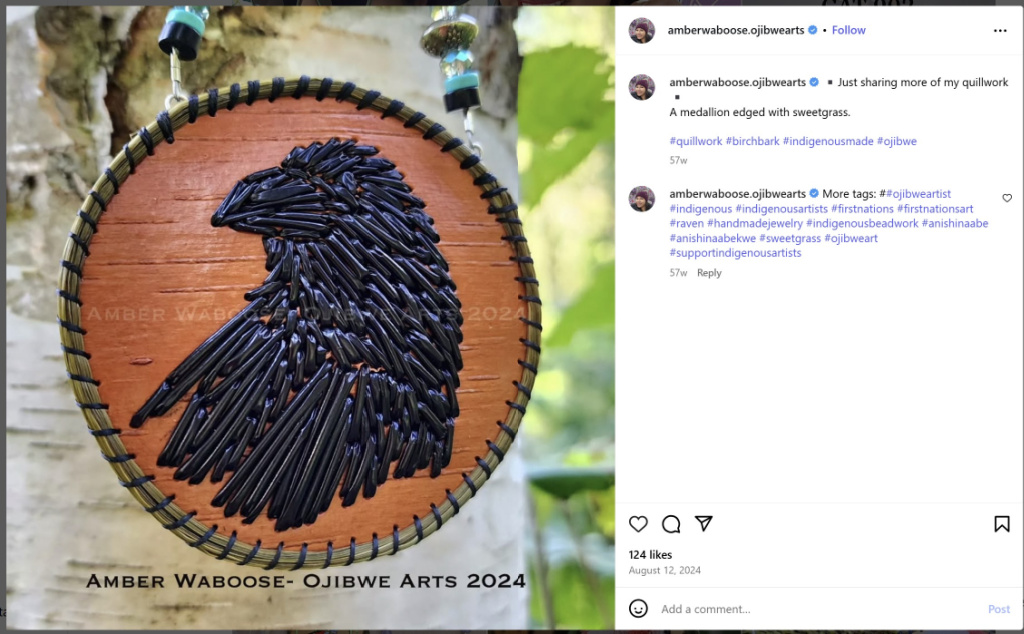
Amber Waboose, of Ojibwe Arts, is an Ojibwe artist specializing in quillwork who often shares her outstanding art on Instagram.
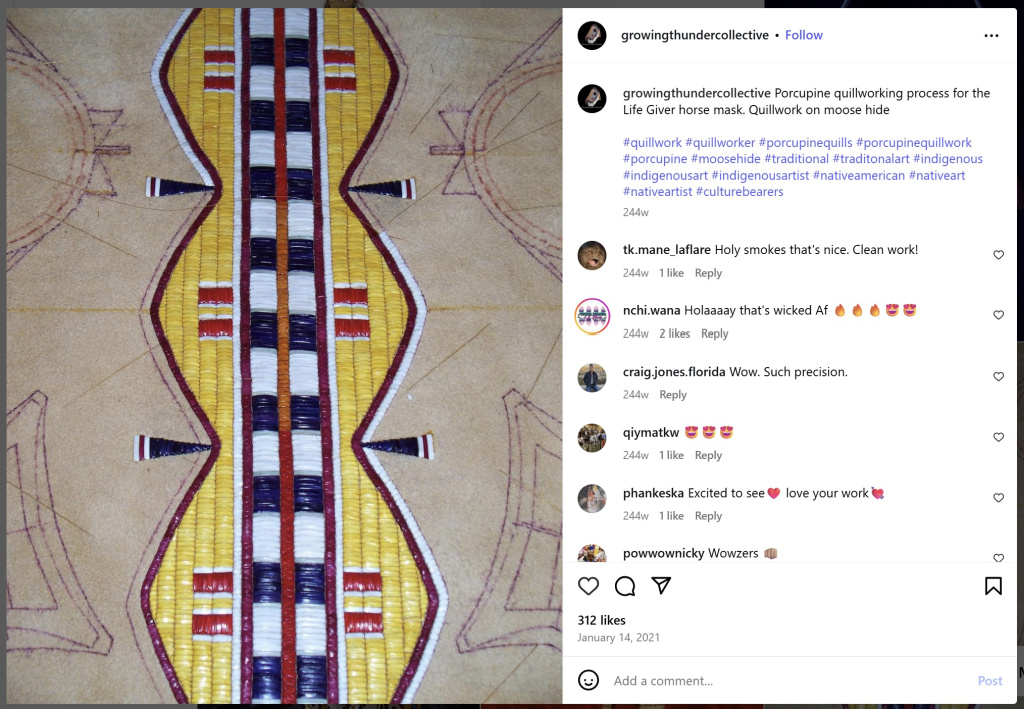
Birchbark is only one of the surfaces which can be embellished with porcupine quills and the “insertion” technique preferred by Mi’kmaw artists is one of many methods. Materials and techniques vary from region to region and across Indigenous groups.
In the Instagram photo below, quillwork is being applied to moose hide by the Growing Thunder Collective. This trio of three generations of Assiniboine/ Sioux artists from Montana excels in traditional beadwork and quillwork.
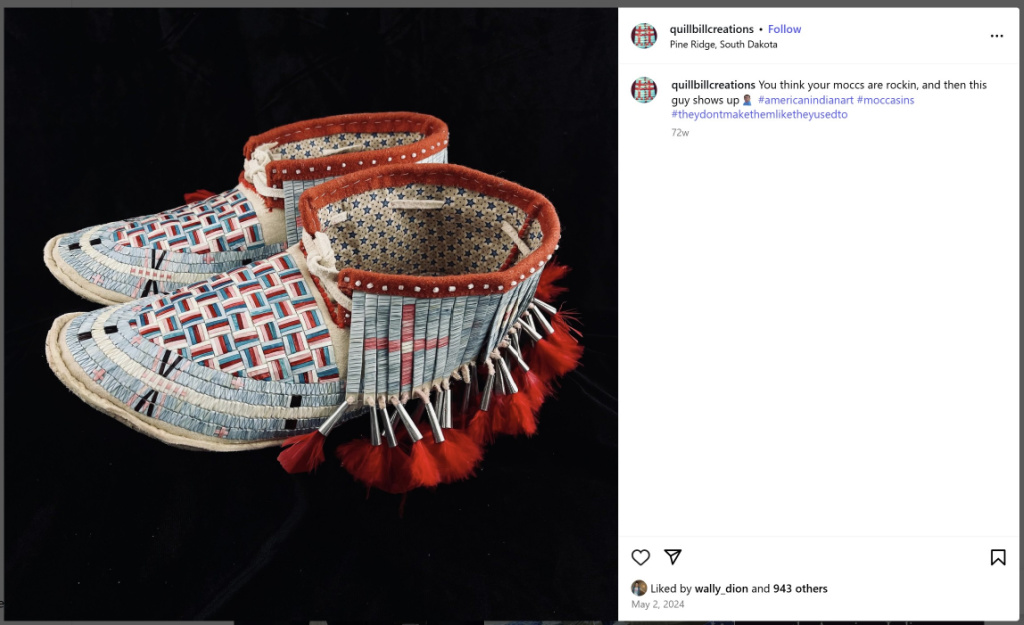
Bill Mendoza of Quill Bill Creations also creates outstanding Northern Plains porcupine quillwork and beadwork. He is an award-winning artist whose work has been acquired by renown institutions such as the Smithsonian’s National Museum of the American Indian.
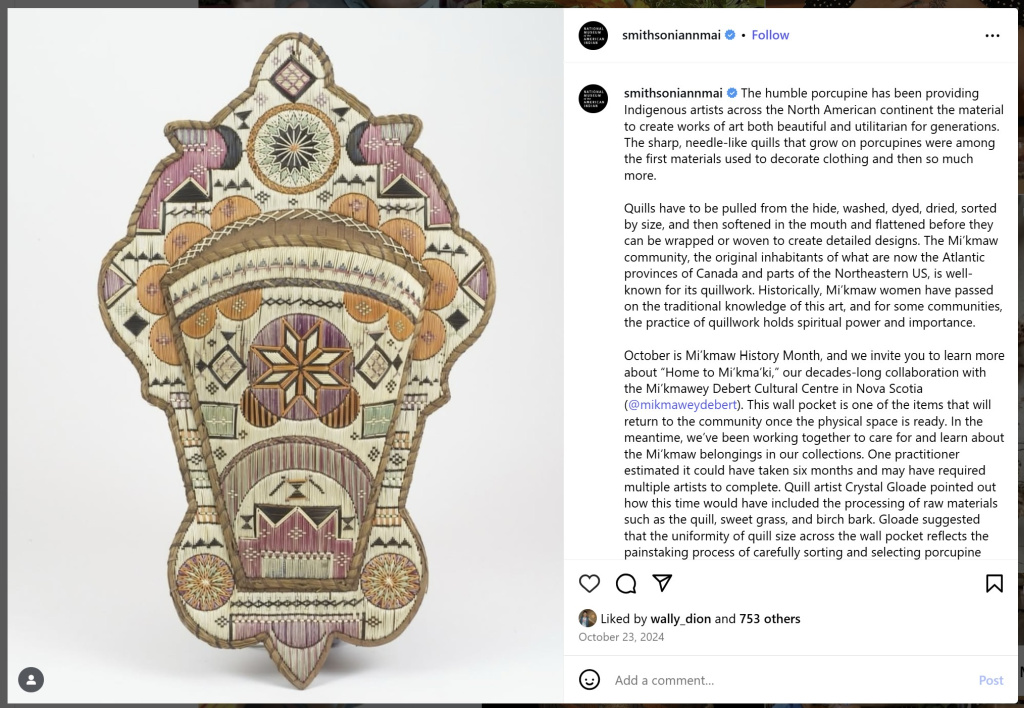
Speaking of the National Museum of the American Indian, this Smithsonian organization recently shared the below quilled birchbark wall pocket on Instagram. The explanation read, “The humble porcupine has been providing Indigenous artists across the North American continent the material to create works of art both beautiful and utilitarian for generations. The sharp, needle-like quills that grow on porcupines were among the first materials used to decorate clothing and then so much more.
… The Mi’kmaw community, the original inhabitants of what are now the Atlantic provinces of Canada and parts of the Northeastern US, is well-known for its quillwork. Historically, Mi’kmaw women have passed on the traditional knowledge of this art, and for some communities, the practice of quillwork holds spiritual power and importance.
October is Mi’kmaw History Month, and we invite you to learn more about “Home to Mi’kma’ki,” our decades-long collaboration with the Mi’kmawey Debert Cultural Centre in Nova Scotia … This wall pocket is one of the items that will return to the community once the physical space is ready. In the meantime, we’ve been working together to care for and learn about the Mi’kmaw belongings in our collections.”
More Info
The Millbrook Cultural & Heritage Centre, located in Millbrook, Nova Scotia, is a “cultural museum where every exhibit tells a part of the Mi’kmaq people’s story”. See their website for more info.
The Art Gallery of Nova Scotia is located in Halifax, Nova Scotia. With a permanent collection of over 19,000 works, the Gallery is considered a “gateway for the visual arts in Atlantic Canada by engaging people with art”. See their website for more info including details about the Ta’n a’sikatikl sipu’l | Confluence exhibition.
The following online article were consulted in the writing of this blog post:
. Artist Known: Revitalizing Mi’kmaw Porcupine Quillwork article by Cheryl Simon. The article was published online by “Meet Us Halfway: a Journal of Arts and Culture [which] is dedicated to art writing in Epetkwitk / Prince Edward Island and its surrounding region”.
The Nova Scotia Museum is responsible for a family of museums, including 28 decentralized sites, across the province of Nova Scotia. You can learn more on their website or Instagram.
NovaMuse is a digital library for over 55 museum collections from across Nova Scotia. Here are the links to the Porcupine Quill Rocking Cradle listing and its promotional postcard listing.
The following quillwork artists are mentioned in this blog post:
. Cheryl Simon of Mi’kmaq Quill Art – see more on Facebook
. Melissa Peter-Paul – see more on Instagram or her website
. Tara Francis of IndigenEast – see more on Instagram or her website
. Jeremy Frey Baskets – see more on Instagram or his website
. Amber Waboose of Ojibwe Arts – see more on Instagram or her website
. Growing Thunder Collective – see more on Instagram
. Bill Mendoza of Quill Bill Creations – see more on Instagram or his website.
The National Museum of the American Indian “is an active and visible component of the Smithsonian Institution” with locations in Washington DC, New York City and Suitland Maryland. You can learn more on their website or Instagram.
Today’s Takeaways
1. Porcupine quillwork is a unique art form in which quillers use porcupine quills to embellish storage containers, textiles and other objects.
2. The Mi’kmaq, the first people of Nova Scotia who have been living in their homeland of Mi’kma’ki for more than 11,000 years, are well known for their “quilled bark” created with porcupine quills on a birch bark base.
3. “Over the past 15 years, Mi’kmaw porcupine quill art has been undergoing a revitalization in Epekwitk [PEI], resulting in a thriving community of quill artists.” Cheryl Simon


Comments are closed.