
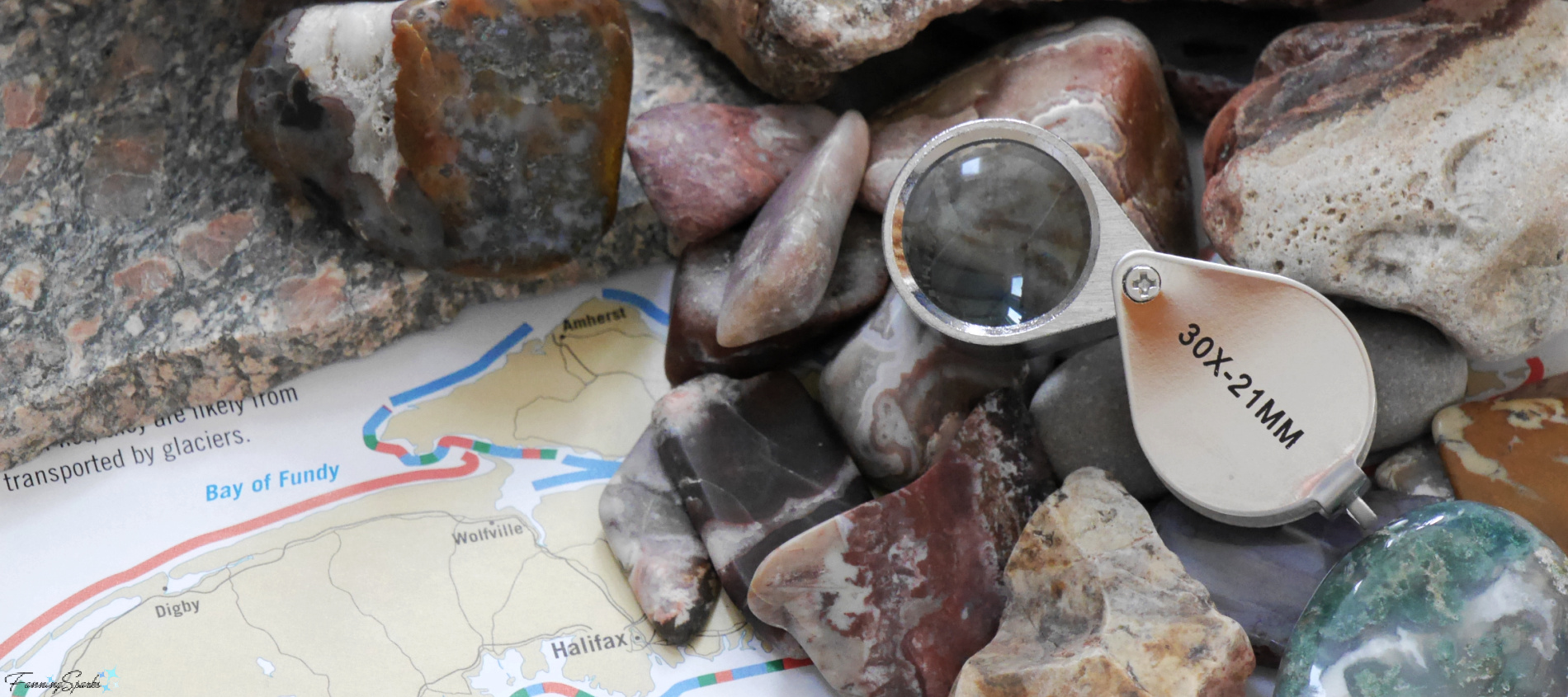
In addition to the standard historical and religious events, it seems there’s a designated day for just about every global cause, scientific wonder, special interest, food item and quirky pop culture trend. Special designated days cover the spectrum from serious observations such as the upcoming International Day of Peace to fun and silly events such as International Talk Like a Pirate Day. Falling somewhere in the middle of the serious-to-silly range are hobbies and special interests such as National Collect Rocks Day.
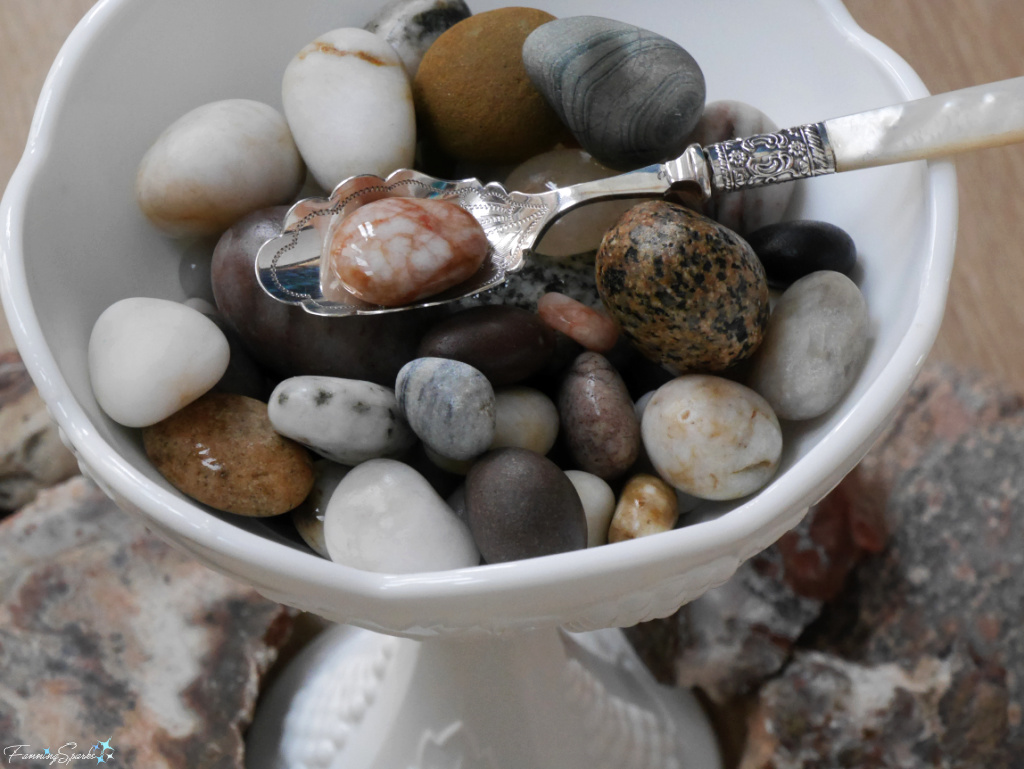
Celebrated annually on September 16, National Collect Rocks Day is an opportunity “to celebrate Earth and science, to indulge your inner geologist, and to learn fascinating things about the material that makes up Earth’s surface” writes John Copeland in his EARTH magazine article Geologic Column: Collect Rocks Day Offers Opportunity for Inspiration.
I’m no expert on these topics but I am an eager student. A few years ago, I asked the Nova Scotia Agate Facebook group for advice. I wrote: “… I’d love to learn more about Nova Scotia agate, amethyst and minerals … Aside from visiting the Fundy Geological Museum in Parrsboro, what’s the best way to get educated? Where/how would a novice go about trying rock hounding? Are there any tours or guided excursions you would recommend?”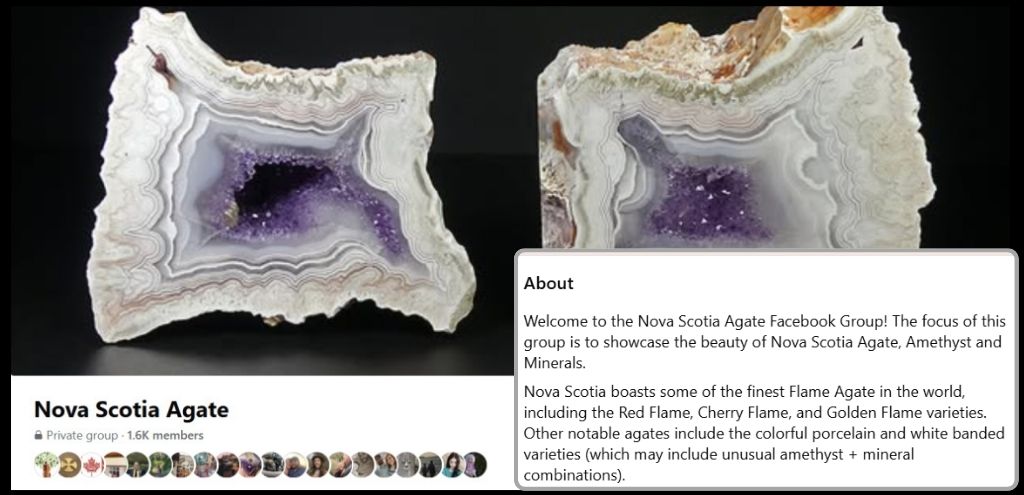
Group members provided very helpful recommendations including that 1) Scots Bay Beach is a great place to start and 2) Fundy Treasures offers fantastic tours. It took some time to come together, but this summer my sister Marian and I joined Fundy Treasures on their Journey into Gemstones guided tour. Fun fact: we now appear on the tour listing!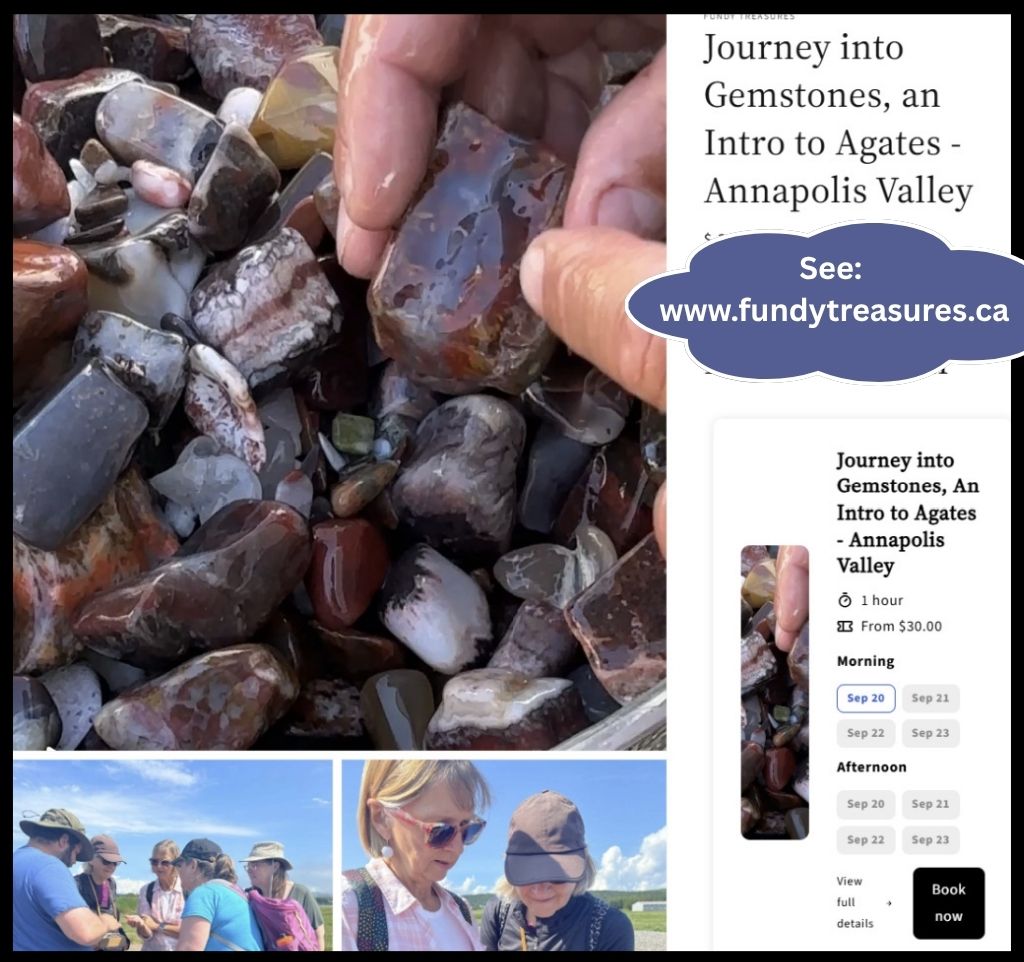
Our tour guide, Brian Hebert, is somewhat of a celebrity ― at least in the world of geology (the study of rocks and minerals) and paleontology (the study of fossils). He is the only Canadian to have ever won the prestigious Harrell L. Strimple Award from the international Paleontological Society. As “one of the most respected honours in the world of paleontology, … the Strimple Award recognizes exceptional contributions made by an amateur paleontologist—someone whose passion, dedication, and scientific impact have meaningfully advanced the field” explains the 2023 press release.
Brian is known to have a keen eye for finding fossils, an impressive depth of knowledge and a gift to know where fossils might be. In fact, he’s found more than one world-class fossil in Nova Scotia including a fossilized skull with intriguing teeth which led to a newly discovered species, the Hebert’s Tyrant Digger (Tyrannoroter heberti) which is named after him!
We didn’t talk about fossils though ― our tour, An Intro to Agates – Annapolis Valley, focused on agates and jaspers. “Agates, with their vibrant colors and intricate banding, are consistently among the most sought-after rocks for collectors” according to the Collect Rocks Day listing on the National Today website. “Their widespread availability and unique beauty make them a favorite for both beginners and experienced rockhounds”.
We met Brian and our fellow tour participants at Scots Bay in the Annapolis Valley region of Nova Scotia. Credit for the below image goes to the Atlantic Geoscience Society ― it’s from their brochure titled Nova Scotia Pebbles. I simply overlaid the arrow and label to indicate our destination.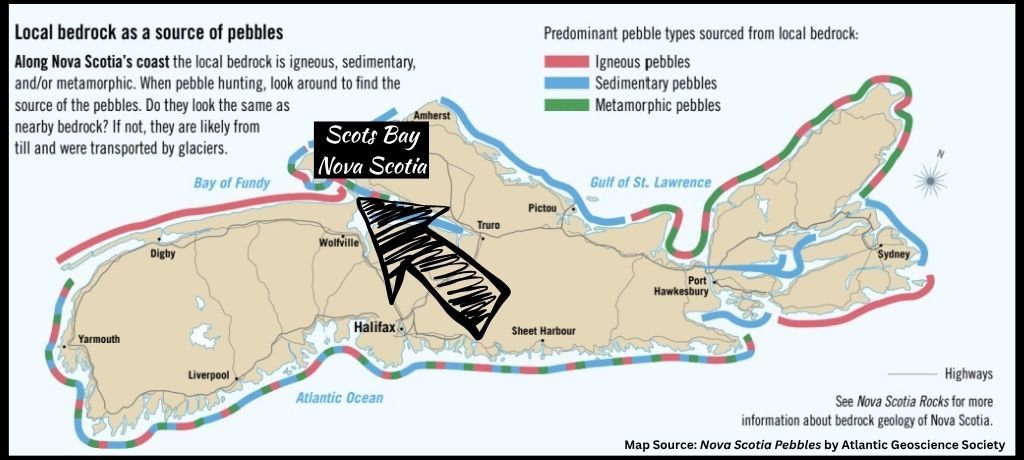
The map illustrates “Local Bedrock as a Source of Pebbles” and calls out the three main types of bedrock ― igneous, metamorphic, and sedimentary ― and where they are found along Nova Scotia’s coast. The red line indicates bedrock in the Scots Bay area is predominately igneous. Yikes, it’s a flashback to high school geology!
“Bedrock is the hard, solid rock beneath surface materials such as soil and gravel. Bedrock also underlies sand and other sediments on the ocean floor. Bedrock is consolidated rock, meaning it is solid and tightly bound. Overlying material is often unconsolidated rock, which is made of loose particles.” writes National Geographic in their article Bedrock. “Exposed bedrock can be seen on some mountaintops, along rocky coastlines, in stone quarries, and on plateaus. Often, these visible exposures of bedrock are called outcroppings or outcrops.”
Outcroppings and visible bedrock are common sights in Nova Scotia. I shared several examples in the blog post Solid as a Rock. But these days, I need go no further than the shoreline near my home to see examples like this.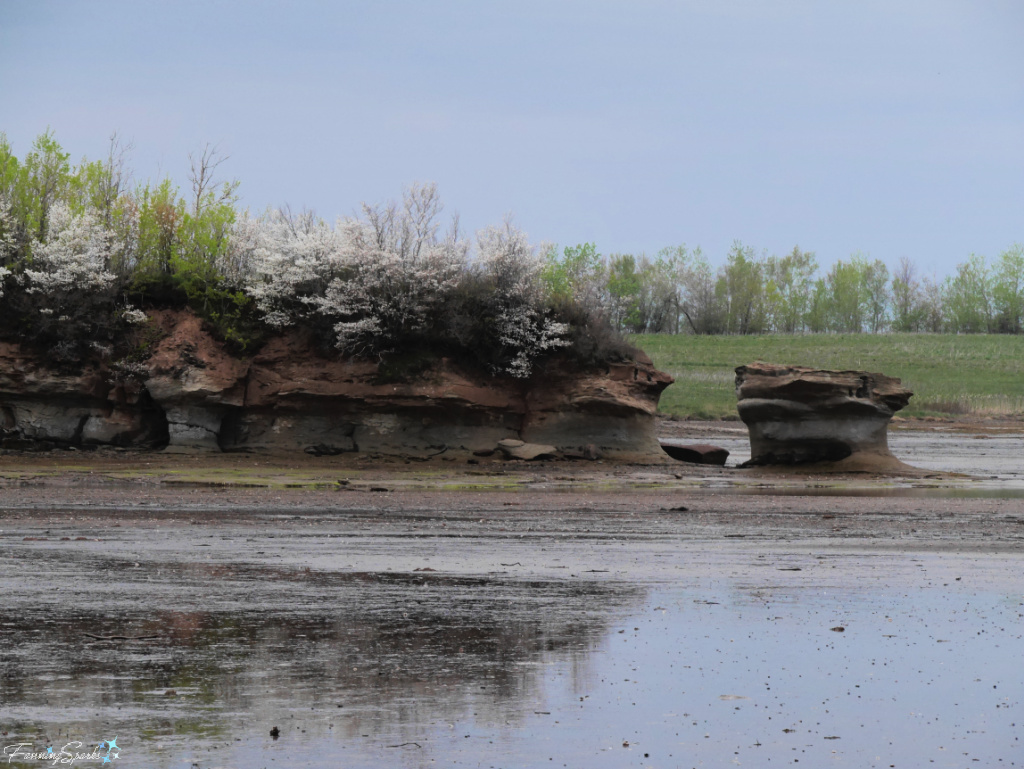
A closer look at these cliffs shows how bedrock transforms into rocks and pebbles. In answer to the question ― “How are pebbles formed?” ― the Nova Scotia Pebbles brochure explains: “After many years, bedrock fractures and breaks due to physical and chemical weathering. Resulting fragments are moved by wind, water, and ice (eroded), then transported and eventually deposited in sedimentary environments like rivers, lakes, and beaches. During transportation, fragments collide with one another and become smoothed and rounded.”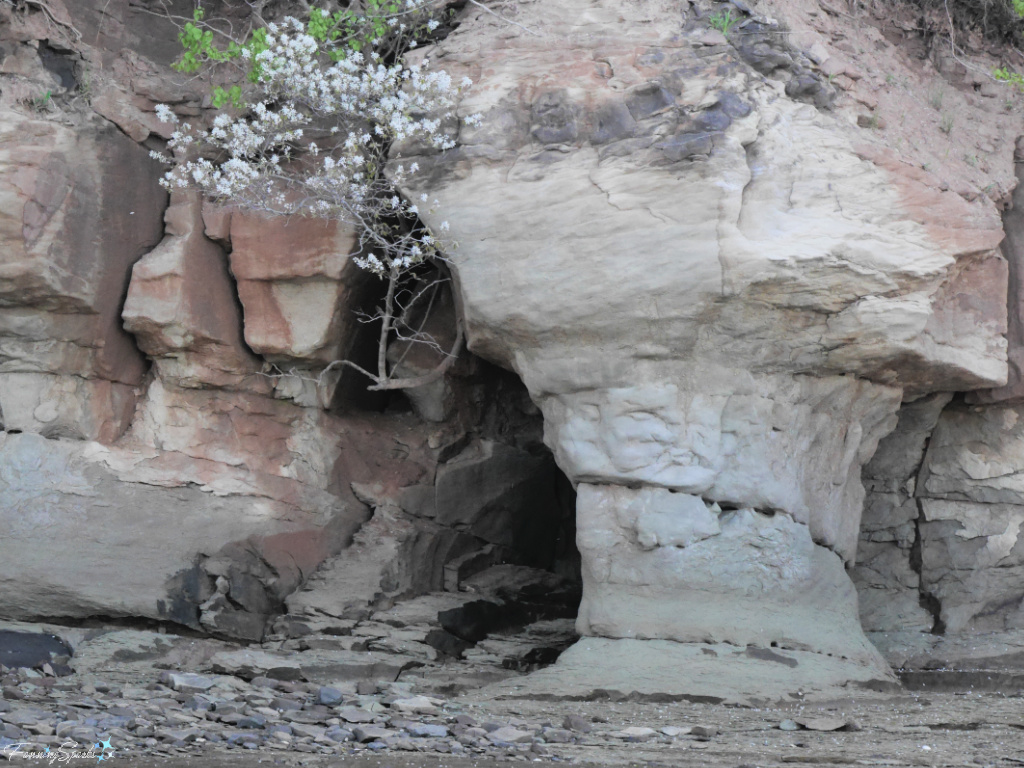
Returning to the topic of rock types ― igneous, metamorphic, and sedimentary rocks are often explained using cooking analogies. In his book, Basic Rockhounding and Prospecting, author Garret Romaine compares the rock cycle to baking cookies. “Think about how rocks form and how the Earth recycles them. … Think of the sugar cookie dough you squeeze out of a tube or scoop with a spoon onto a greased baking sheet. The cookie dough is similar to an igneous rock that comes out of a volcano. Once you cook the dough, it changes somewhat, and it’s hard – like a metamorphic rock. Then, if you crumble up the cookies into crumbs, those are the same as sedimentary rocks. … The ingredients are the same during each stage, but the chemistry changes with heat, and the amount of water vapor is the biggest variable.”
This brings me back to Scots Bay and its predominately igneous rocks and pebbles. My first impression of Scots Bay was heavy fog over a long, sweeping beach …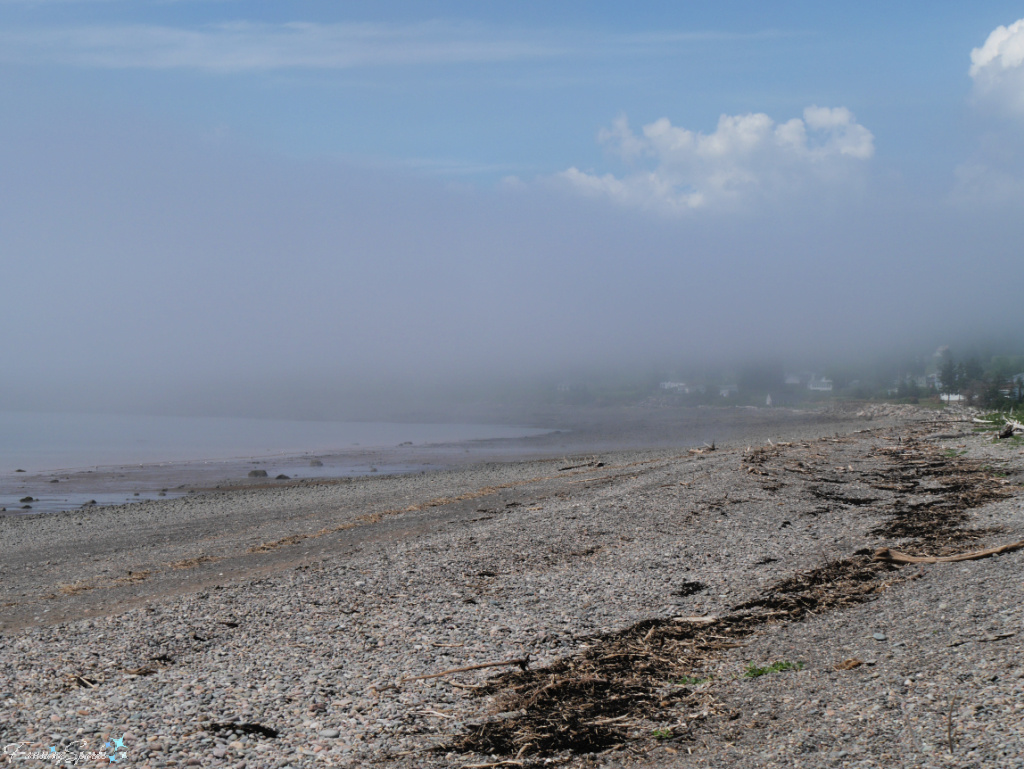
… covered in lots and lots of rocks and pebbles.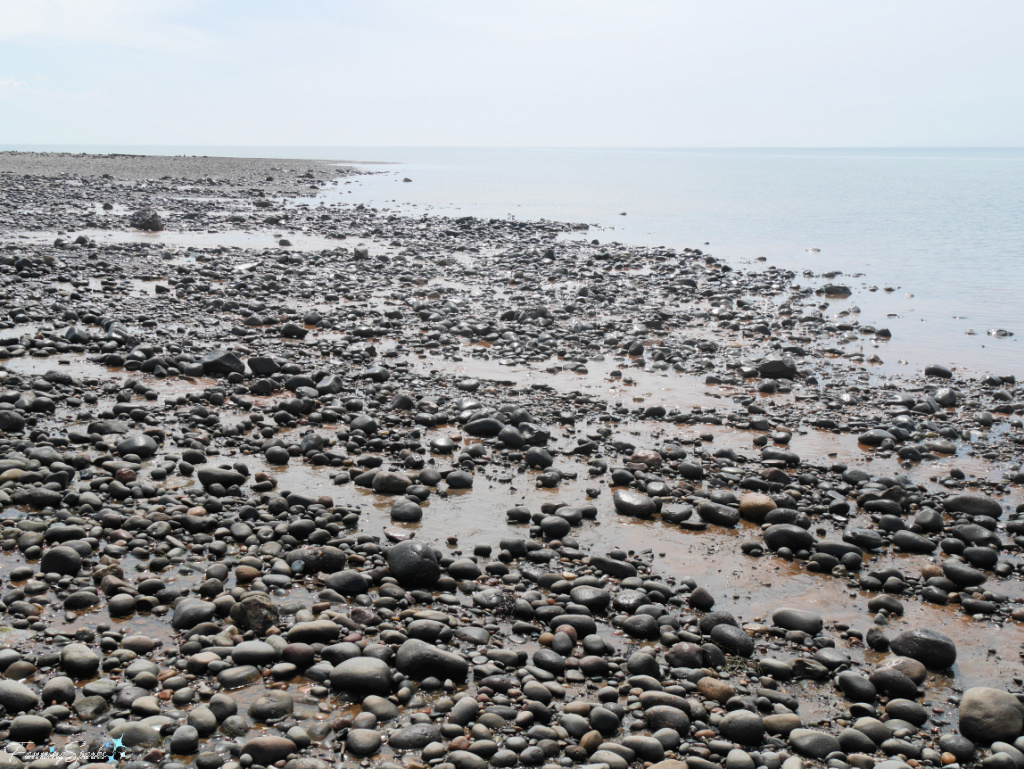
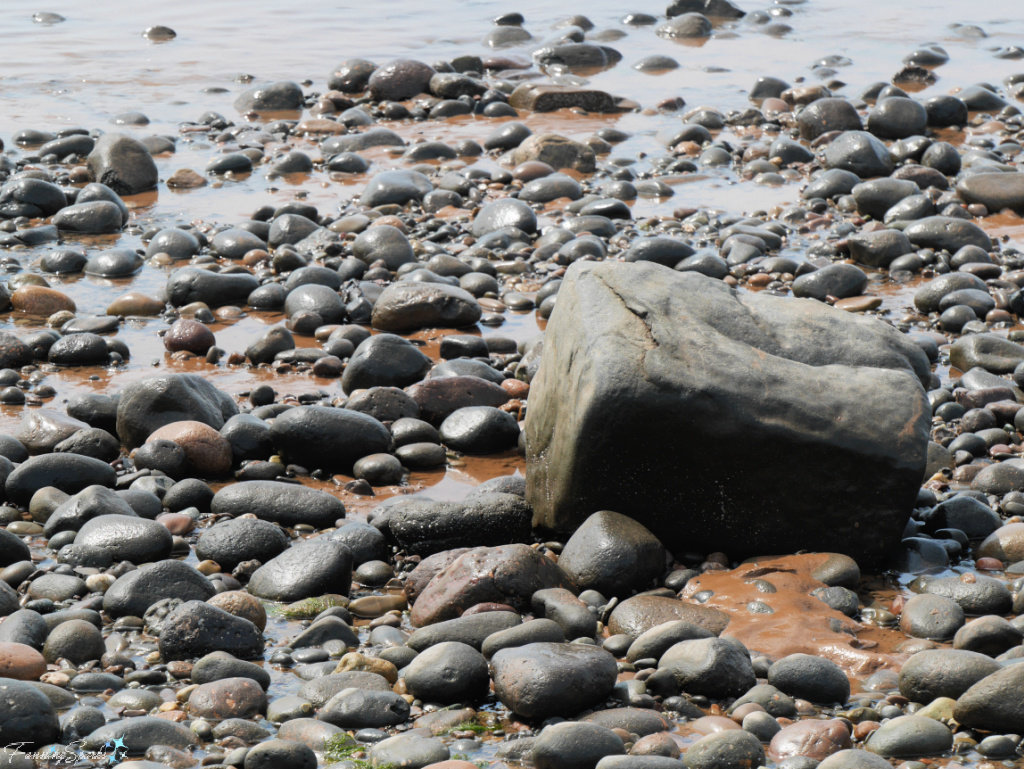
Brian began our tour with an introduction to agates and jaspers.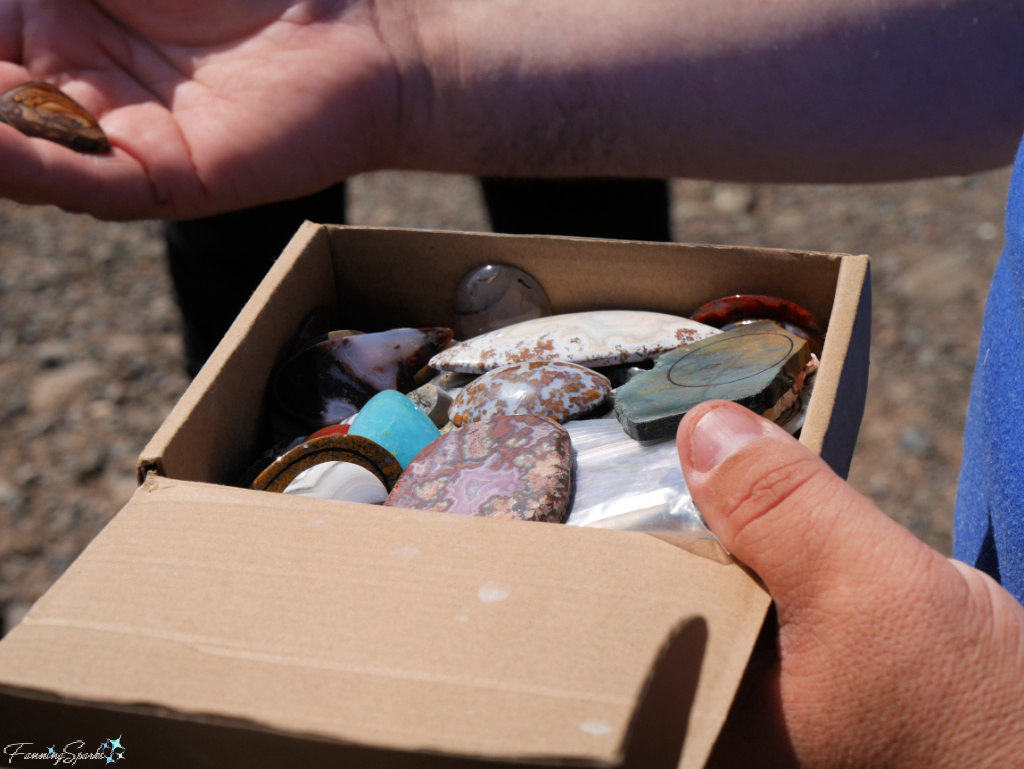
Here are some of the specimens he shared with us ― all are cut to showcase the beautiful colours and patterns.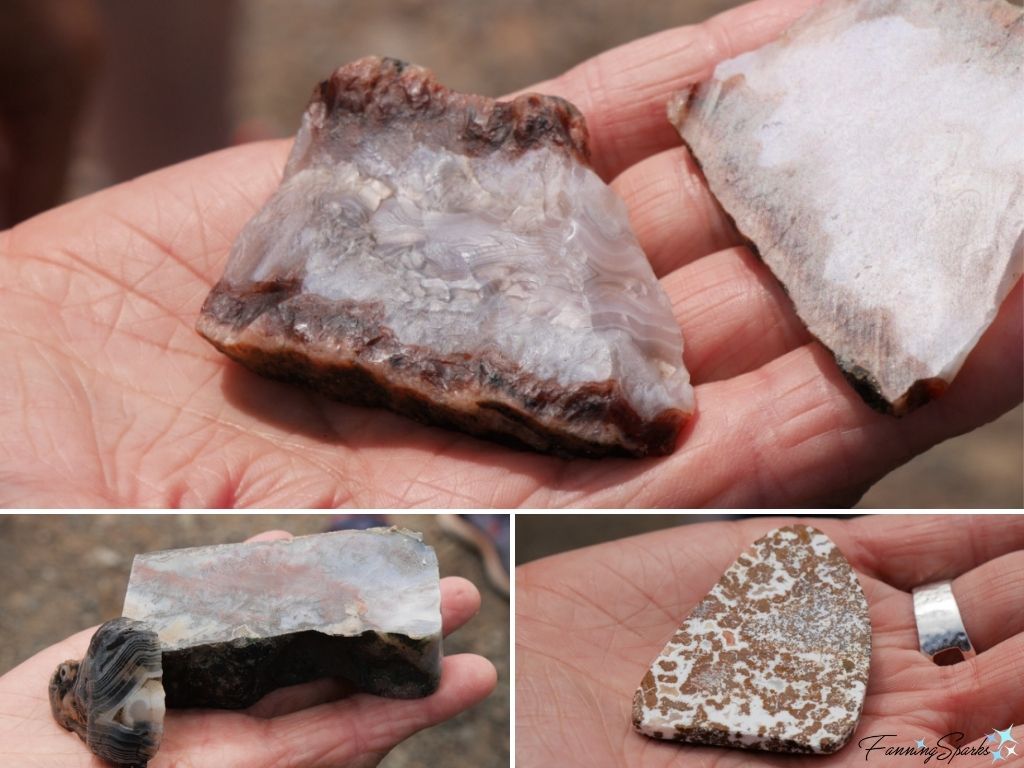
Shown below, two sections on the agate slice have been marked for cutting.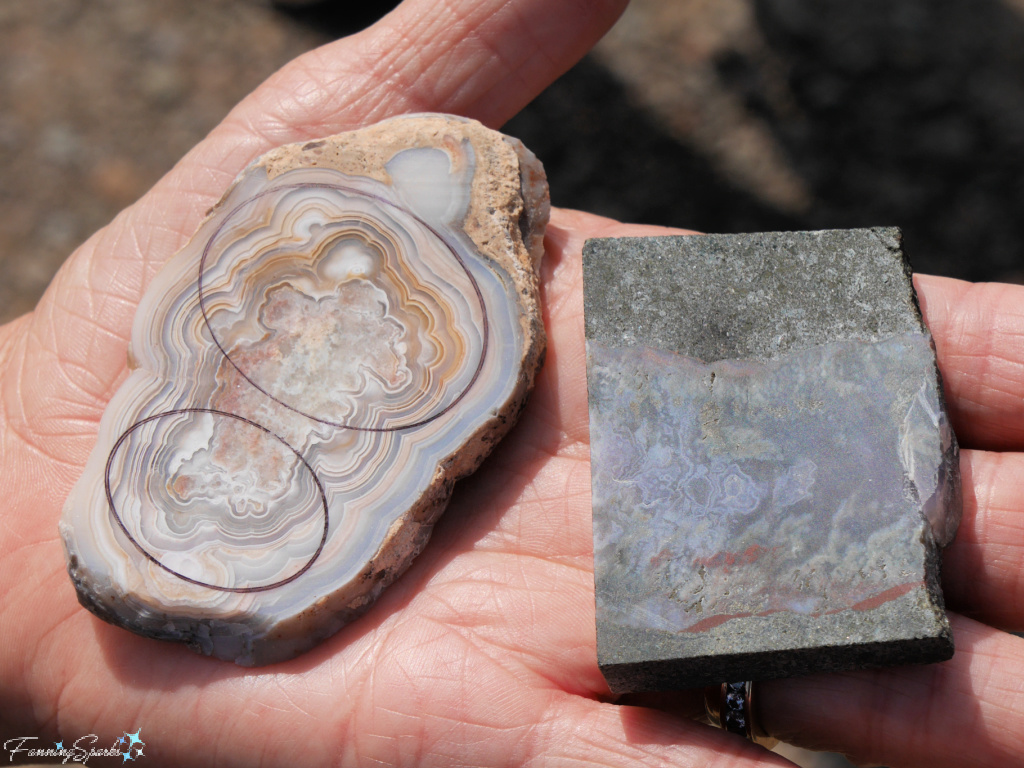
Taking it one step further, these agates have been shaped and polished into finished cabochons. Splendid!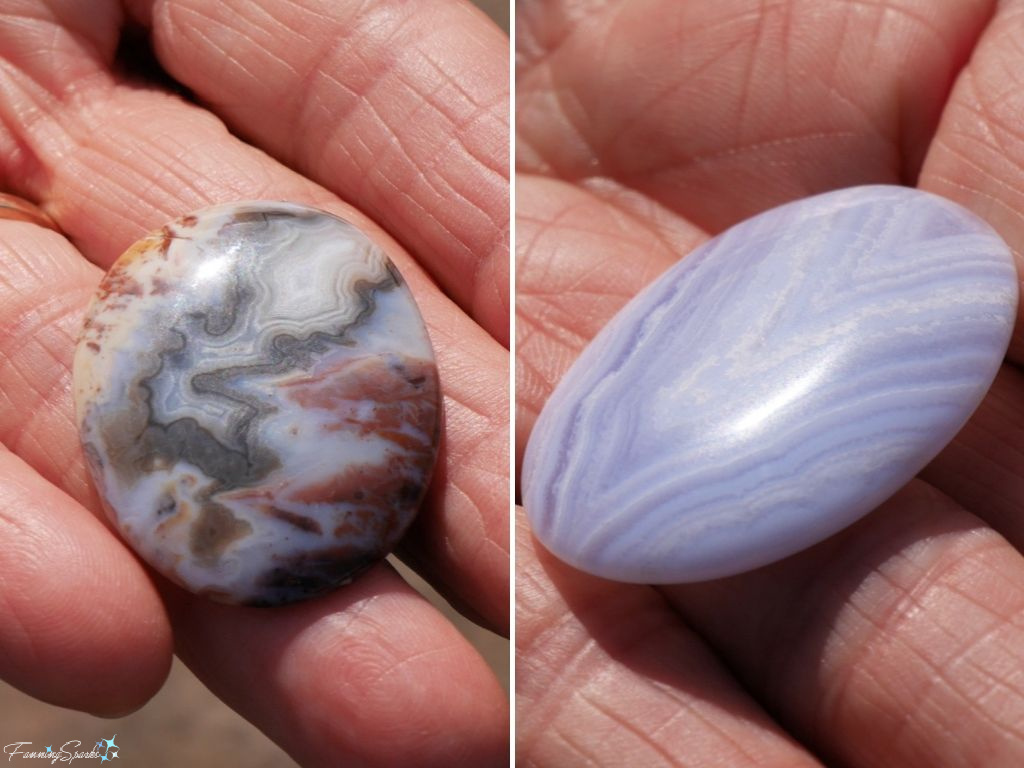
Speaking of cabochons, regular readers may remember the beaded amethyst cabochon pendant from my previous blog post All Around the Amethyst Cabochon. Here’s my finished pendant displayed on a small rock containing some amazing amethyst crystals. A great deal of effort is required to transform raw amethyst into a polished cabochon into a beaded pendant.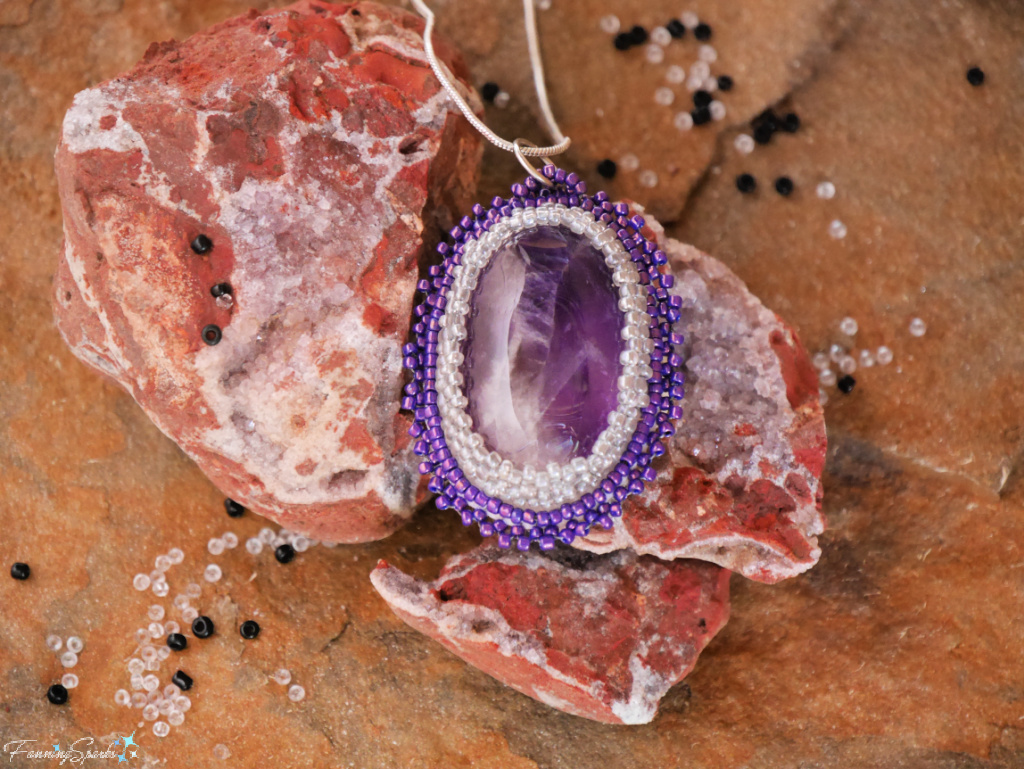
The first step is to find a rock containing the desired mineral or gemstone. In our case, we were hunting for agates and jaspers which Brian advised us would have a waxy, almost greasy, texture and sheen. He pointed us in the right direction and we set out to scan the pebbled shore for hidden treasure. Here’s a photo by Fundy Treasures showing our merry band on the beach.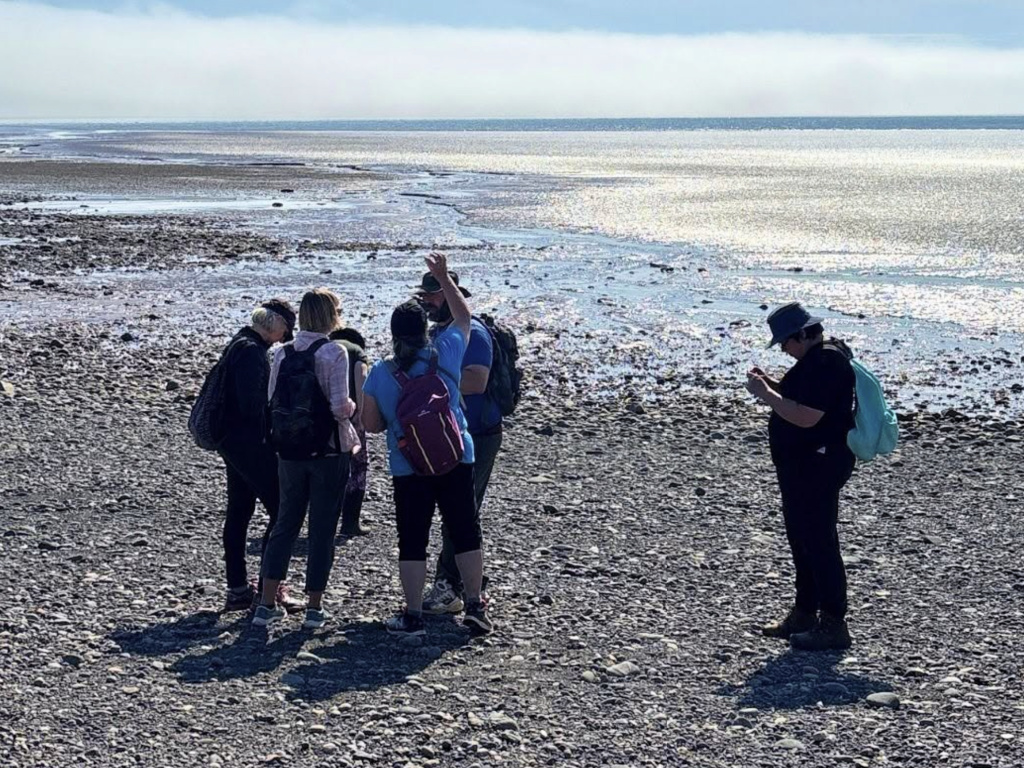
Brian patiently reviewed and identified our findings. This was a great way to learn what to look for ― each checkpoint helped us refine our search and find better specimens. Here’s a look at my final stash.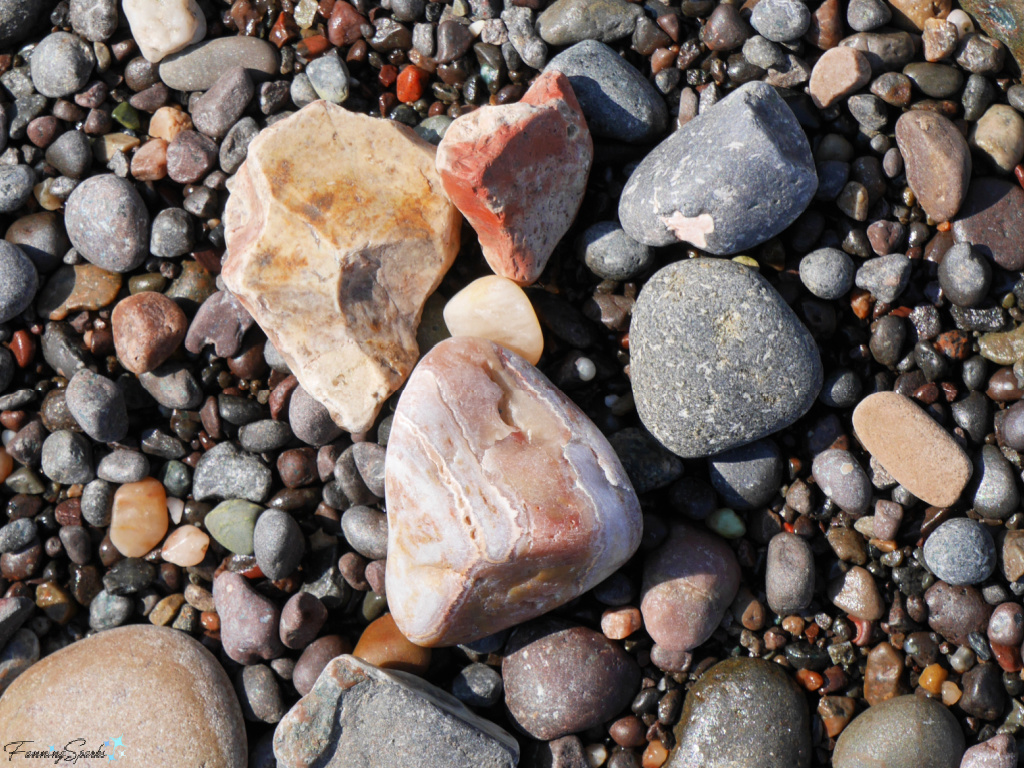
The tricky bit, I’ve learned, is that rocks and pebbles rarely contain only one mineral. Rocks are, in fact, made of a combination of minerals and the desired one is often covered with other material. So, finding a sizable specimen of a specific mineral requires a practiced eye and a great deal of know-how.
In an ongoing effort to learn more, I recently attended the Nova Scotia Gem and Mineral Show and Sale in Parrsboro, Nova Scotia. This event has been held every year for 59 years. The show program describes the event as a “showcase of geological treasures … with over 40 high-quality exhibitors of spectacular gems, minerals, jewelry and metalwork. … The gem and mineral displays, and specimens for sale, are some of the finest in the Maritimes.” Demonstrations and guided walks round out the program.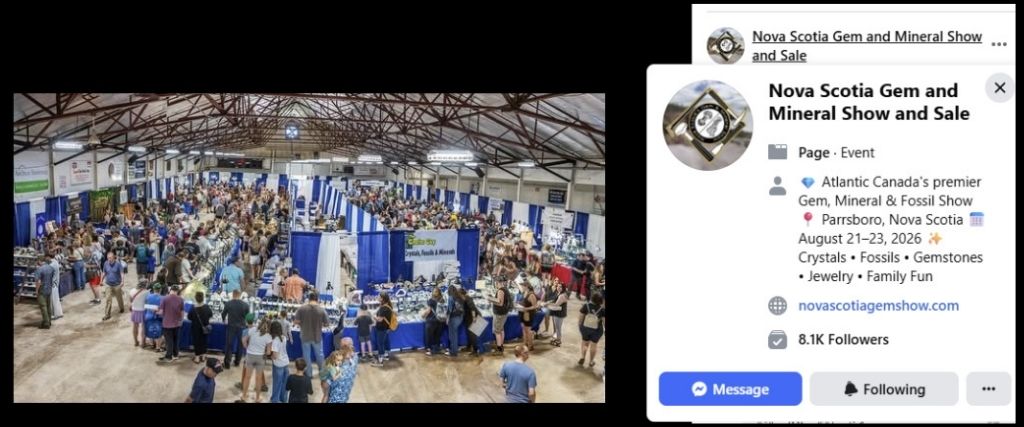
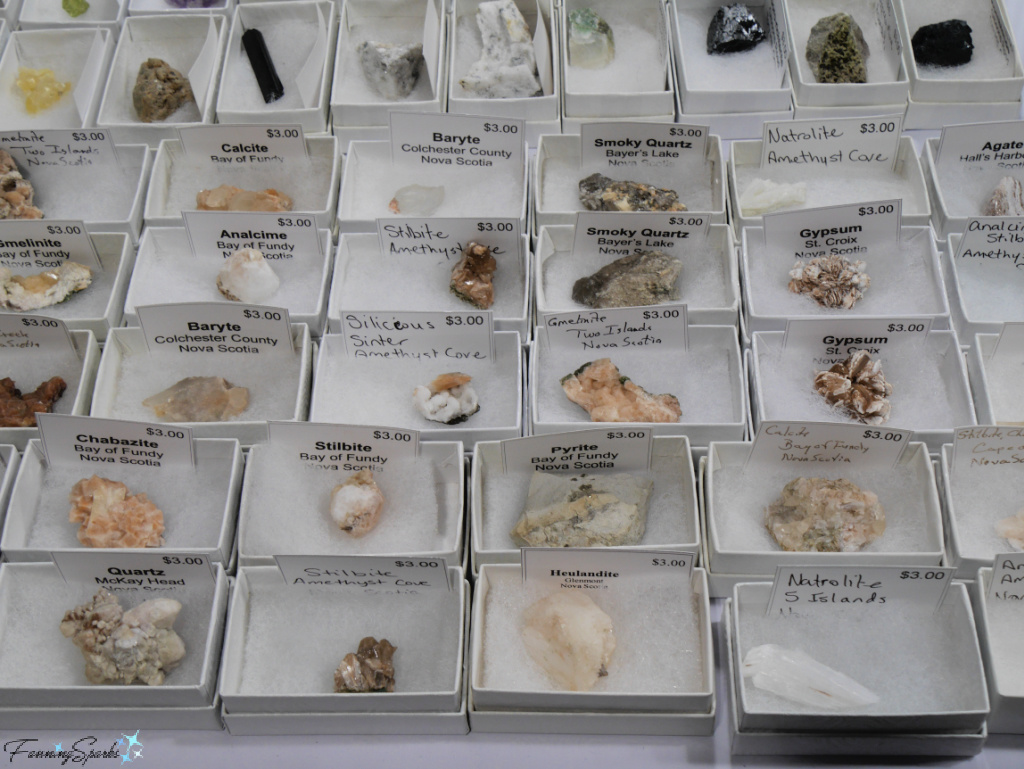
Exhibitors showcased a global selection of unique specimens. Their detailed labels turned the exhibit hall into a hands-on geology classroom.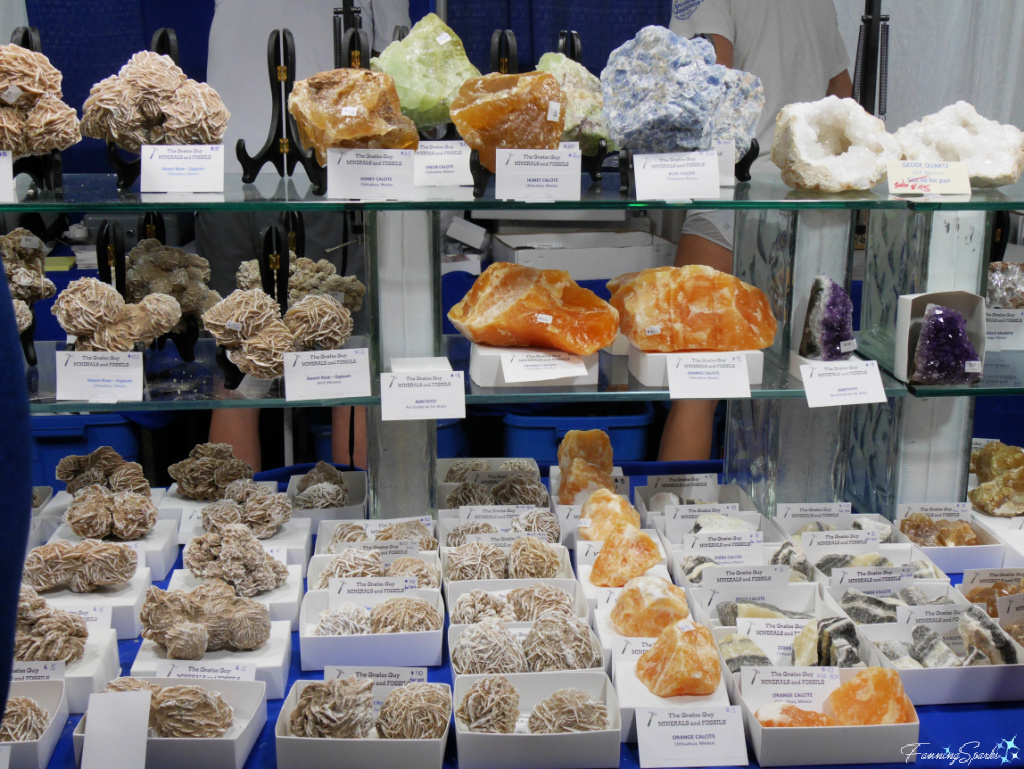
We also visited the outstanding Fundy Geological Museum in Parrsboro. In Frank Johnson’s excellent Wonderful Museums article, Fundy Geological Museum Parrsboro Nova Scotia: Unearthing Ancient Worlds and Tidal Wonders on the Bay of Fundy, he calls it “the definitive interpretive center dedicated to unraveling the profound geological history, significant paleontology, and unique mineralogy of the Bay of Fundy region”.
Johnson describes the mineralogy exhibit as “a dazzling array of local mineral specimens, reflecting the region’s volcanic past”. He writes, “You’ll see stunning examples of agates, amethysts, jaspers, and zeolites – each a testament to the hydrothermal activity that occurred as lava cooled and water percolated through the rocks. The colors and crystalline structures are mesmerizing, demonstrating the incredible artistry of nature itself.” I concur.
Shown below is a section of the Earth’s geological calendar exhibit which outlines evolution from first life to the present age ― from the Precambrian Period 4,600 to 542 million years ago to the current Quaternary Period which started 2½ million years ago.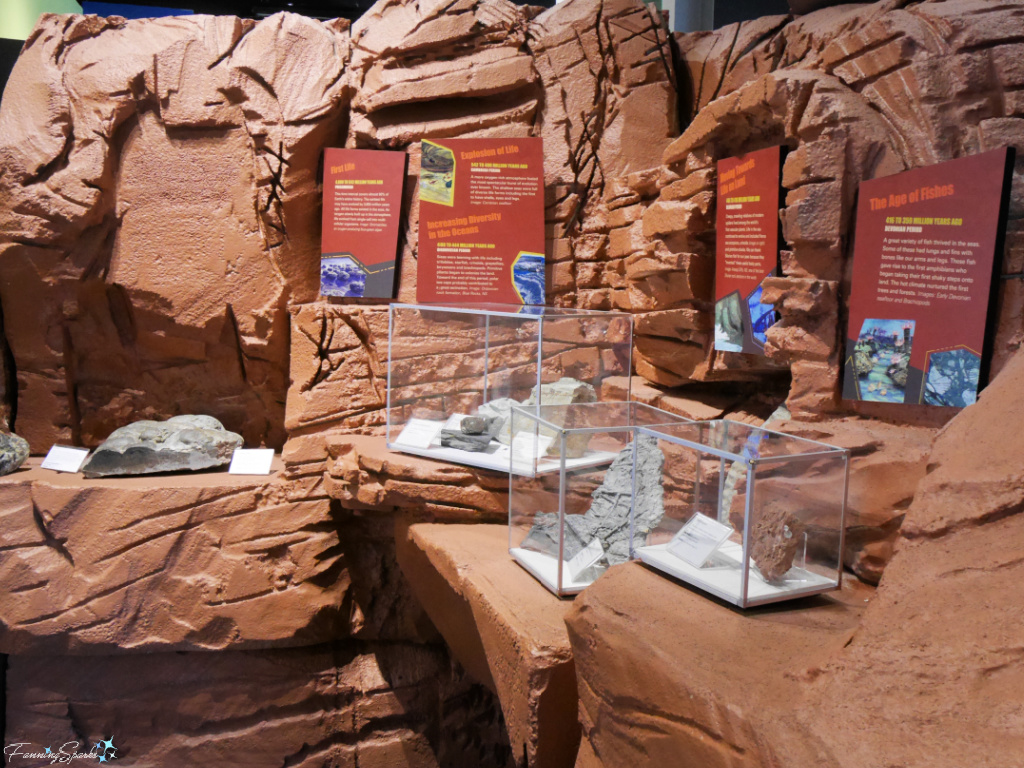
There are a number of fascinating fossils on display including the below Semionotoid fish fossil which was found in Five Islands, Nova Scotia. As noted on the exhibit sign, “they are Early Jurassic in age, about 190 million years ago”.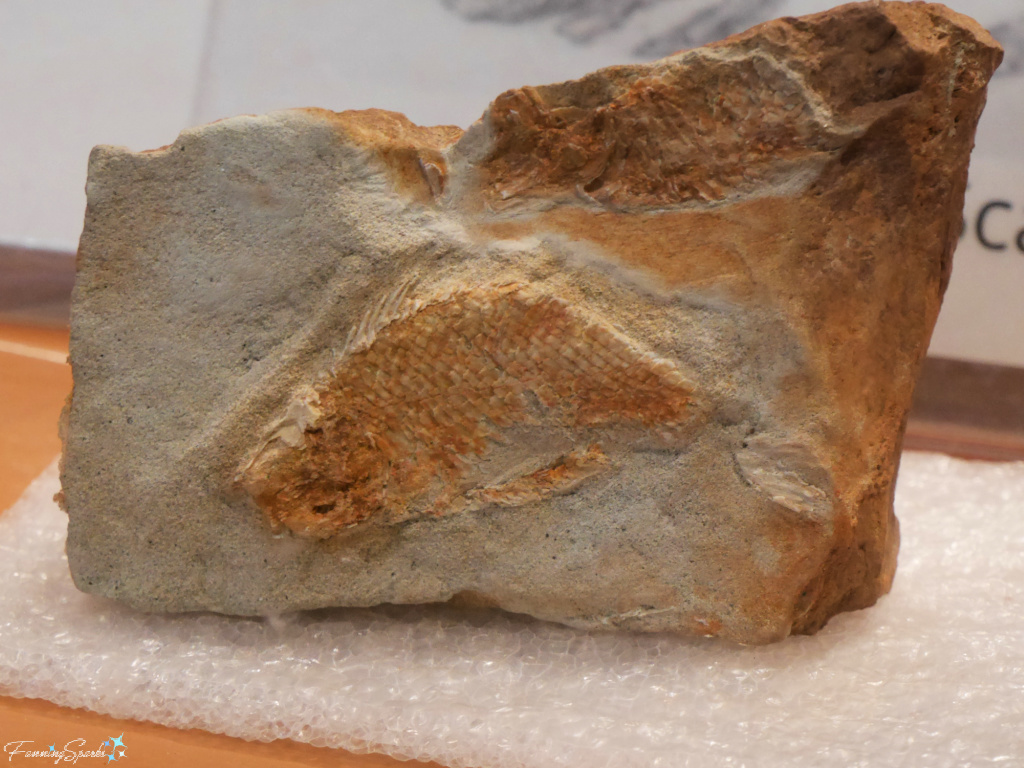
Signs in the mineralogy exhibit reveal that the coastal region around Parrsboro is often called “nature’s jewel box [because] the Fundy shores are lined with agate, jasper, amethyst and delicate zeolite minerals as a result of volcanic activity about 200 million years ago”.
Shown below is a stunning specimen of agate. Agate, by the way, is Nova Scotia’s provincial gemstone. This one originated in the Late Triassic Period, about 200 million years ago, and was found in the Bay of Fundy region.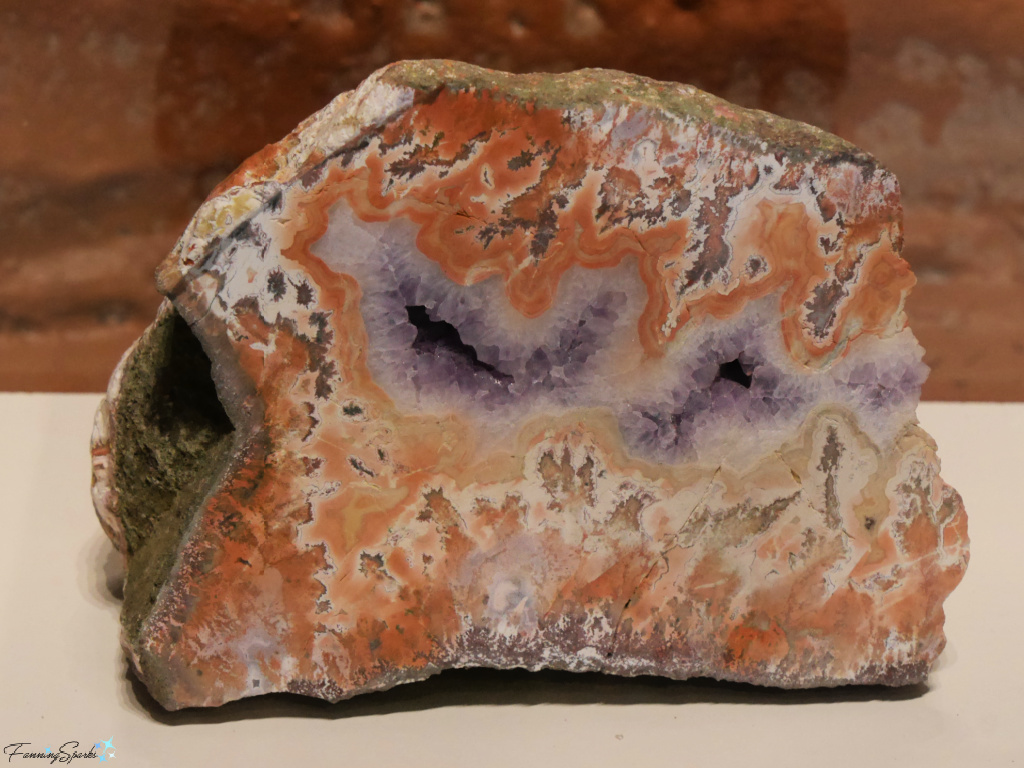
Nova Scotia also has a provincial mineral ― it is stilbite. As explained on the Nova Scotia’s Provincial Symbols section of the Government of Canada’s website, stilbite is a “mineral from the zeolite group … which is widely noted for its beautiful crystals, pleasing colours, and relative abundance”. Interestingly, it is “an excellent natural filter because of its structure and chemically sticky surfaces … [and] has many diverse uses from water softeners and filter components to molecular sponges.”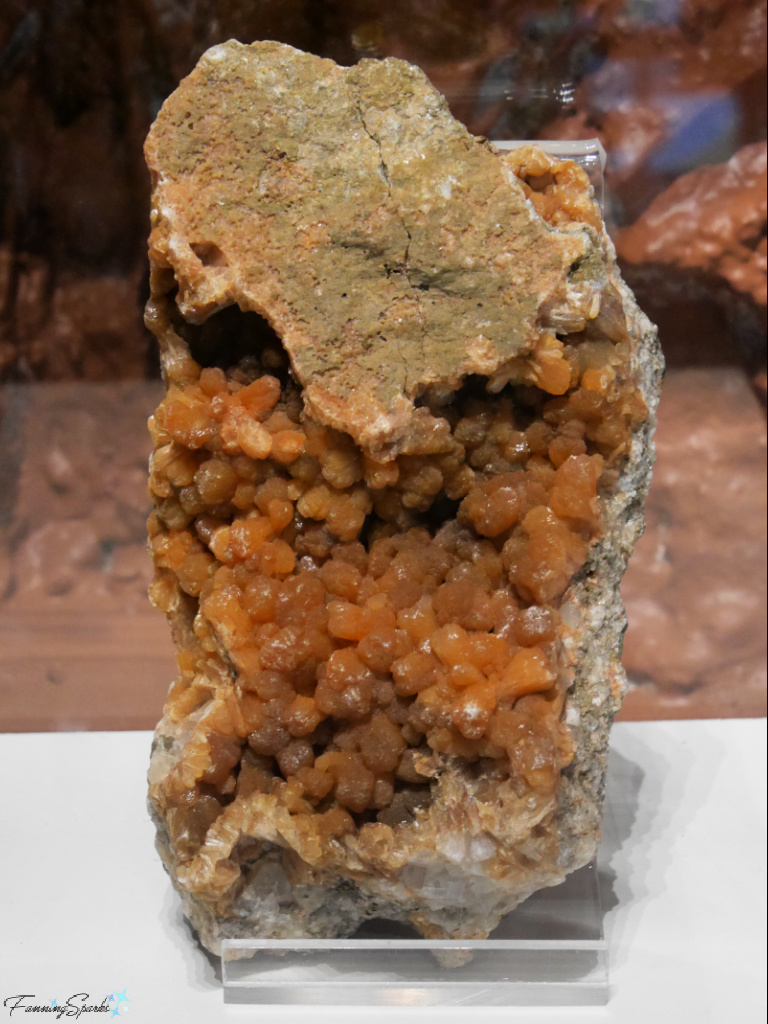
Both agate and stilbite are common in the Jurassic-aged basalt flows around the Bay of Fundy. Their abundance, however, does not mean collecting is a free-for-all for rockhounds. The Fundy Geological Museum posts this warning sign.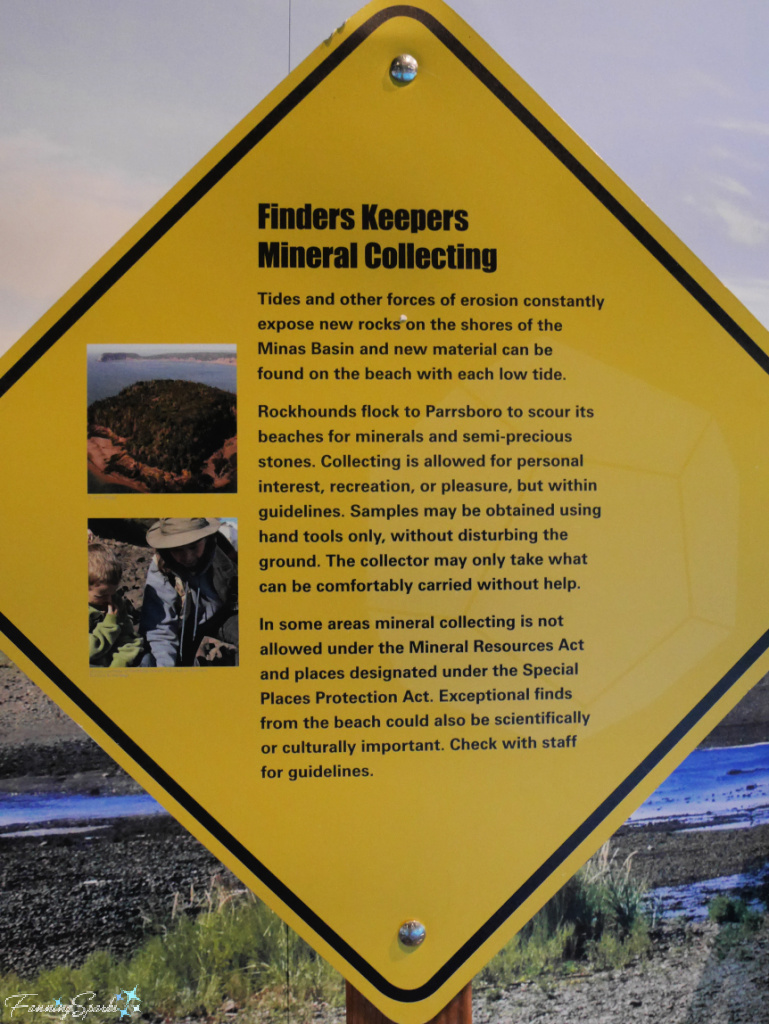
The complete provincial guidelines ― A Guide to Rock and Mineral Collecting in Nova Scotia ― are posted on the Nova Scotia Department of Natural Resources website. “Specific guidelines for recreational rock and mineral collecting” include, for instance,
“. Collecting is done for personal interest, recreation, or pleasure.
. Samples are obtained using hand tools only, with no ground disturbance.
. The amount of material removed from a specific site must not exceed what would be considered easy to carry unassisted by the collector.
. Collecting at a specific site or location is restricted to one day per year.”
Rockhounds and casual collectors must also ensure they have “the necessary permission from the landowner.” Please refer to the official, published document (available here) for the complete, current guidelines.
Now that I’ve dipped my toe into the world of rockhounding, having all these resources at my fingertips makes me feel more than ready to celebrate National Collect Rocks Day in style!
More Info
Previous blog posts mentioned in this blog post include:
. Solid as a Rock
. All Around the Amethyst Cabochon.
Fundy Treasures is a small, local business showcasing the Bay of Fundy. Owner/operators Brian Hebert and Laura Thompson offer guided fossil and gemstones tours as well as a selection of hand-crafted goods. I thoroughly enjoyed the Journey into Gemstones: An Intro to Agates tour ― it was a great way to spend an afternoon and the perfect introduction to rockhounding. Brian generously shared his expertise and skillfully engaged each participant. There’s nothing like a knowledgeable, enthusiastic tour guide to get you hooked on a new hobby! Special thanks to Brian, Laura and my fellow students for making the Journey Into Gemstones tour a top-notch experience! To learn more about Fundy Treasures check out their website or Instagram page.
The Nova Scotia Gem and Mineral Show and Sale is held annually in Parrsboro, Nova Scotia. See their website or Instagram page.
The Fundy Geological Museum is an outstanding resource which is, as Frank Johnson wrote, “the definitive interpretive center dedicated to unraveling the profound geological history, significant paleontology, and unique mineralogy of the Bay of Fundy region”. See the Fundy Geological Museum website or Instagram page for more information.
The following books, websites and articles were consulted in the writing of this blog post:
. Geologic Column: “Collect Rocks Day” Offers Opportunity for Inspiration article by John Copeland on EARTH Magazine website
. Nova Scotia Agate Facebook Group
. Brian Hebert Receives the 2023 Harrell L. Strimple Award for Paleontology article on Fundy Treasures website
. Collect Rocks Day article on National Today website
. Nova Scotia Pebbles Guide, Nova Scotia Minerals and Gems, and Nova Scotia Rocks: Explore Our Geology brochures published by the Atlantic Geoscience Society and available here on their website
. Bedrock, an education resource article, published on the National Geographic website
. Basic Rockhounding and Prospecting book by Garret Romaine
. Fundy Geological Museum Parrsboro Nova Scotia: Unearthing Ancient Worlds and Tidal Wonders on the Bay of Fundy article by Frank Johnson on Wonderful Museums website
. Nova Scotia’s Provincial Symbols article on Government of Canada/ Canadian Heritage website
. A Guide to Rock & Mineral Collecting in Nova Scotia brochure available from the Nova Scotia Department of Natural Resources / Geoscience & Mines Branch website
. various Wikipedia entries.
Today’s Takeaways
1. National Collect Rocks Day is an opportunity “to celebrate Earth and science, to indulge your inner geologist, and to learn fascinating things about the material that makes up Earth’s surface” John Copeland
2. Discover a destination’s history and geology through a guided excursion with a local expert.
3. Consider combining multiple references ― such as hands-on experimentation, knowledgeable guides, museum exhibits, special events, printed reference material and online resources ― to learn about a hobby or interest.

Comments are closed.