
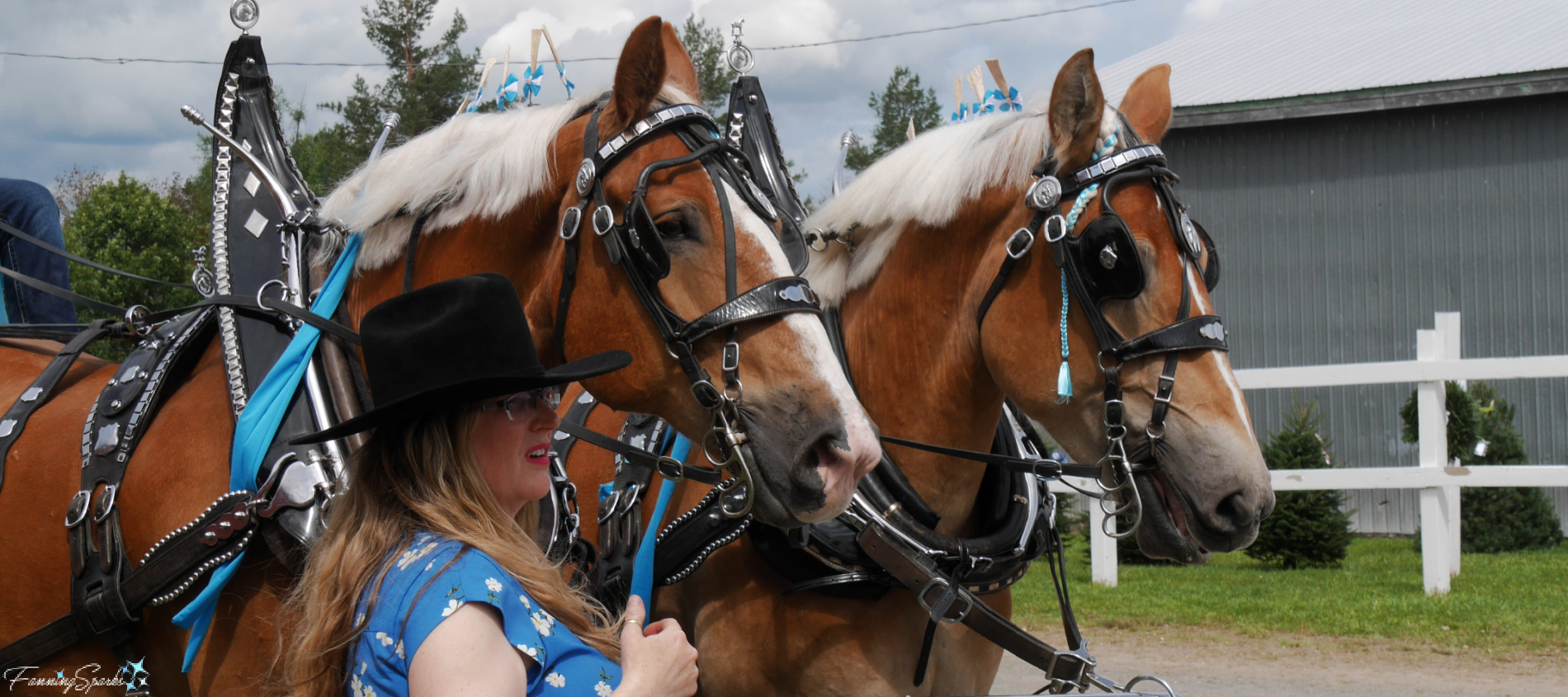
The unseen bond between horse and handler truly comes alive when you see a team of draft horses in motion. I was lucky enough to witness it firsthand at Nova Scotia’s recent exhibitions.
At the Eastern Nova Scotia Exhibition in Antigonish, driver Angela MacIntyre guided her magnificent Belgians through the competition. As shown below, the wagon seat is above and behind the horses meaning the only contact between the driver and the horses is via the lines (reins). She used the lines to communicate her instructions with a quiet, practiced confidence.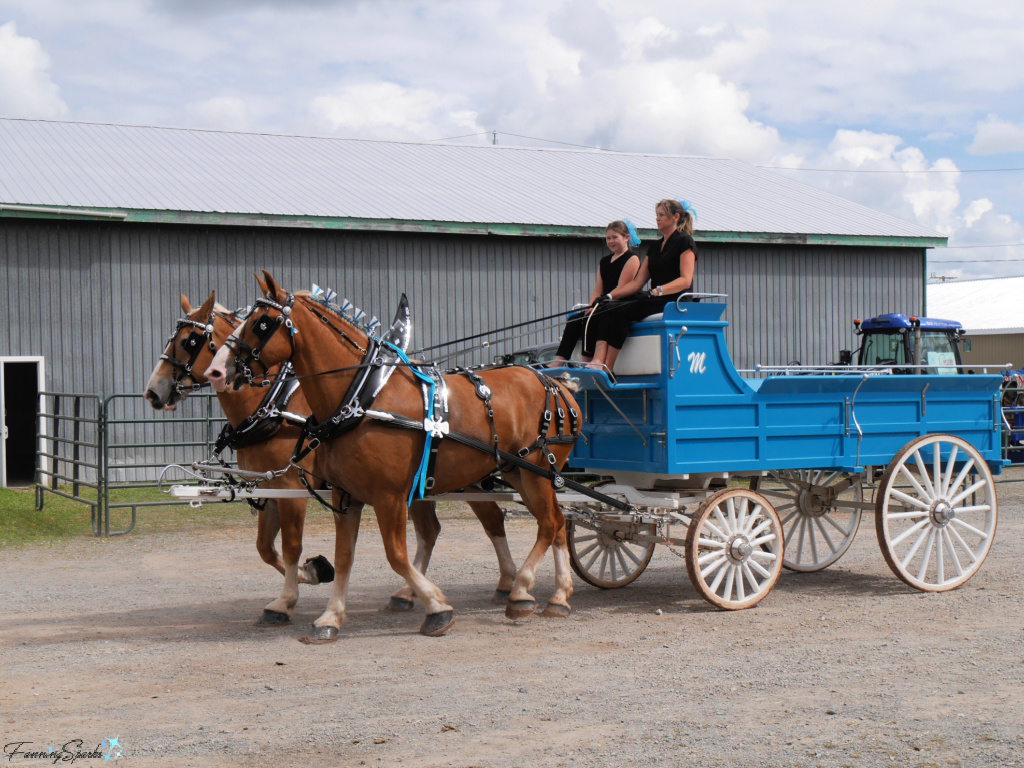 Karen Proust and her splendid Percherons were equally impressive. It takes a strong bond and incredible skill to control that much power with only minute movements of the lines!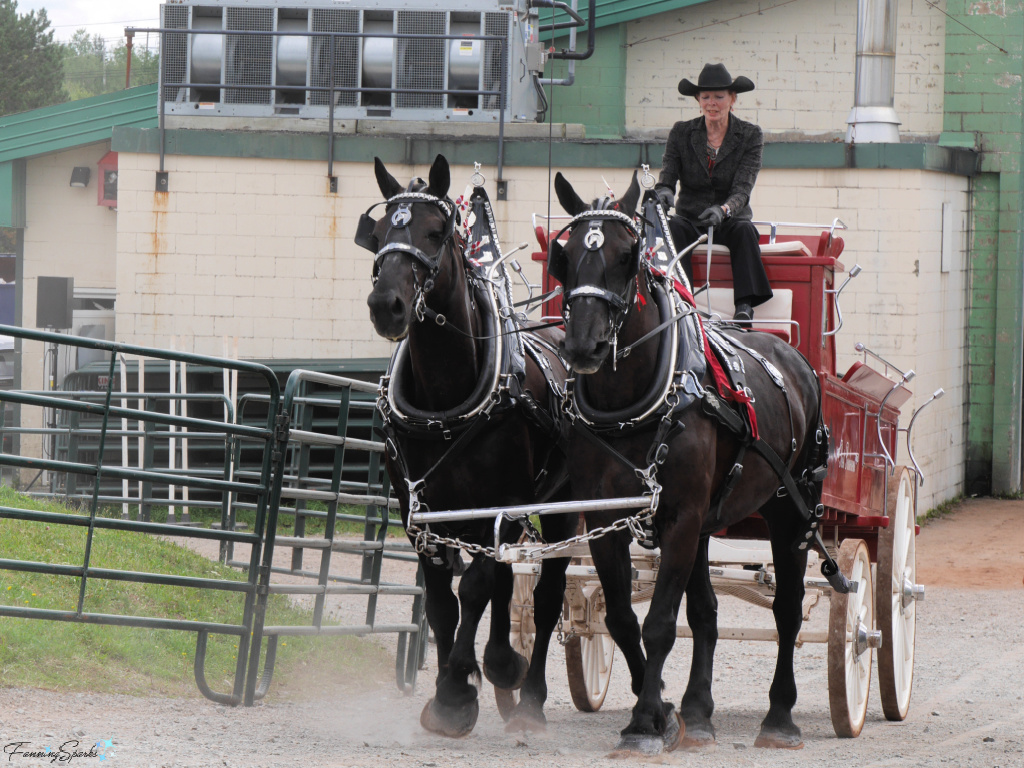
Draft horses, also known as working horses or heavy horses, are the largest and most powerful creatures in the equine world. Sizes vary by breed but the average weight ranges from 640 to 910 kg (1,400 to 2,000 lb) and the average height ranges from 163 to 193 cm (16 – 19 hands high). Note a horse’s height is measured in hands, which is equivalent to 4 inches, from the ground to the top of the withers (the highest part of the back between the shoulders).
Notice how this woman was dwarfed by the handsome horse she was leading.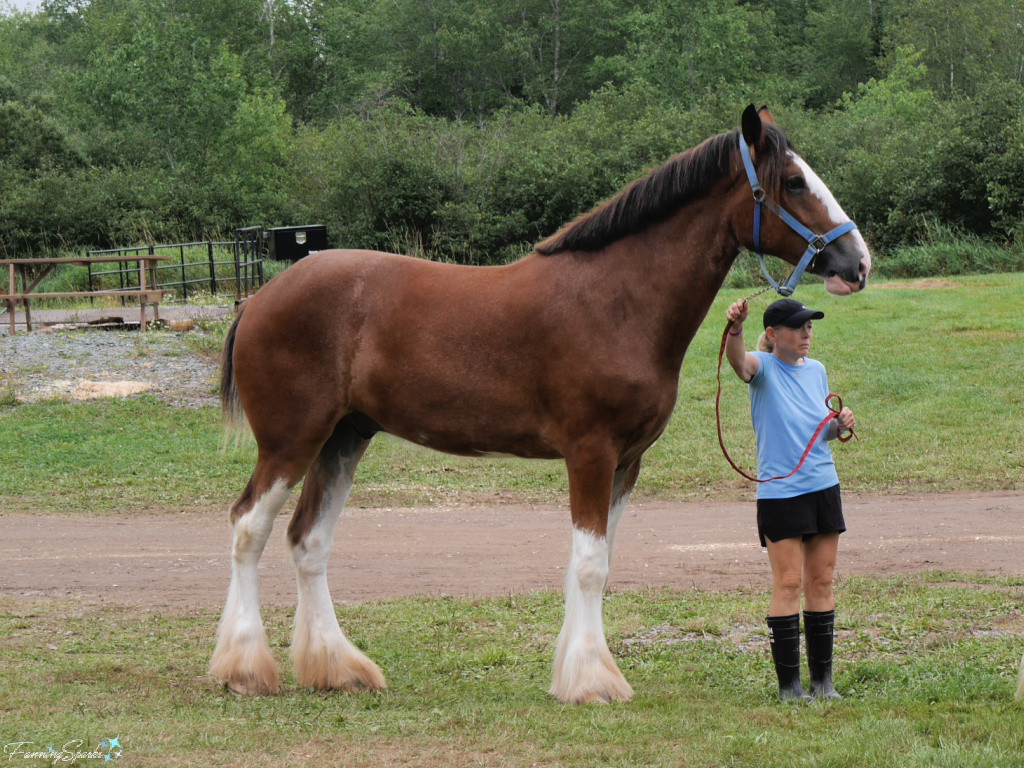
Despite their intimating size, draft horses are known for their calm, steady demeanor earning them the nickname of “gentle giants”. It was amazing to witness how nonchalant these horses were as they were being sprayed with water and lathered with soap in their pre-competition grooming at the recent Halifax County Exhibition in Middle Musquodoboit.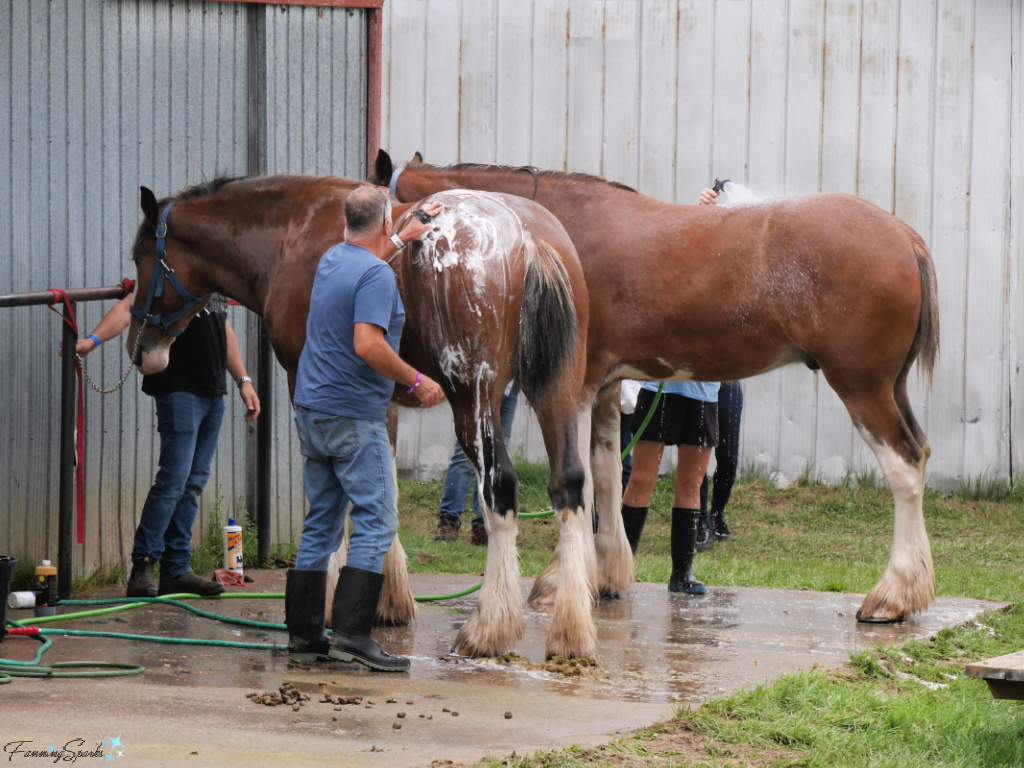
As I understand it, a horse’s legs are typically rather sensitive so having their feathering ― the heavy hair on their lower legs ― shampooed might be alarming for some. It wasn’t for this beauty.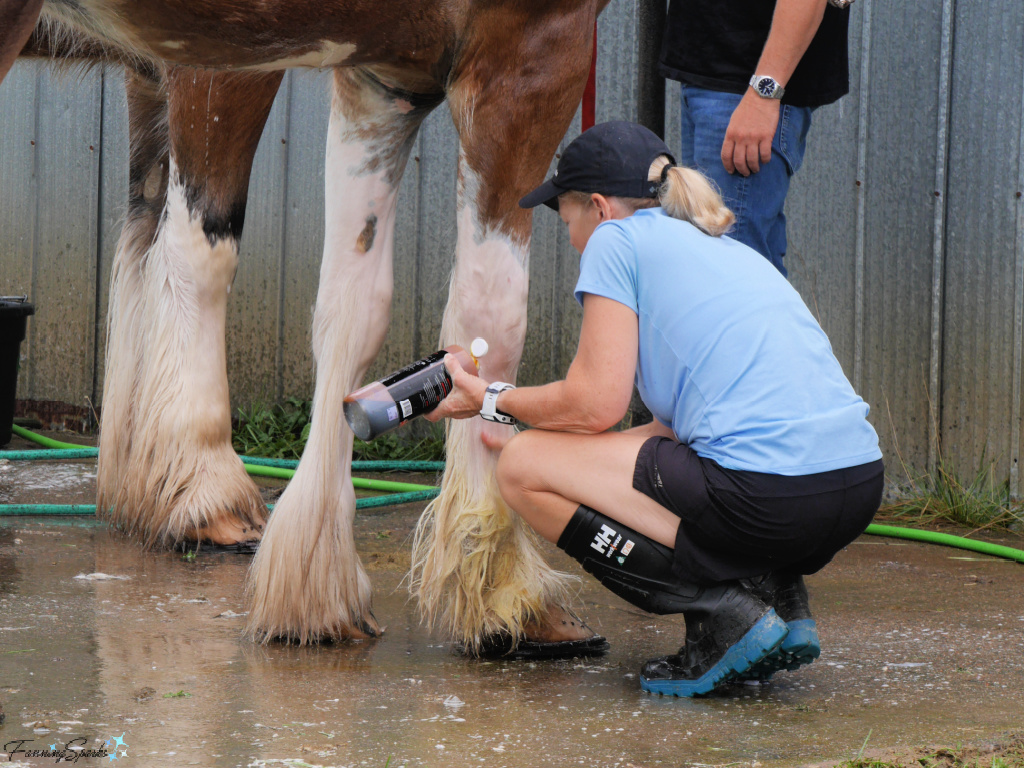
Watching the draft horse competitions at the agricultural exhibitions, brought to mind this old photo of my Dad. It was taken in 1955 or 1956, shortly after he immigrated to Canada from the Netherlands. I wish I’d asked him about his experiences working with those horses before he passed away but, sadly, I never did.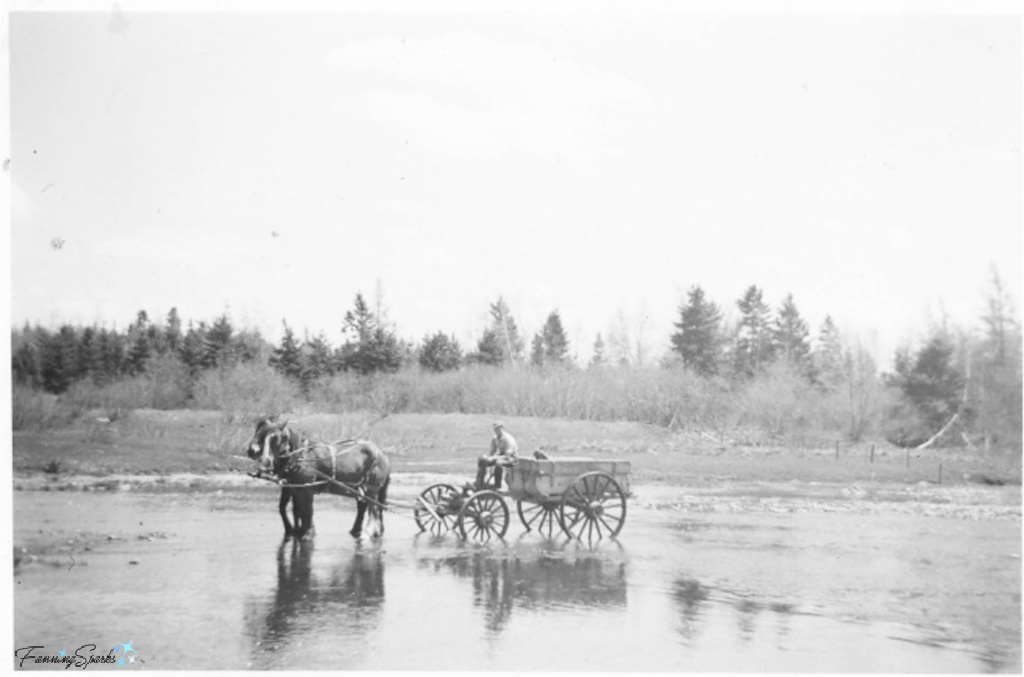
I do know he grew up working with horses on his childhood farm ― they were an integral part of tending the land and growing crops. The below photo was taken about seven years earlier on Zeldenrust (Seldom Rest), the family farm in the Netherlands. My Dad is walking next to a sledge being driven by my Opa (grandfather). Family folklore says they were transporting Brussels sprout foliage – the leaves and stems left behind after the sprouts were harvested ― to be fed to the livestock.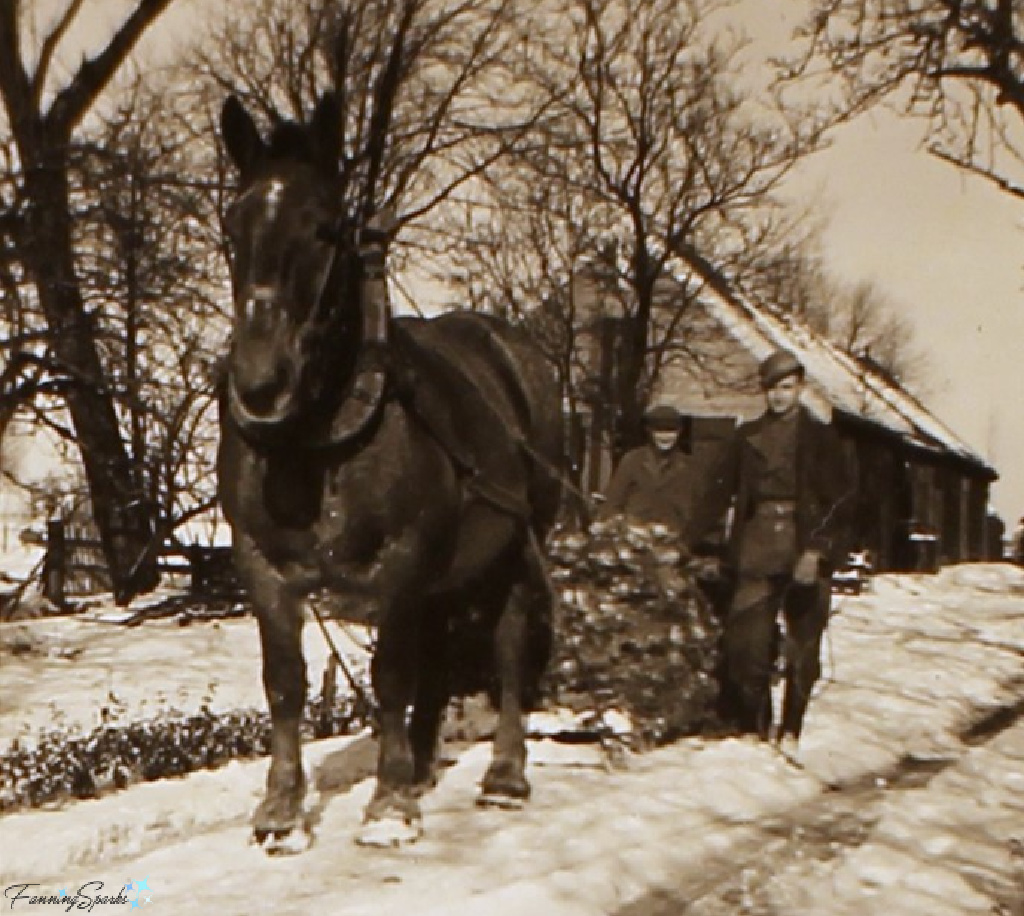
I guess that’s how Dad developed a soft spot for horses – only as working animals, mind you, he never could quite get on board with keeping horses as pets. I suppose that’s also why, decades later, he loved watching draft horse competitions like those I attended recently.
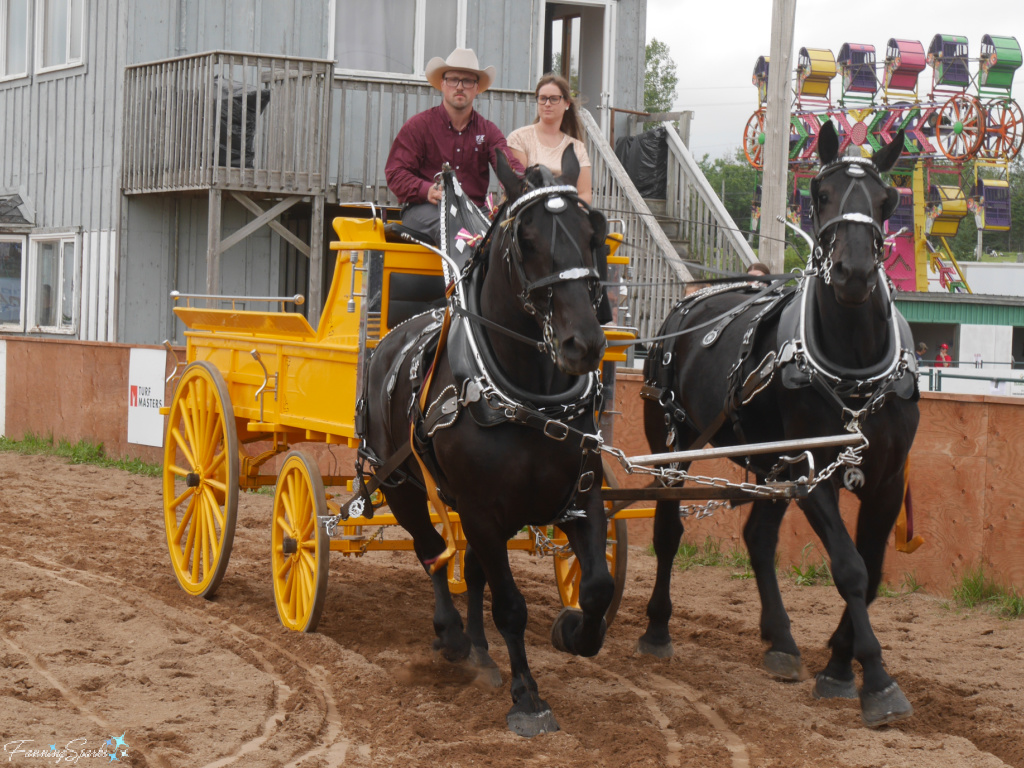
Shown below are competitors in the Draft Horse – Matched Team Heavy Percherons class at the Halifax County Exhibition. Nathan and Sam Smith, from Whirlwind Hill Farm in Stewiacke, Nova Scotia circle the ring.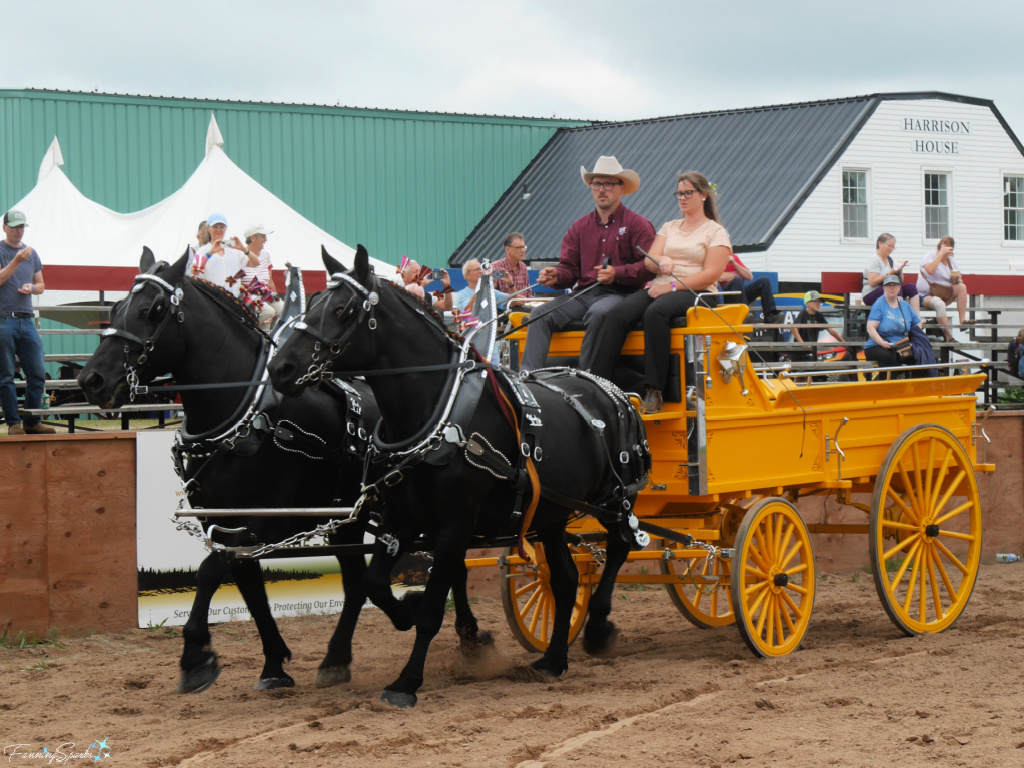
Karen Proust, from Proust Percherons in Wolfville, Nova Scotia, also competed in that class.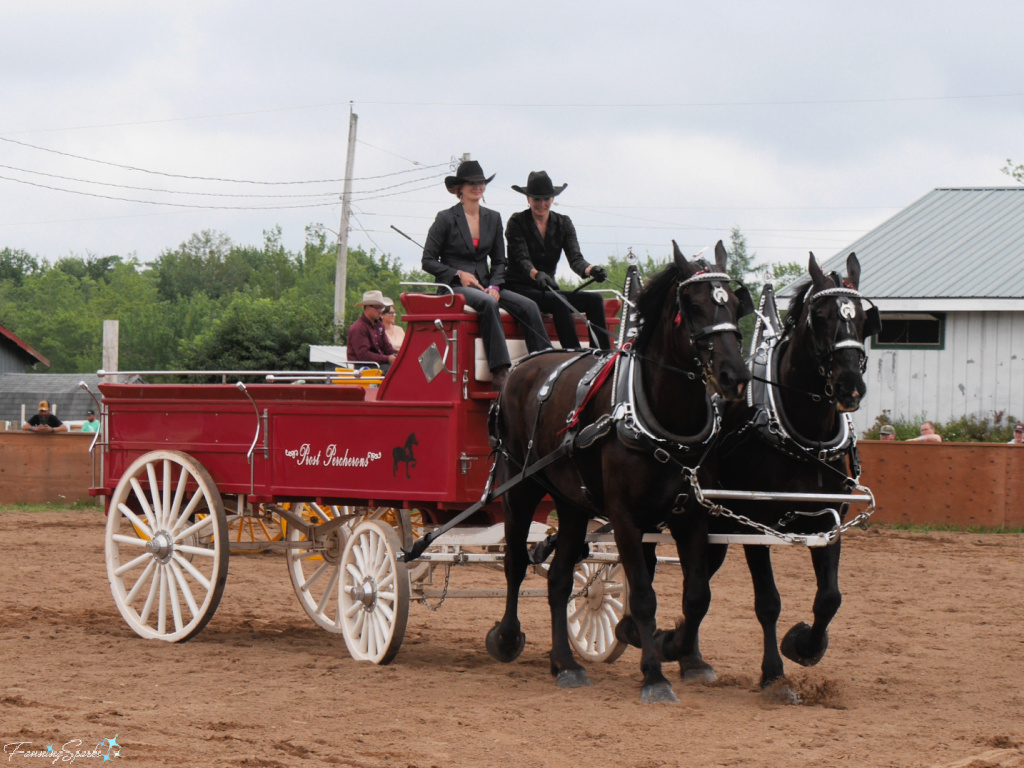
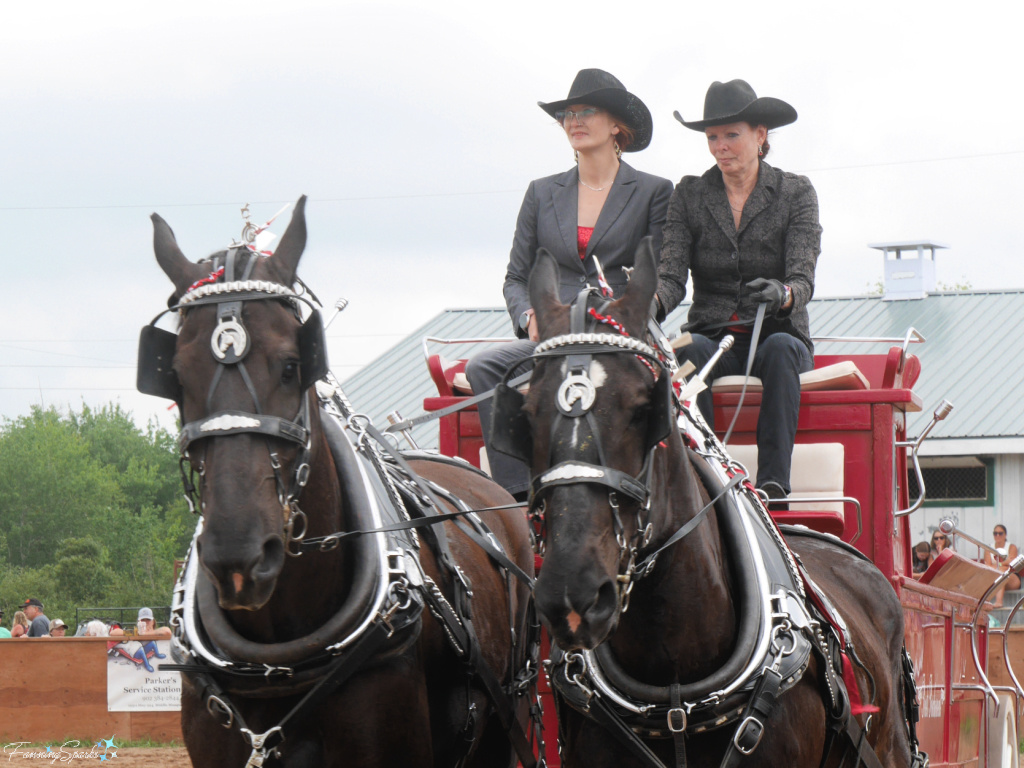
As noted, the above photos were taken during the Draft Horse – Matched Team Heavy Percherons competitive class. Interestingly, there were separate competitive classes for heavy weight vs light weight draft horses. There were also separate classes for Percherons, Belgians, and Clydesdales ― the three most popular draft horse breeds in North America. I did a little research on the three horse breeds and learned that each one has its own unique history, physical and temperamental characteristics, and following of staunch supporters.
Belgians
The country of “Belgium began the rearing of tall, strong, courageous horses for military use in the eleventh century” write authors Sigmund A Lavine and Brigid Casey in their book Wonders of Draft Horses. “The finest specimens came from the Brabant region where the Belgian Heavy Draft was developed.” Subsequently, the Great Horse stallions were exported to other countries to be bred with native mares. “In time, this practice resulted in the development of new types of heavy horses, some of them bred for specific duties”.
Belgians are considered “the ideal draft animal for long, slow, heavy hauling” due to their size, weight, heavy muscles and wide, low-set bodies. They are “extremely gentle, very patient, and most intelligent. Thus, while it takes several years to break most breeds of draft horses to harness, Belgians complete their schooling when quite young”.
In terms of appearance, Belgians can have a variety of coat colours but most have red-brown coats in chestnut, sorrel or blonde with light blonde manes and tails. The Belgian Draft Horse Corporation of America elaborates “Belgians often have white markings on their faces and legs. Some Belgians have a large white stripe on their face called a blaze. White markings on the lower legs include socks and stockings.”
Shown below is a team from MacIntyre’s Belgians, in Savage Harbour, Prince Edward Island, preparing to compete in the Draft Horse – Team Light Belgians class at the Eastern Nova Scotia Exhibition.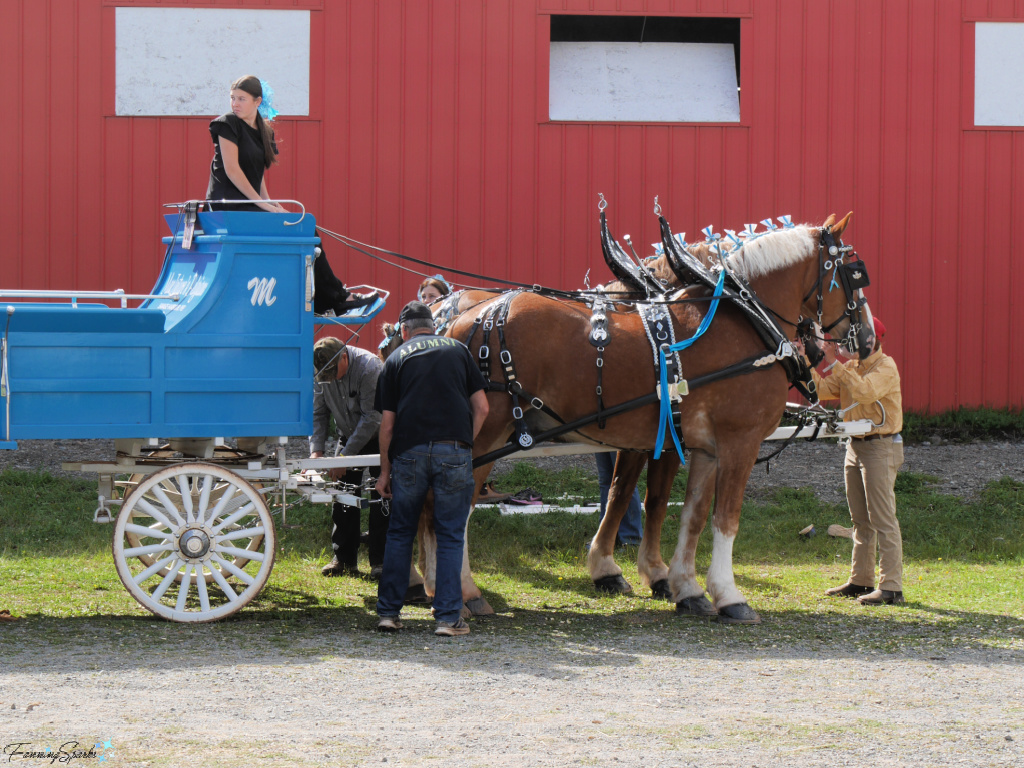
I believe these Belgians are from Whitetail Acres Farm in Edwardsville, Nova Scotia.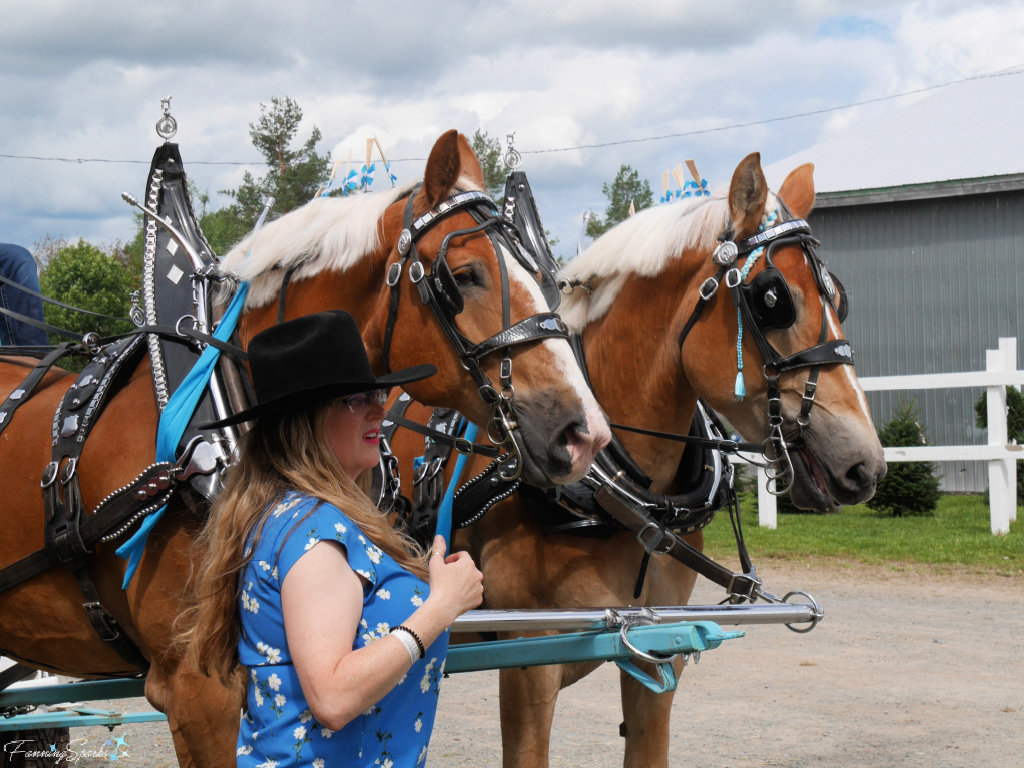 Percherons
In the article, In Praise of the Percheron, author Caitlin MacDonald explains Percherons also have roots as war horses. Their history traces back to France in the former Perche province. The heyday for Percherons in Canada was around the 1930s when “there were three times as many registered Percherons as the other four draft breeds of the time combined”.
“Characteristically solid and sound” MacDonald writes “their immense popularity is explained in anecdotal evidence of the time, with farm owners praising them as very easy keepers in comparison to other breeds, with unrivalled endurance and temperament. Those that used them for urban work preferred the Percheron for its style and elegance”.
The Percherons popularity has waxed and waned over the years. A few years ago, people rediscovered the breed’s versatility and their popularity was on the rise. “The Percheron is still gainfully employed” writes MacDonald, “as an agricultural, transportation, and pleasure horse … they are trainable, calm, friendly, eye catching, easy keepers, and happy workers.”
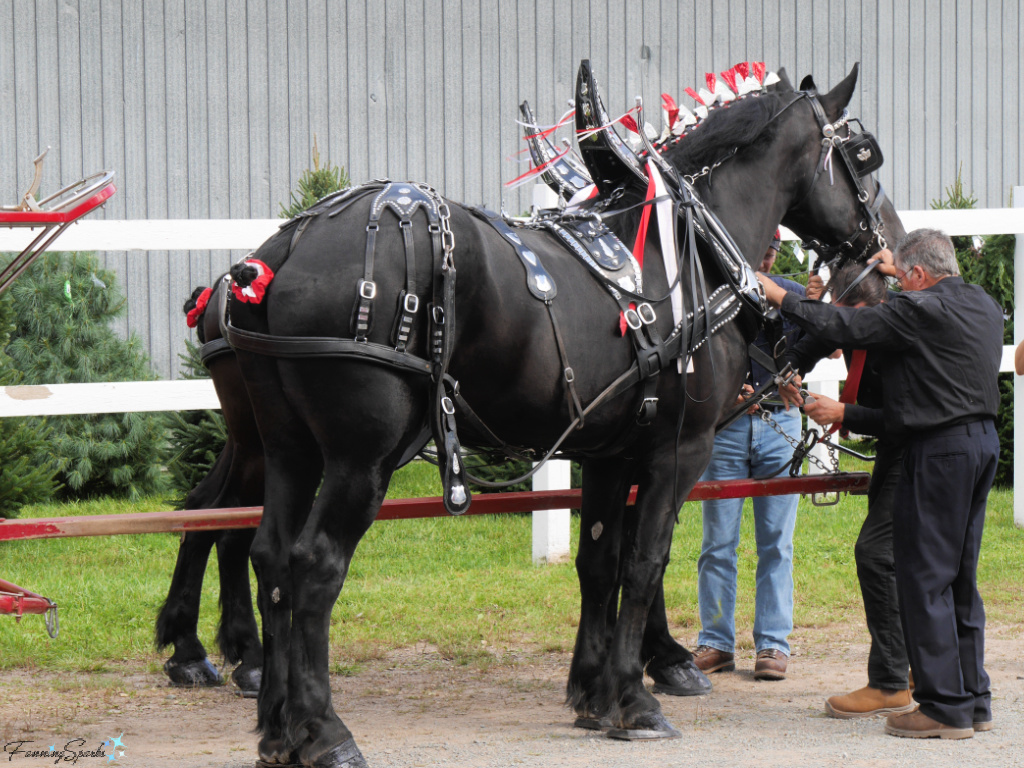
Percherons are “known affectionately as “blacks and greys” [because] these colours are predominant, but sorrel and bay appear occasionally”. The Percherons I had the pleasure to observe were black like these from Giffin’s Percherons in Antigonish, Nova Scotia.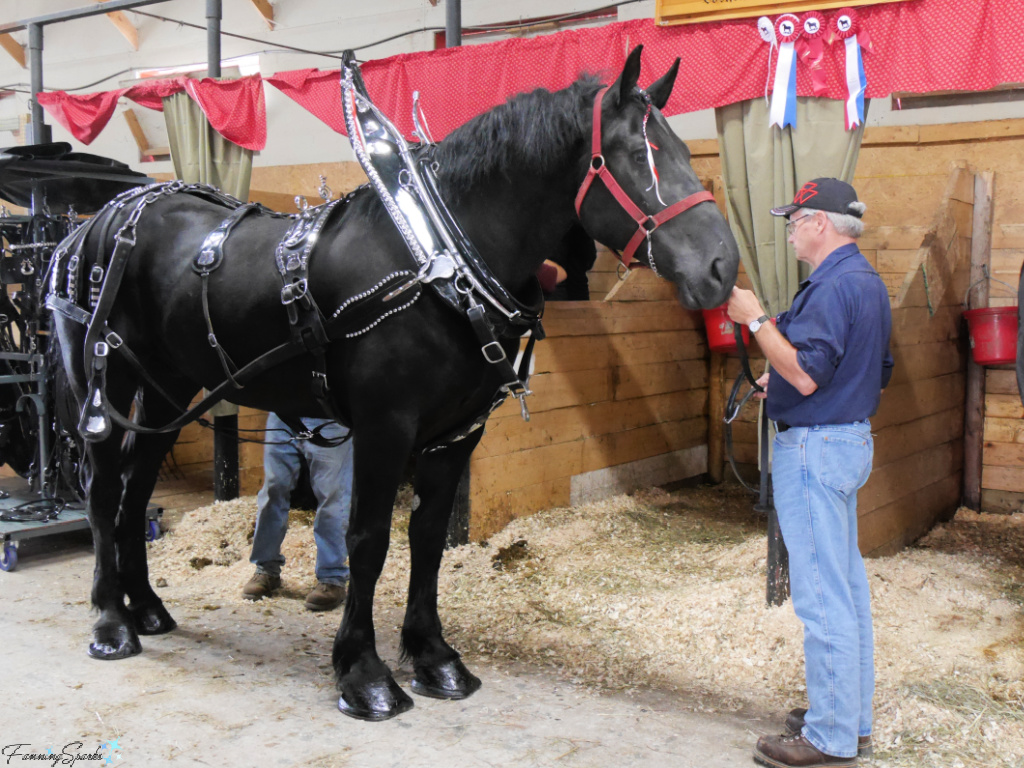
 Clydesdales
Clydesdales are the third draft horse breed featured at the regional exhibitions. Most people recognize these gentle giants as the legendary Budweiser Clydesdales. Anheuser-Busch’s famous eight-horse Clydesdale hitch teams have participated in parades, shows and advertising since 1933 when August A. Busch’s sons gifted him the original Budweiser Clydesdales. Interestingly, the promotional idea and the actual horses and beer wagon came from Shea’s Brewery in Winnipeg, Canada. They were introduced to the American public, under the Budweiser brand, in April of that year to commemorate the repeal of Prohibition.
Clydesdales originate from the Clyde Valley of Lanarkshire, Scotland over 300 years. “The Clydesdale quickly built a reputation as a horse not only of power and ability, but also of style, beauty, intelligence, a willingness to work, and with a personality that made them such a pleasure to work with” writes Margaret Evans in her article The Rich History of the Clydesdale Horse on the Horse Journals website.
“Today, most Clydesdales are bay, brown, or black, with white legs and a blaze. They have straight, silky feathering covering their lower legs and hooves. They stand an average 17 to 18 hands, weighing some 800 to 900 kilograms and are well muscled with an elegant, energetic gait, arched neck, and proud presence.”
Shown below are Clydesdales from Caseydale Farms in Centre Burlington, Nova Scotia.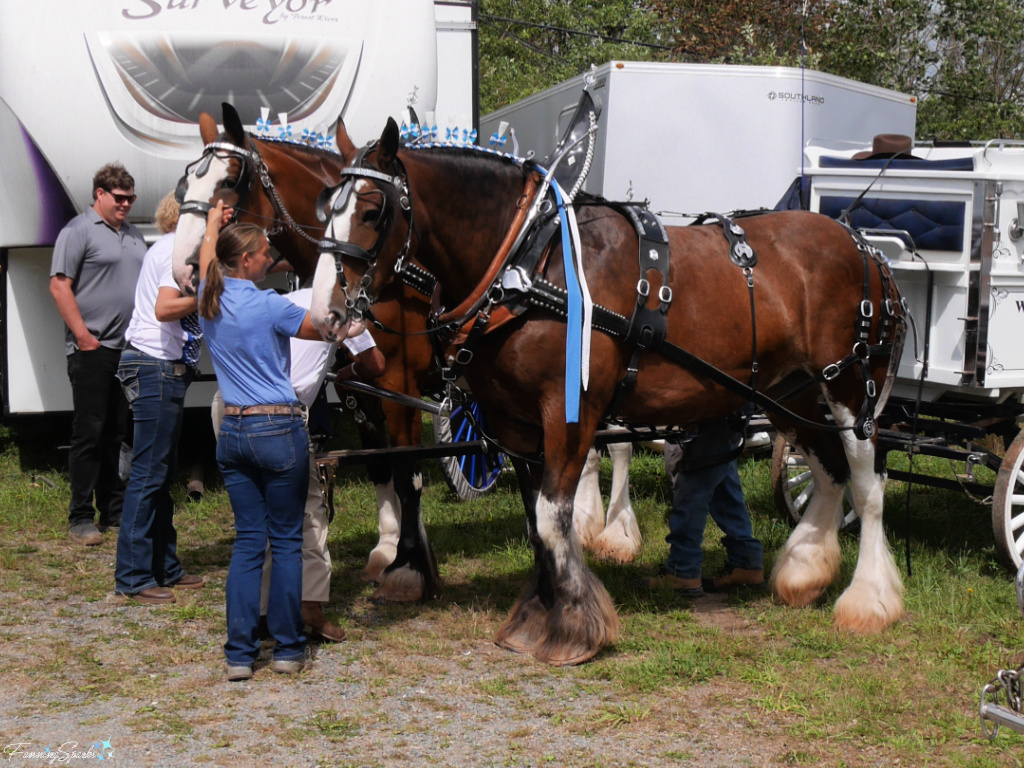
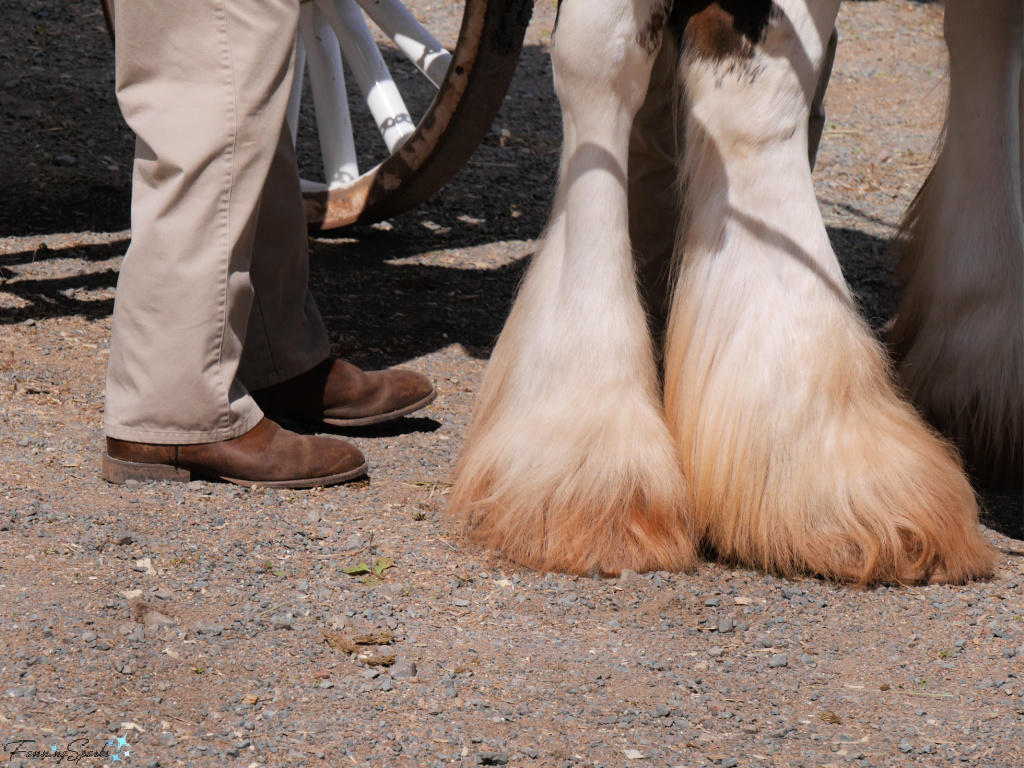
Watching the various teams hitch up for their competitions was fascinating ― from final grooming to harnessing to hitching ― it was non-stop action! There’s a great article on the Horse Nation website titled A Draft Horse Show Day, Deconstructed written by Kristen Kovatch in which she “unpacks a recent draft horse hitch show day for a behind-the-scenes look”. The author shares some interesting insight into many of the things I observed.
For instance, most of the draft horses I saw had elaborately styled manes topped with jaunty, colorful, ribbon flowers. Kovatch explained that to create this festive look, owners twist sections of mane with long, brightly-colored ribbons or bands of fabric to make a “mane roll”. Then, after the horses are hitched up, they insert matching rosettes (also called “mane flights”) into the mane. The mane roll and rosettes serve to accentuate the horse’s neck making it look longer, cleaner and more elegantly arched. They also help a team of horses look more matched while showcasing the stable’s colours.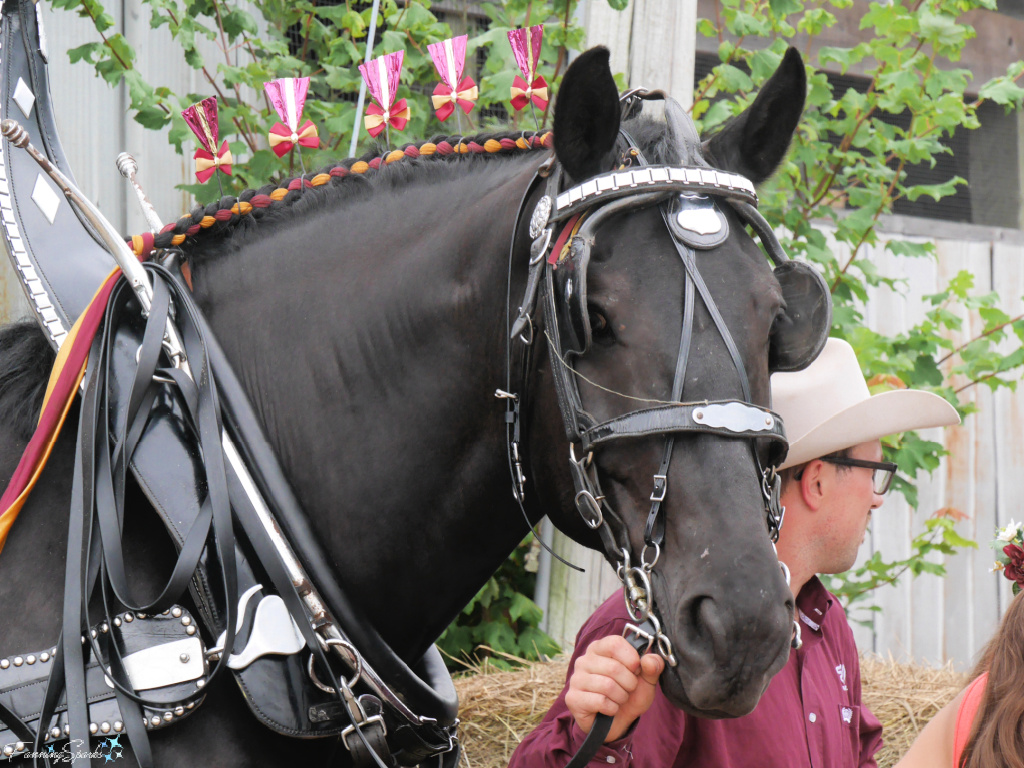
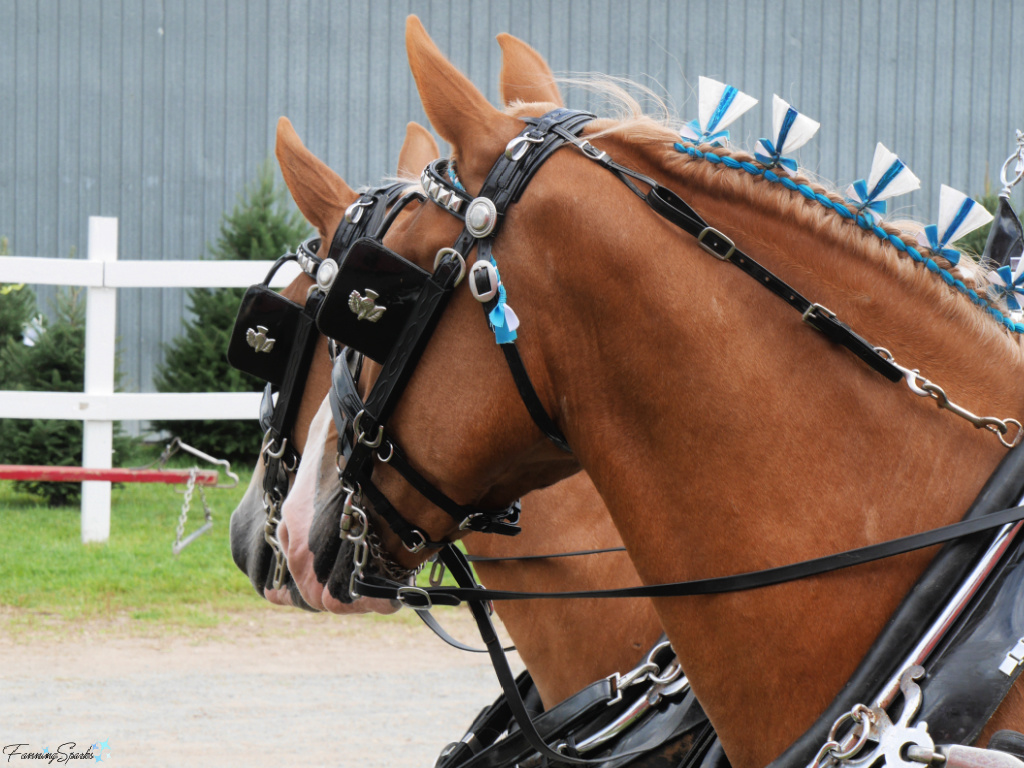
Kovatch explained that preparing the hitch for the show ring is a complex process requiring several people. First each individual horse is harnessed ― usually while standing in the barn or tied up. Kovatch writes “The show harness is intricate … so I pass him the harness in sections: collar, polished hames, backpad and belly band, tugs, martingale, britchen assembly”. Then the horses are walked to the yard for hitching.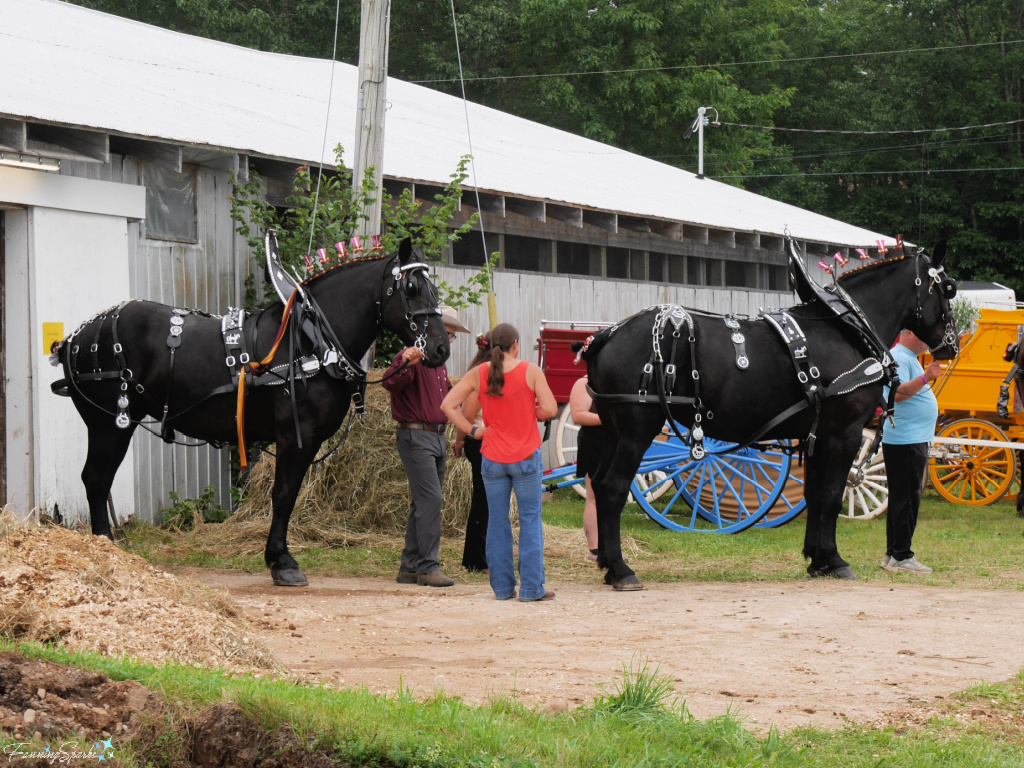 “The process of hooking up” explains Kovatch, “is one of the most dangerous parts of driving draft horses, especially in a high-energy environment like the outside of the show ring”. The horses are walked over to the wagon and backed into position. Kovatch goes on to the describe physically hooking their gear ― one person “shimmies up onto the driver’s bench to take the lines while” two men “get the massive and heavy tongue clipped in to the horses’ martingales, then drop the tugs and chains to anchor to the eveners as I hold the [horses’] heads for added security”.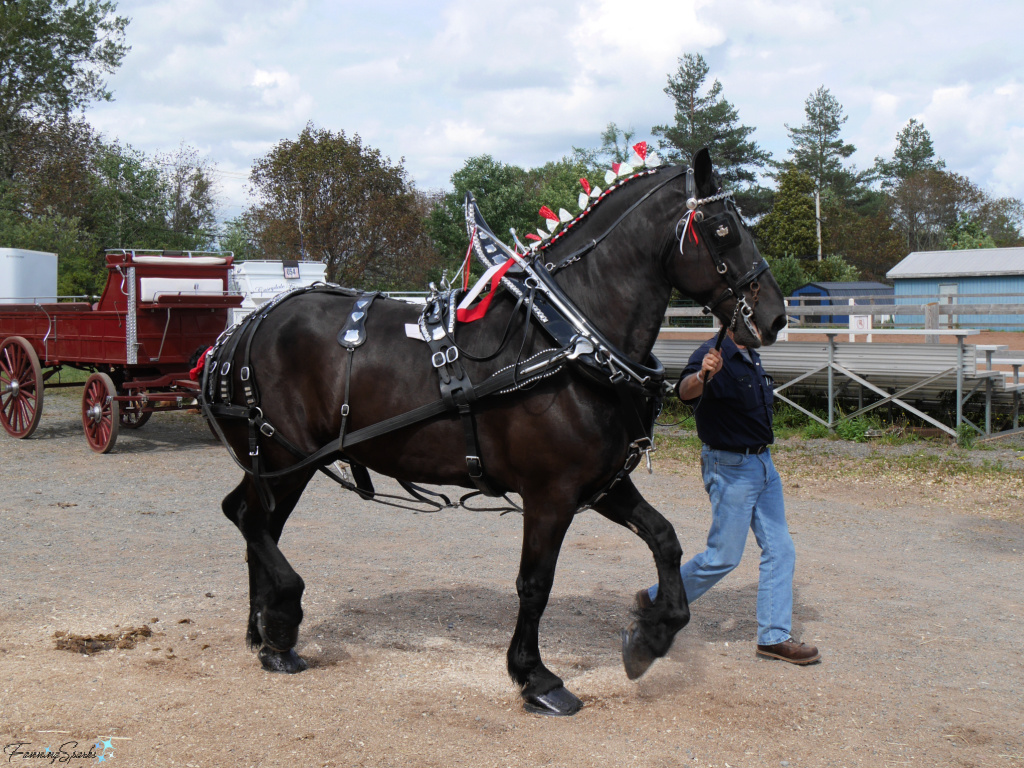
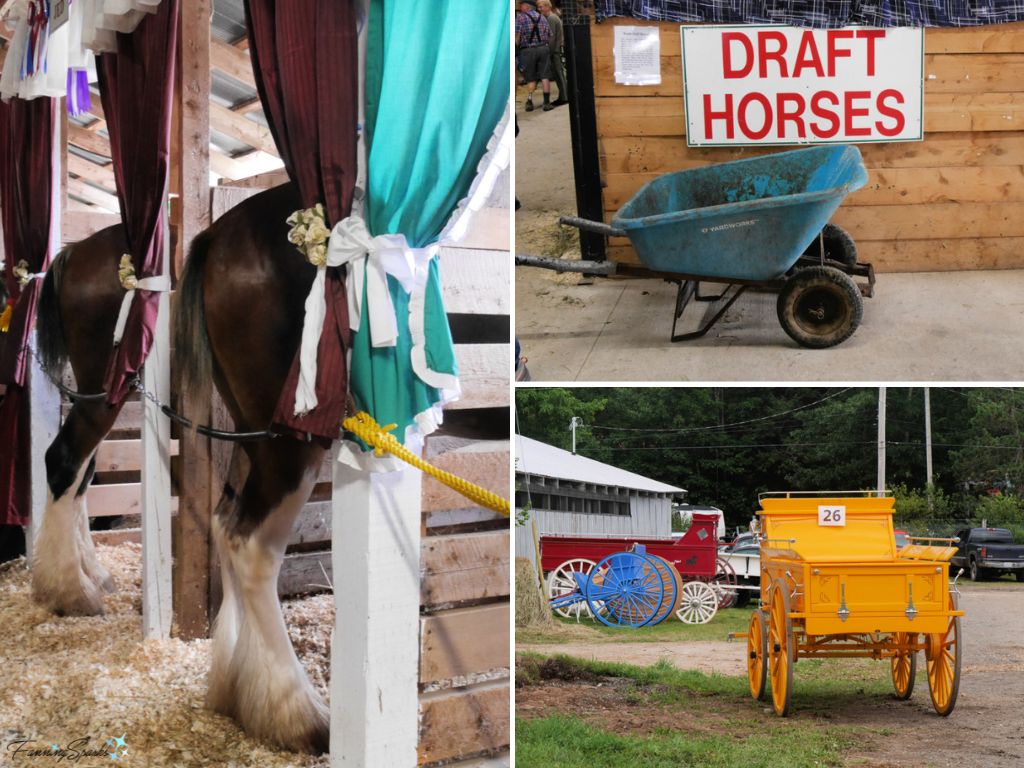
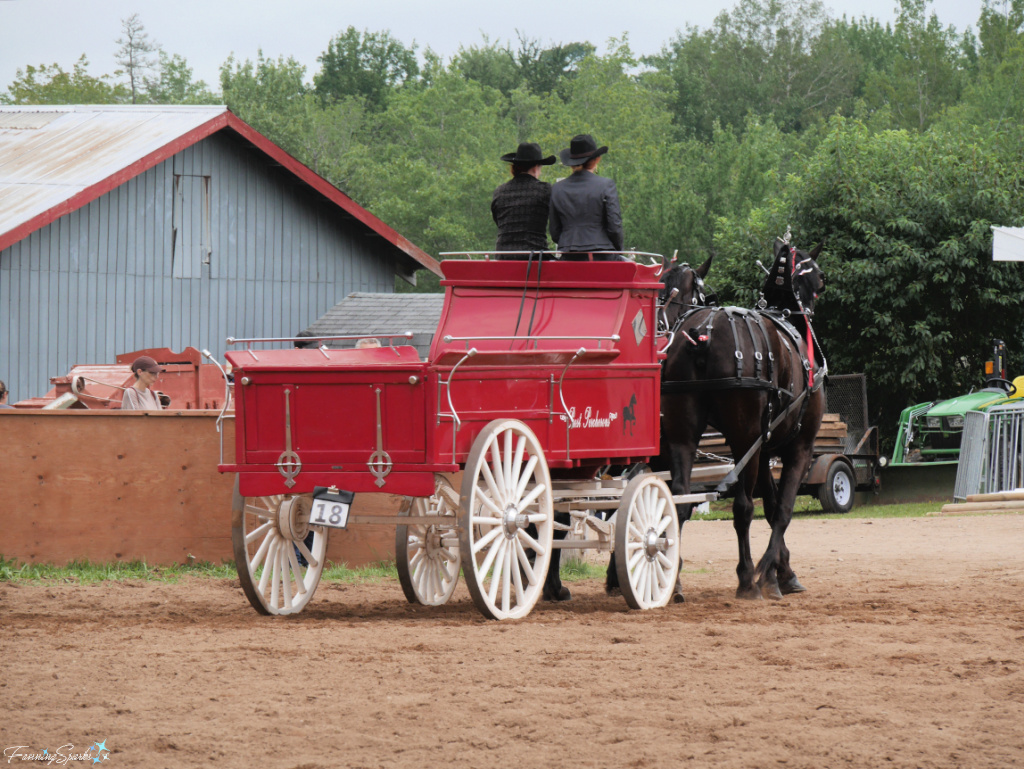
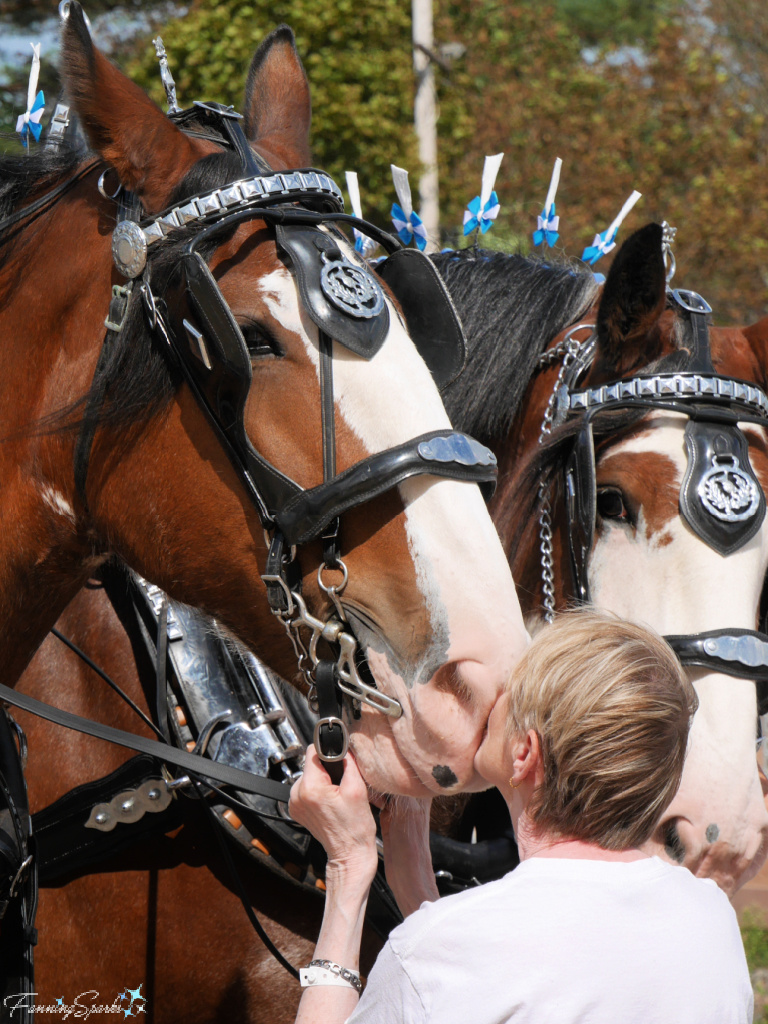 Here are a few more random snaps from the recent draft horse competitions at the Halifax County and Eastern Nova Scotia exhibitions.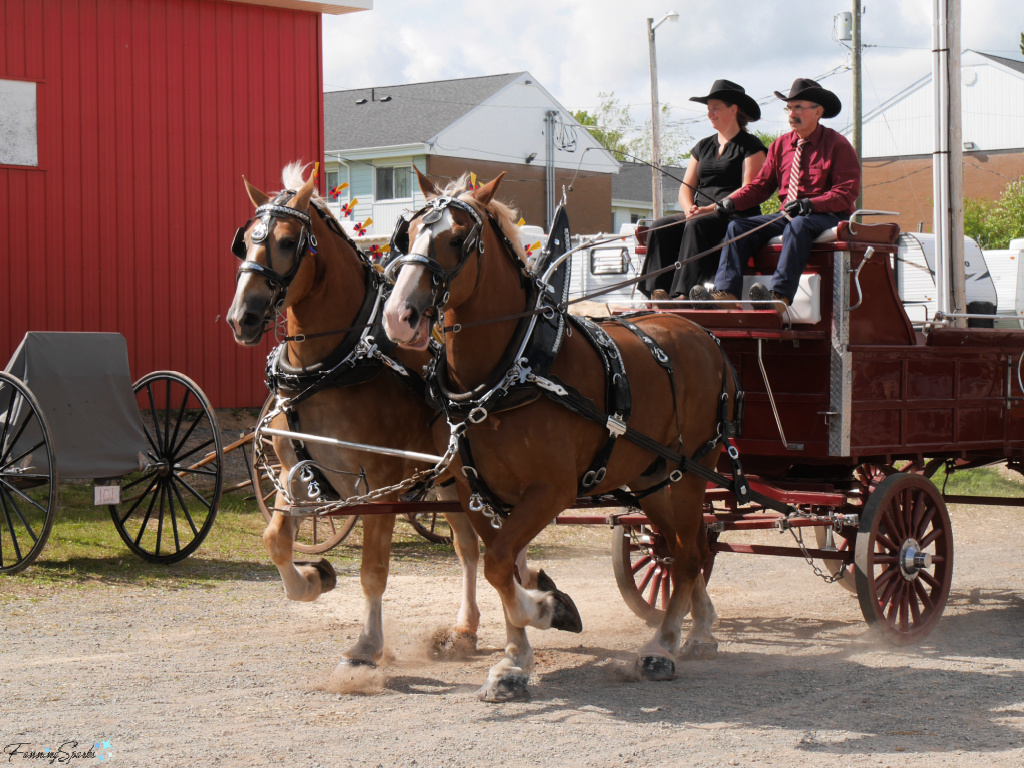
I’ll share one final photo. It’s a favorite because it captures a last-minute adjustment before the team heads to the ring ― the horses are hitched, the driver holds the lines in anticipation, and a man stands on a stepstool to insert rosettes into the horses’ manes.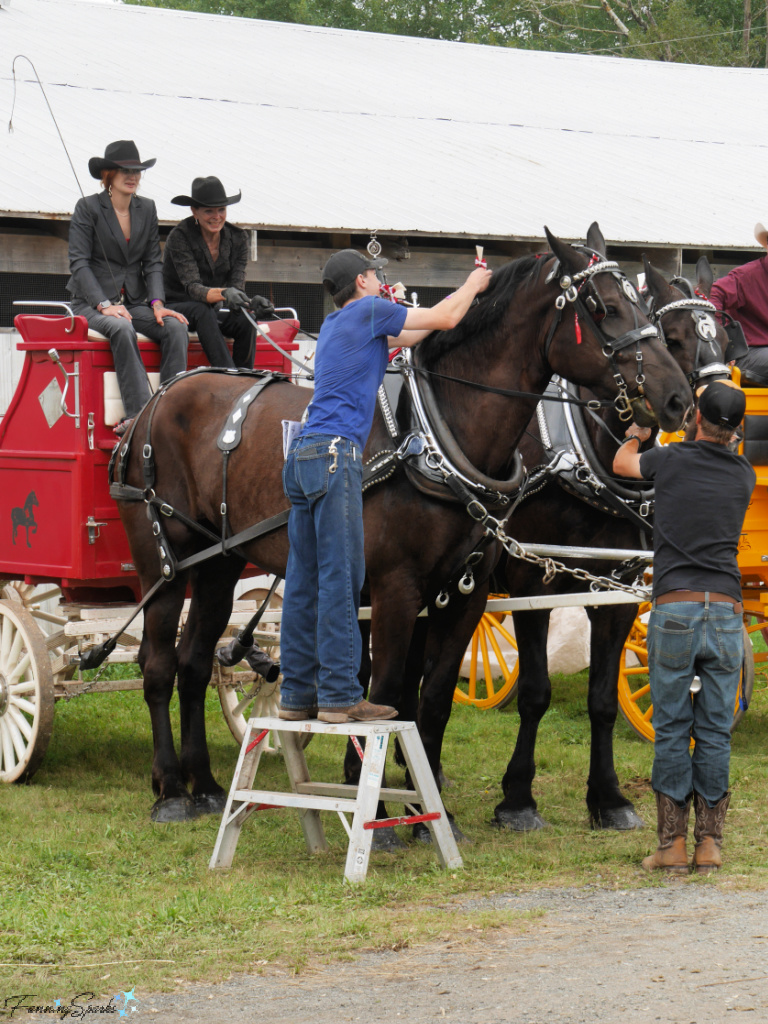
More Info
The Halifax County Exhibition is held in the small, rural community of Middle Musquodoboit in Nova Scotia, Canada. I’ve also written about this exhibition in a previous blog post ― see Strong as an Ox. The Eastern Nova Scotia Exhibition is held in Antigonish, Nova Scotia.
Both of these annual summertime events have a long tradition of celebrating agriculture, community and rural life. If you’re interested in an authentic, country-life experience, be sure to check out one of Nova Scotia’s annual agricultural fairs. You can learn more on the Halifax County Exhibition website and Eastern Nova Scotia Exhibition website. Or you can find the schedule and locations for all Nova Scotia’s exhibitions and fairs, here on the Exhibition Association of Nova Scotia website.
I’d like to recognize and acknowledge the tremendous effort ― in time and funds ― invested by the folks competing in these exhibitions. Thank you for sharing your passions with the rest of us! These are the draft horse competitors I photographed and mentioned in this blog post:
. MacIntyre’s Belgians and Angela MacIntyre from Savage Harbour, Prince Edward Island
. Proust Percherons and Karen Proust from Wolfville, Nova Scotia
. Whirlwind Hill Farm, Nathan and Sam Smith from Stewiacke, Nova Scotia
. Whitetail Acres Farm, Shannon and Jordan Peters from Edwardsville, Nova Scotia
. Giffin’s Percherons, Wade and Tyrell Giffin from Antigonish, Nova Scotia
. Caseydale Farms, Brian and Chris Casey from Centre Burlington, Nova Scotia.
Despite my best efforts, I wasn’t able to identify everyone pictured. I apologize to anyone I missed or identified incorrectly. Please contact me with any clarifications ― I’ll be happy to update the blog post accordingly.
The following articles, websites and books were consulted in the writing of this blog post:
. Wonders of Draft Horses book by Sigmund A Lavine and Brigid Casey which is available here on Internet Archives
. Belgian Draft Horse Corporation of America website
. In Praise of the Percheron article by Caitlin MacDonald; Published March 2019 on Horse Journals website
. The Rich History of the Clydesdale Horse article by Margaret Evans; Updated June 2024 on Horse Journals website
. A Draft Horse Show Day, Deconstructed article by Kristen Kovatch; Published August 2016 on Horse Nation website
. Horse-Story in the Making: The Budweiser Clydesdales article on Anheuser-Busch website
. Draft Horse Breed Guide: Characteristics, Health & Nutrition article by Caroline Cochran; Updated July 2026 on Mad Barn website
. Various Wikipedia entries.
Today’s Takeaways
1. Draft horses, also known as working horses or heavy horses, are the largest and most powerful creatures in the equine world.
2. Despite their intimating size, draft horses are known for their calm, steady demeanor earning them the nickname of “gentle giants”.
3. Percherons, Belgians, and Clydesdales ― the three most popular draft horse breeds in North America ― each have their own unique history, physical and temperamental characteristics, and following of staunch supporters.