
At its most basic, coiled rope is a length of cordage wound in a spiral or sequence of rings. In the nautical context, coiling rope is an important part of keeping a vessel’s essential rope and cordage, eg sheets, halyards and cables, “at all times ready for use and free to run”. This expert advice is offered by author Hervey Garrett Smith in his classic book The Arts of the Sailor: Knotting, Splicing and Ropework.
In a chapter on Belaying, Coiling and Stowing, Smith emphasizes the criticality of “orderliness-the habit of keeping things in their proper places and maintaining them in a shipshape condition, ready for use whenever needed.” He elaborates “one of the commonest causes of trouble is loose gear strewn about the deck, ready to trip the unwary and getting a-foul of everything that moves, and rope is the most serious offender”. Then he explains the fundamental procedures for the proper management of rope.
A tour of the Bluenose II, Nova Scotia’s iconic racing schooner, showcases the orderliness Smith expounds.
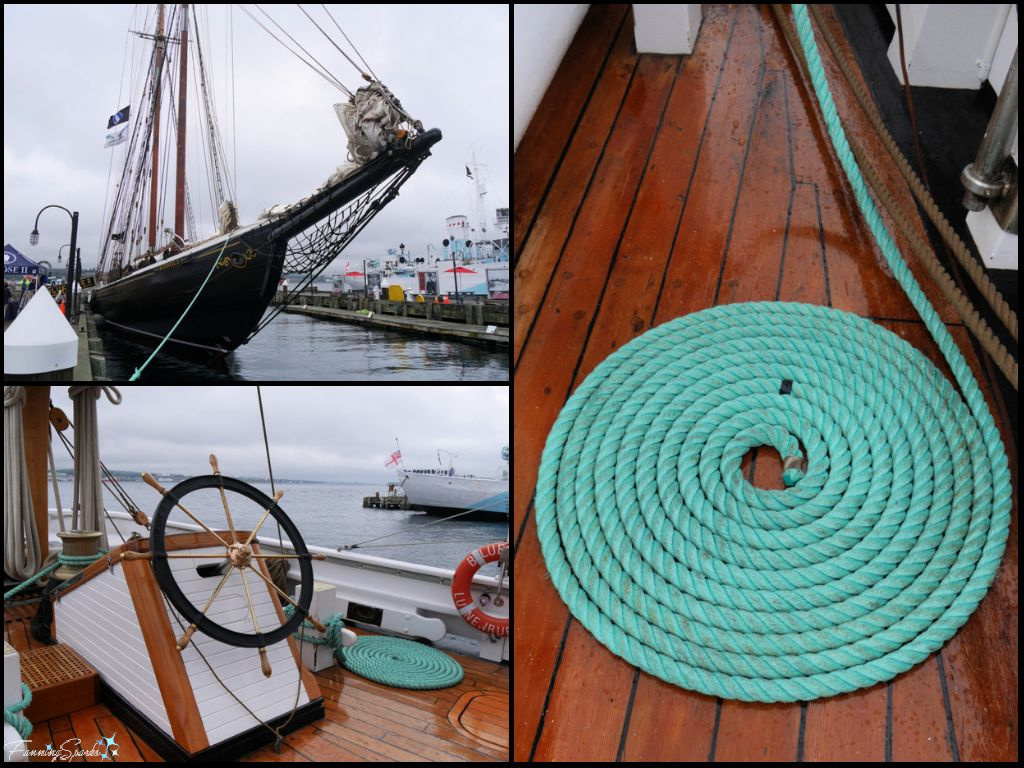
“A cable is too large to be coiled in the hand and so it is coiled down directly on the deck, starting next to the anchor.” writes Smith. “Make each turn slightly larger than the preceding one, because this makes it run more freely, and keep the coil as large as convenient to allow for free circulation of air about the parts. Now capsize [meaning turn over] the coil carefully, rearranging any turn that is out of line …”.
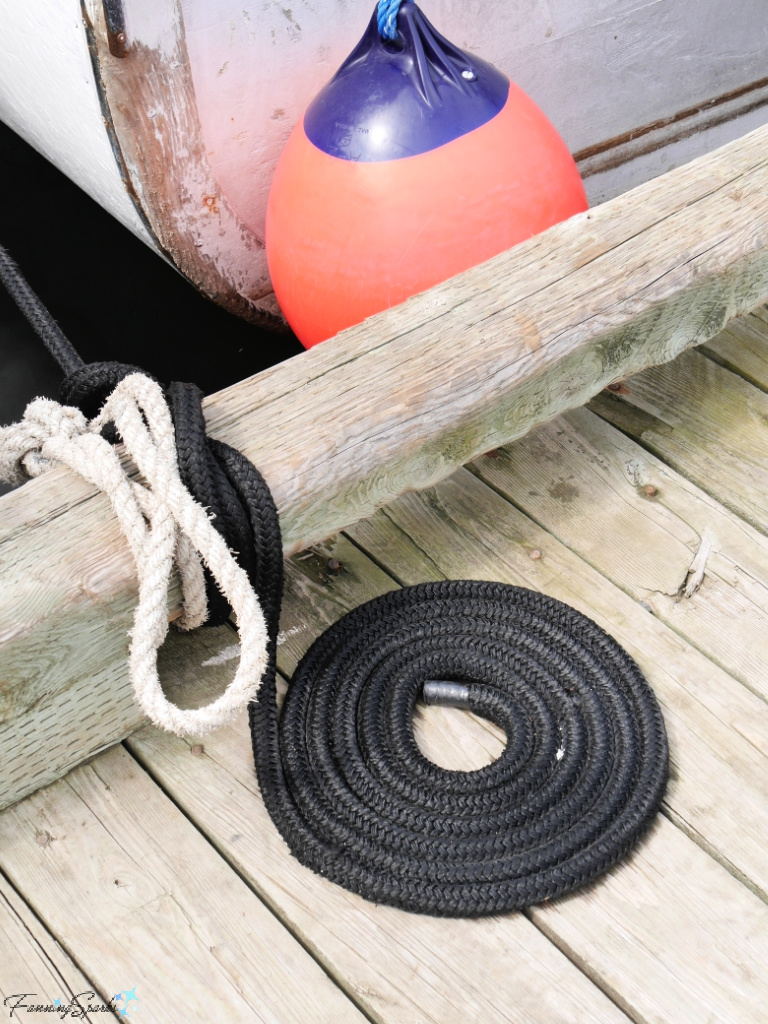
Coiled ropes, like the one shown below, can be spotted around most fishing wharves and vessels.
Smith was motivated to write The Arts of the Sailor: Knotting, Splicing and Ropework to carry forward the traditional “arts of the sailor … defined as ‘a collection of related skills employed in the rigging, working and maintenance of a ship.” He shares “all of the skills involving rope and canvas that are required by the average boat owner”.
One of these skills is the making of rope mats. “For hundreds of years, rope mats of various types were primarily used as chafing gear in sailing ships” writes Smith. “They cushioned the deck … and provided a skid-proof footing for the helmsman. … But in more recent times, they have been sadly neglected … and today [he writes in 1953] they are rarely seen”.
Smith goes on to say, rope mats “are unquestionably useful, inexpensive and easily made. Aesthetically, I know of no single item of traditionally-correct ship’s gear that is more fitting and appropriate, or that does so much to give … character and personality”
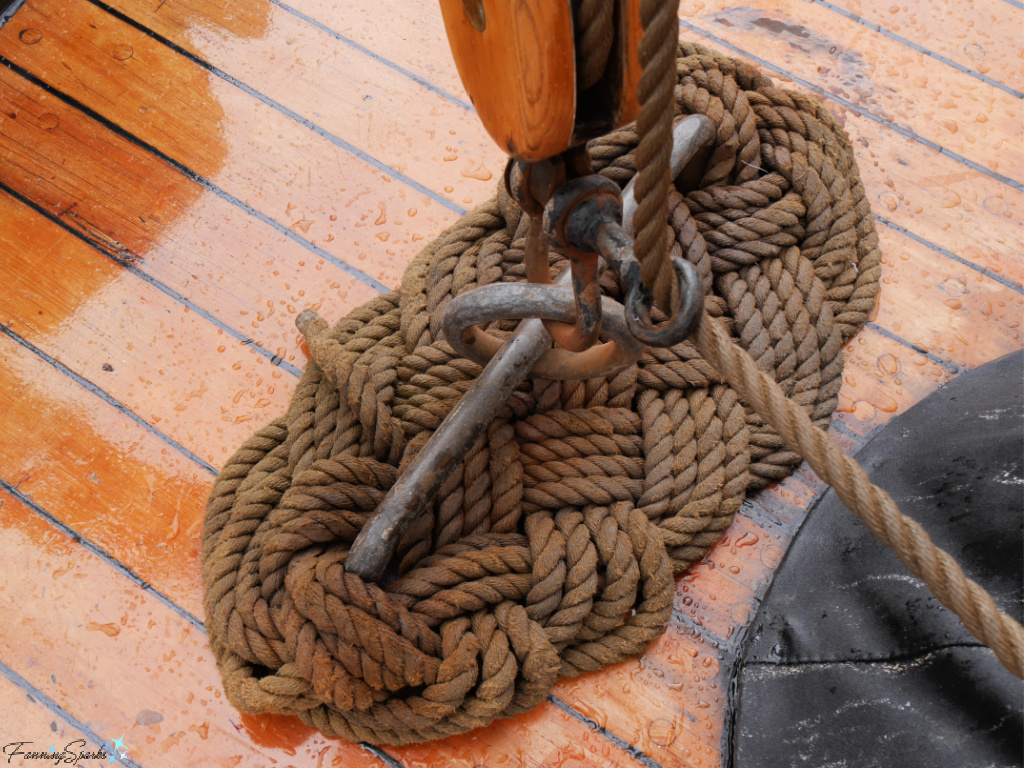
“Originally the thump mat was used on sailing ships to protect the wooden decks of the ship from damage from the movement of rigging blocks attached to the decks” according to an online article How to Make a Rope Thump Mat.
Here’s an example of an actual sailors’ mat on the Bluenose II.
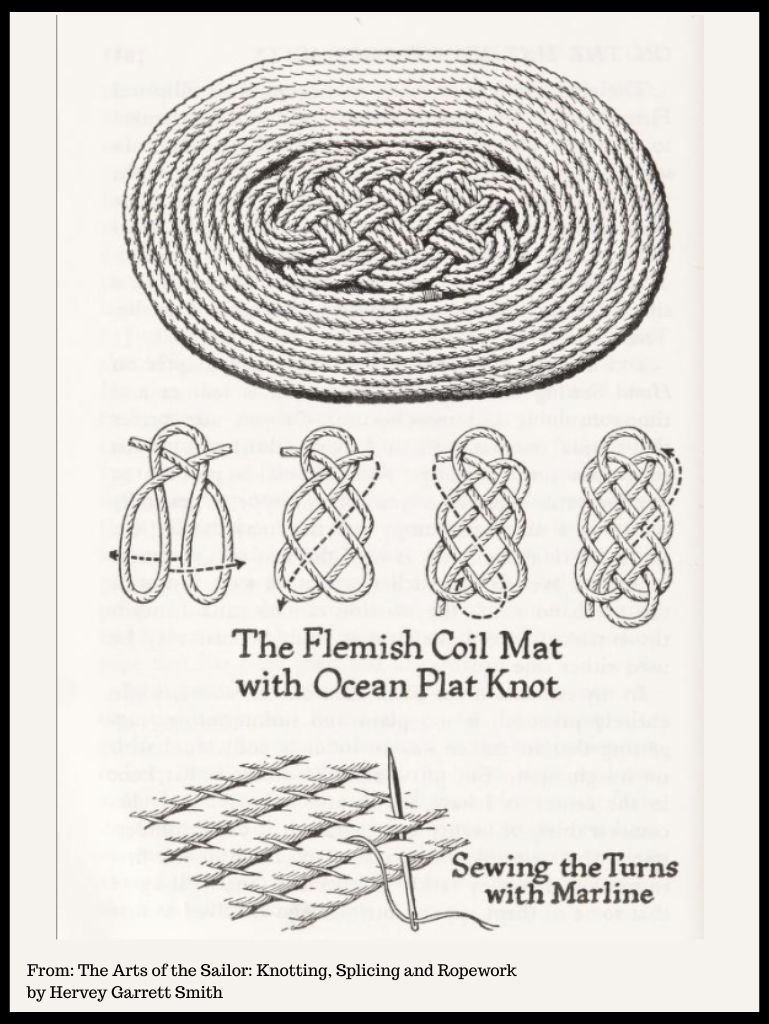
“The simplest mat to make is the round or elliptical Flemish coil” writes Smith. “The rope is first laid out and overhauled to eliminate all twists and turns, for unless it lays absolutely fair the mat will not lie flat, particularly when wet. It is then coiled carefully, the turns lying close and smooth, with even tension throughout. …. Then the turns of the coil are stitched together with a single length of marline threaded in a large sail needle.”
Smith’s instructions are illustrated with his sketch “The Flemish Coil Mat with Ocean Plat Knot”.
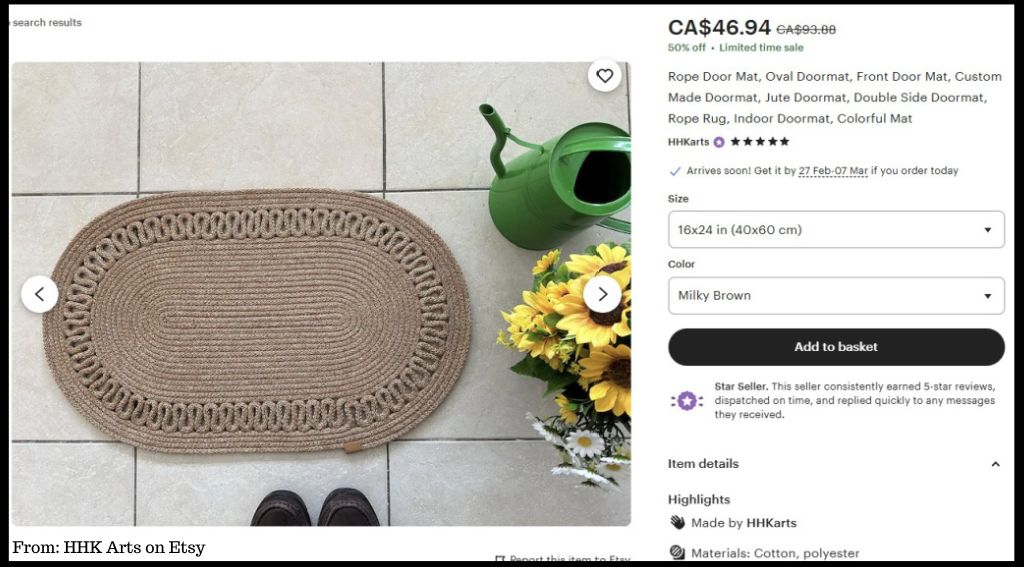
While much has changed since Smith originally shared his expert advice, the idea of coiling rope to make objects such as floor mats is still relevant today. Shown below is a current example from Turkey-based, Etsy seller, HHK Arts Handcraft Atelier. This rope floor mat is made with modern materials – high-quality polyester rope containing 80% recycled polyester and 20% cotton – and, in all likelihood, coiled by hand and sewn with a sewing machine.
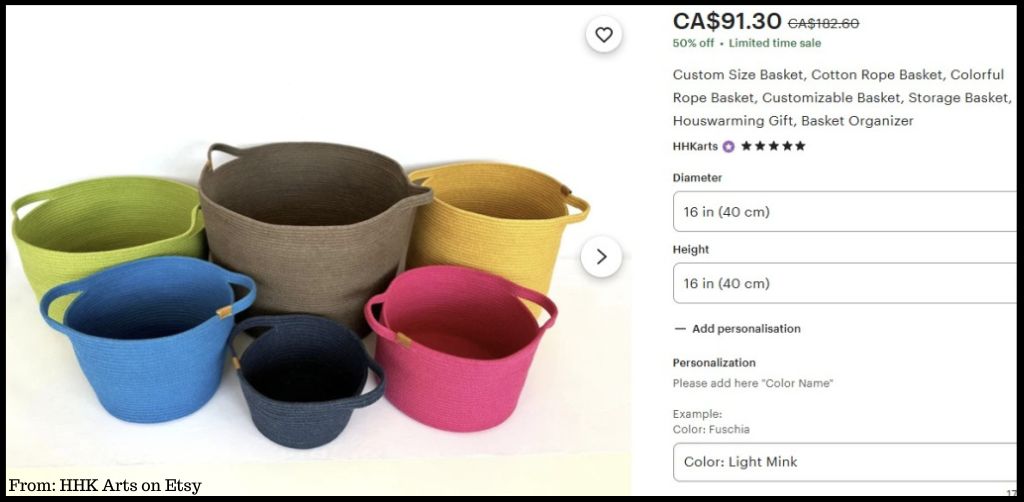
But floor mats are not the only coiled rope options currently available. For instance, this same seller also offers custom-made coiled rope baskets and bins. Etsy shoppers can select a round basket or rectangular bin in their choice of diameter, height and color. These custom options set this vendor’s offerings apart.
When I first wrote about coiled rope basketry two years ago (see Getting Roped into Coiled Rope Basketry), I learned that “makers have been blogging about rope baskets and bowls for several years—I found an April 2016 article proclaiming rope baskets were a trend to watch”. As with many trends, what started as a unique, sought-after, hand-crafted object has evolved into a ubiquitous, run-of-the mill, mass-produced item.
These days generic coiled rope items crowd the shelves of big box stores and the listings of online shops. Simple, coiled rope items are more accessible and affordable but they are no longer special.
As a result, makers, such as the Etsy seller mentioned above, have found new ways to differentiate their offerings ― they have taken simple, coiled rope basketry to the next level.
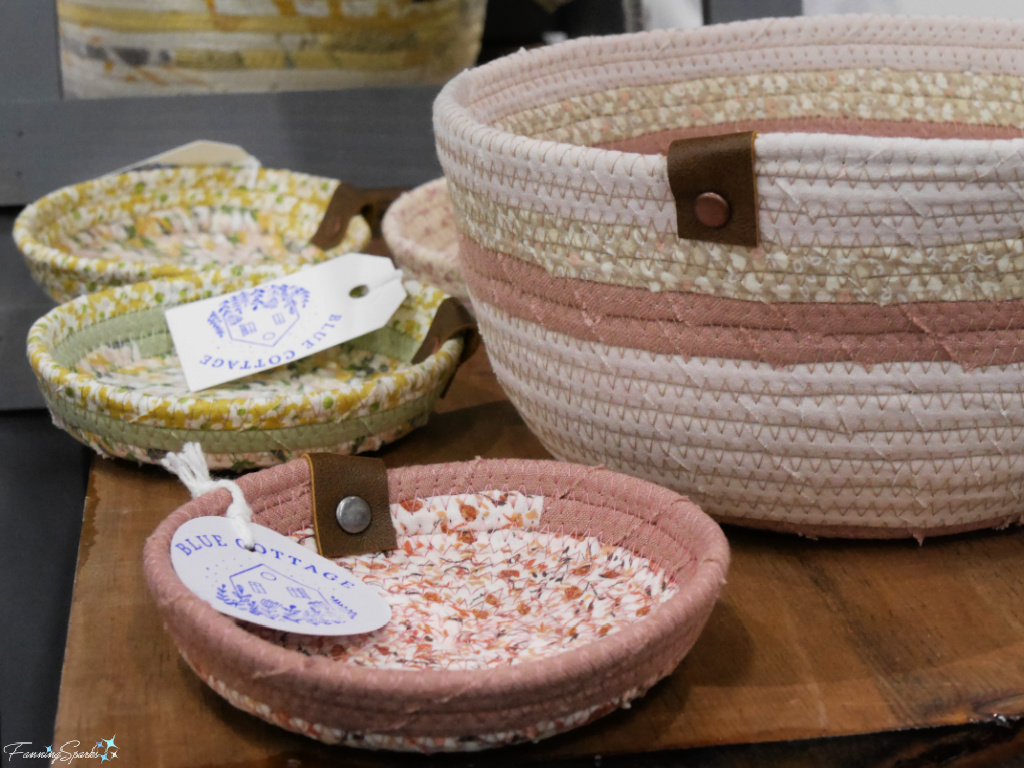
The coiled rope bowls shown below, which I spotted at the Nova Scotia Art and Craft Sale a few months ago (See Happiness is Handmade), are a case in point. Hand-crafted by Nova Scotia-based, Blue Cottage Rugs, these bowls are made with fabric-wrapped rope in a variety of carefully-selected colors and patterns.
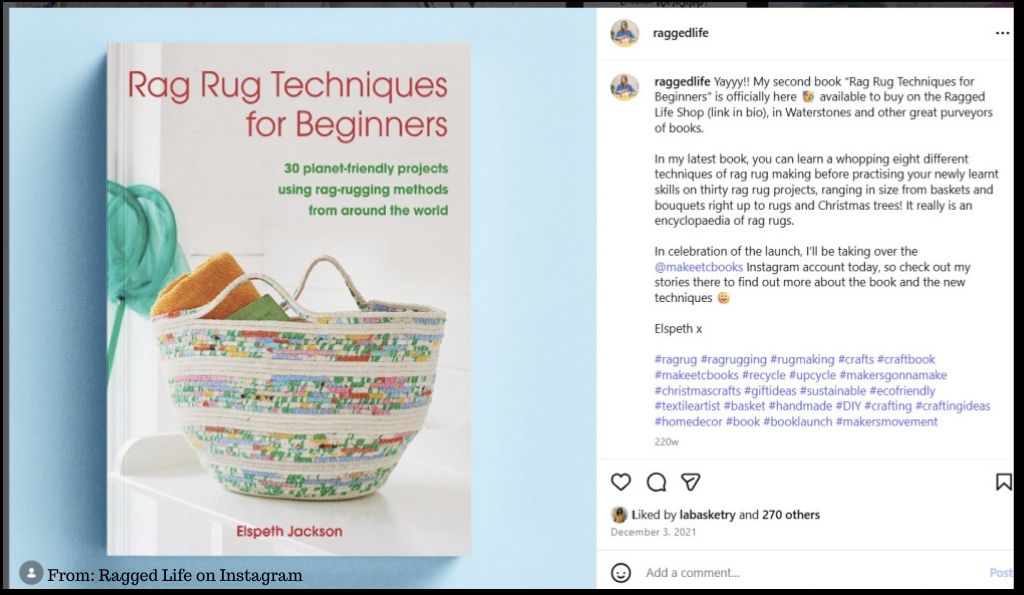
This next example, from UK-based, author and artist, Elspeth Jackson showcases the beauty of combining coiled rope and rag rug techniques.
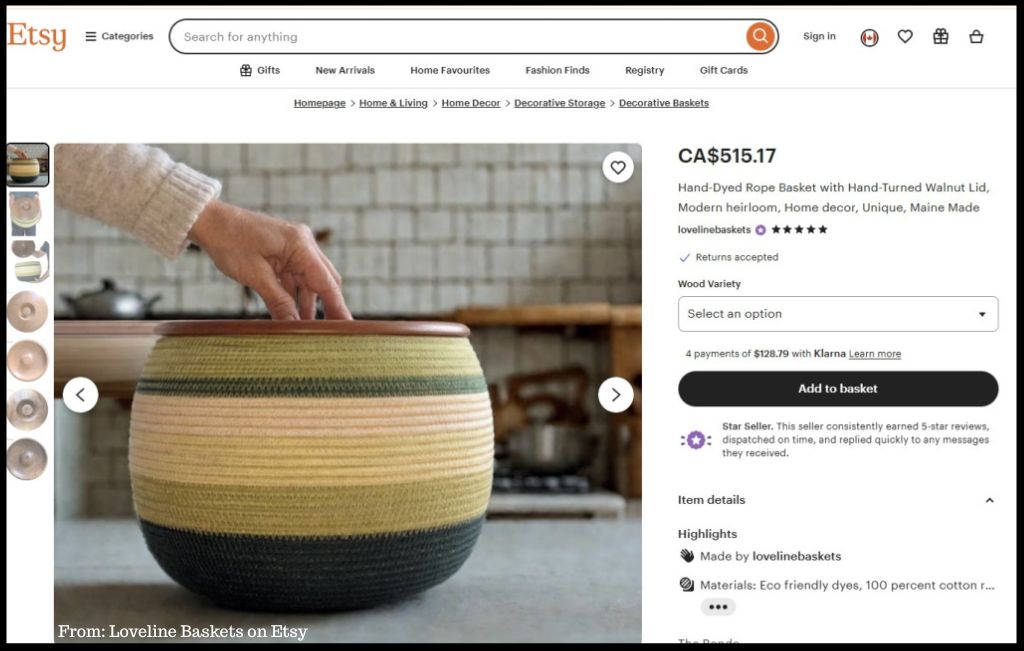
Another example comes from USA-based, Etsy seller, Loveline Baskets. The below coiled rope basket is made with hand-dyed rope in gorgeous hues of green and it’s topped with a hand-turned walnut lid. I’ve had the pleasure of seeing their work in person so I know it’s top quality. This coiled rope basket is hand-crafted, unique, beautiful and useful!
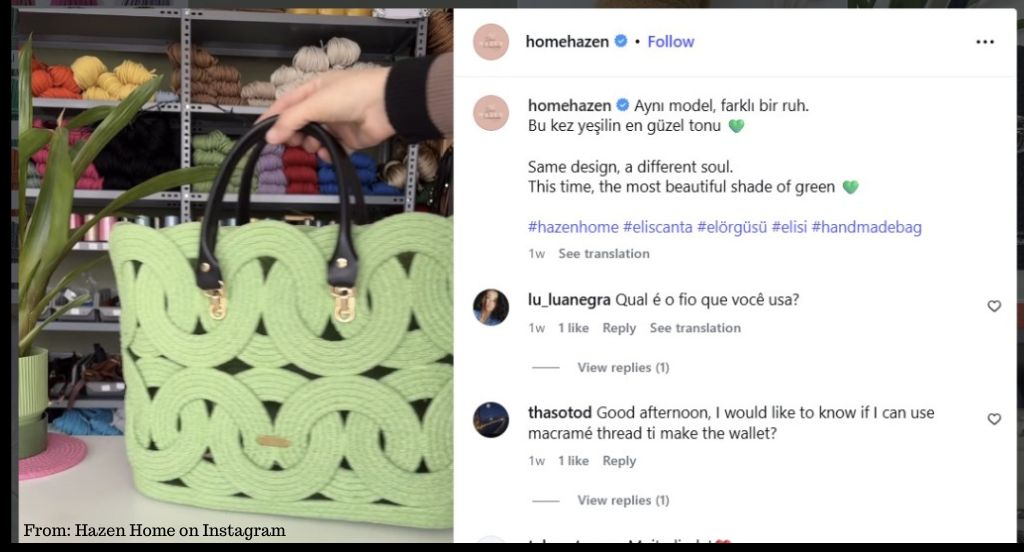
Made by Turkey-based, Hazen Home, which is an e-commerce vendor of rope for craft projects, this next example of coiled rope artwork really stands out! A series of interlocking coiled rope circles is sewn together to create this outstanding handbag! Hazen Home also offers a members-only YouTube channel where they share tutorials for making unique projects like this one.
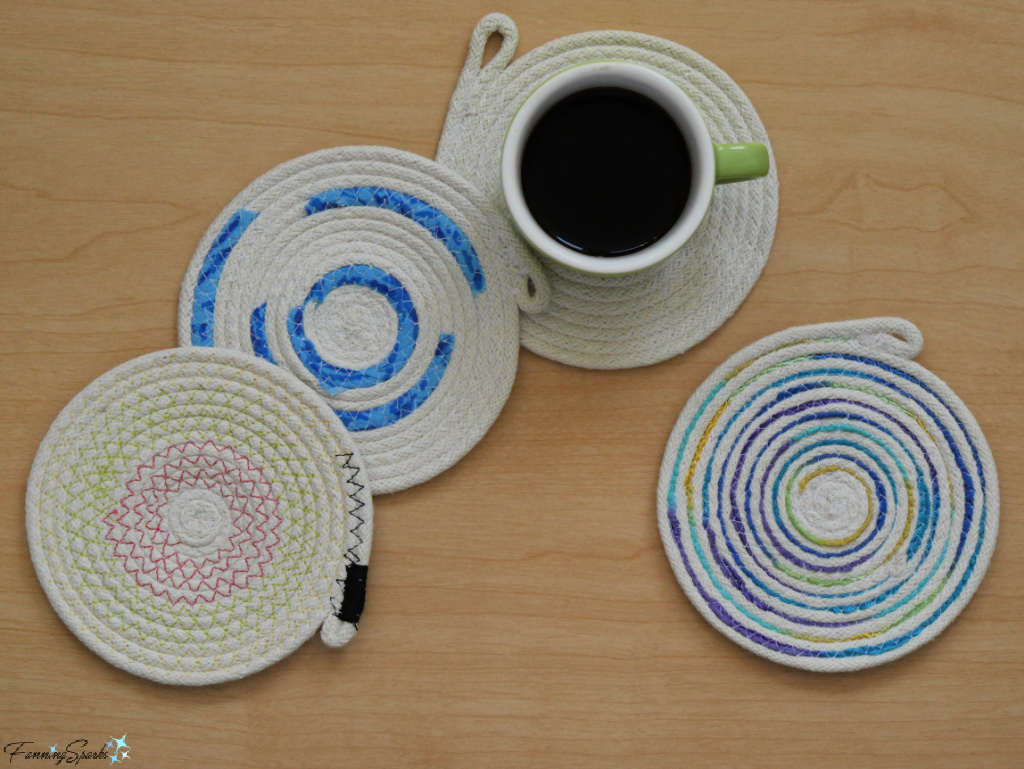
Meanwhile, back at the ranch, Marian (my sister and creative pal) and I have been coiling our own rope. I’d learned the basics when I tackled these coiled rope coasters (see Getting Roped into Coiled Rope Basketry) …
… and these animal-shaped coasters (see Coiled Rope Animal Coasters – DIY Tutorial) a while ago.

Our recent endeavour involved a more ambitious project ― a barrel-shaped basket which has a 12½” (32 cm) diameter and sits 10” (25.5 cm) high. We followed a Domestika online course, Artisan Ropework Homeware with textile artist Jessica Geach, to learn how its done.
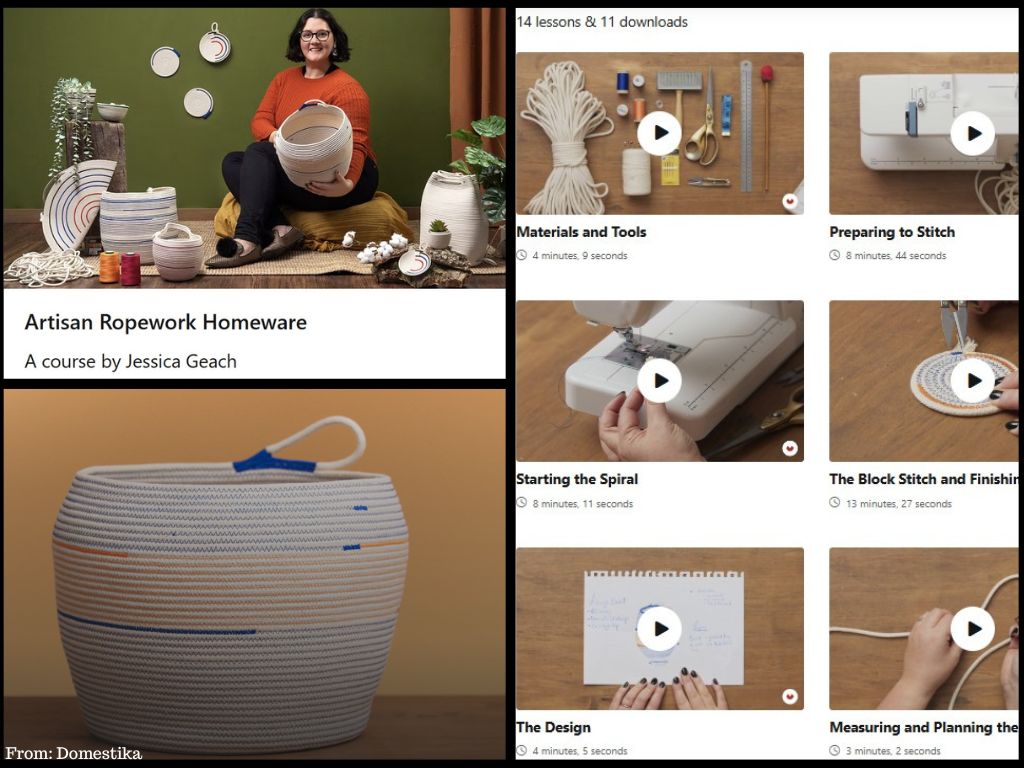
The lessons were fun and easy to follow. And our projects came together nicely. Here’s my finished “lounge basket” as the instructor called it.
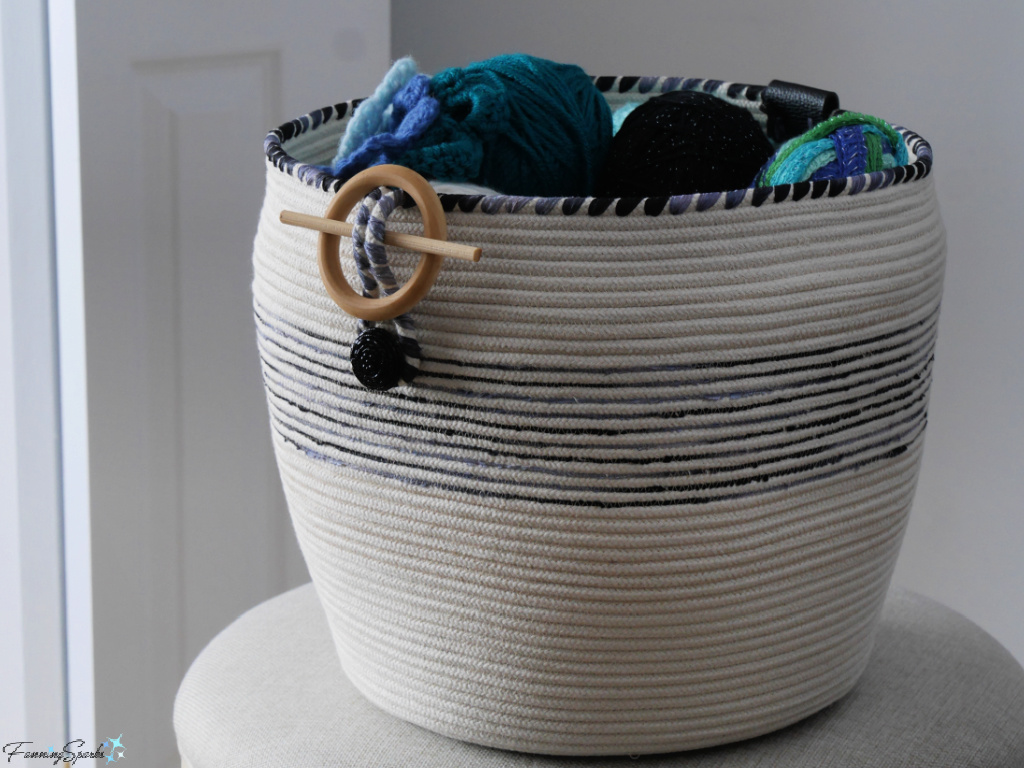
It’s pretty much the same size and form as the class project but has different finishing details. Instead of sewing the body with contrasting thread, I chose to use matching thread. Then I used some black and grey variegated ribbon yarn to add accents. A small rectangular piece of black leather hides the connection point at the top of the basket.

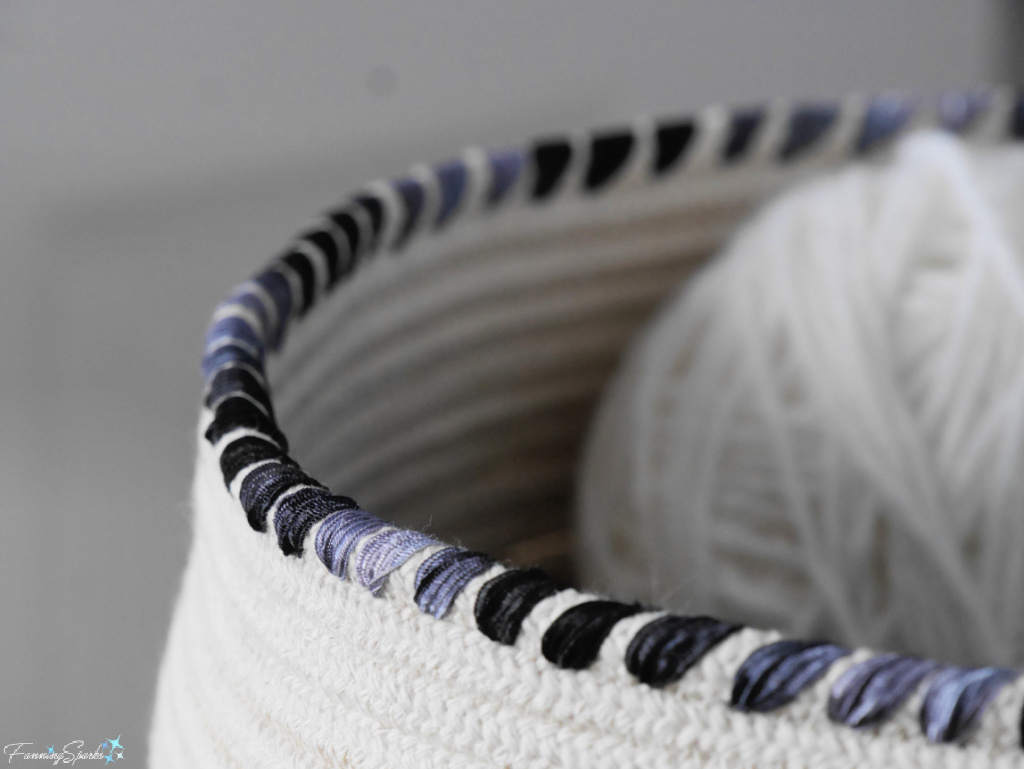
Ribbon yarn threaded through the zigzag stitching around the body of the basket adds a little contrast and interest …

… as does the whip-stitching around the top rim.
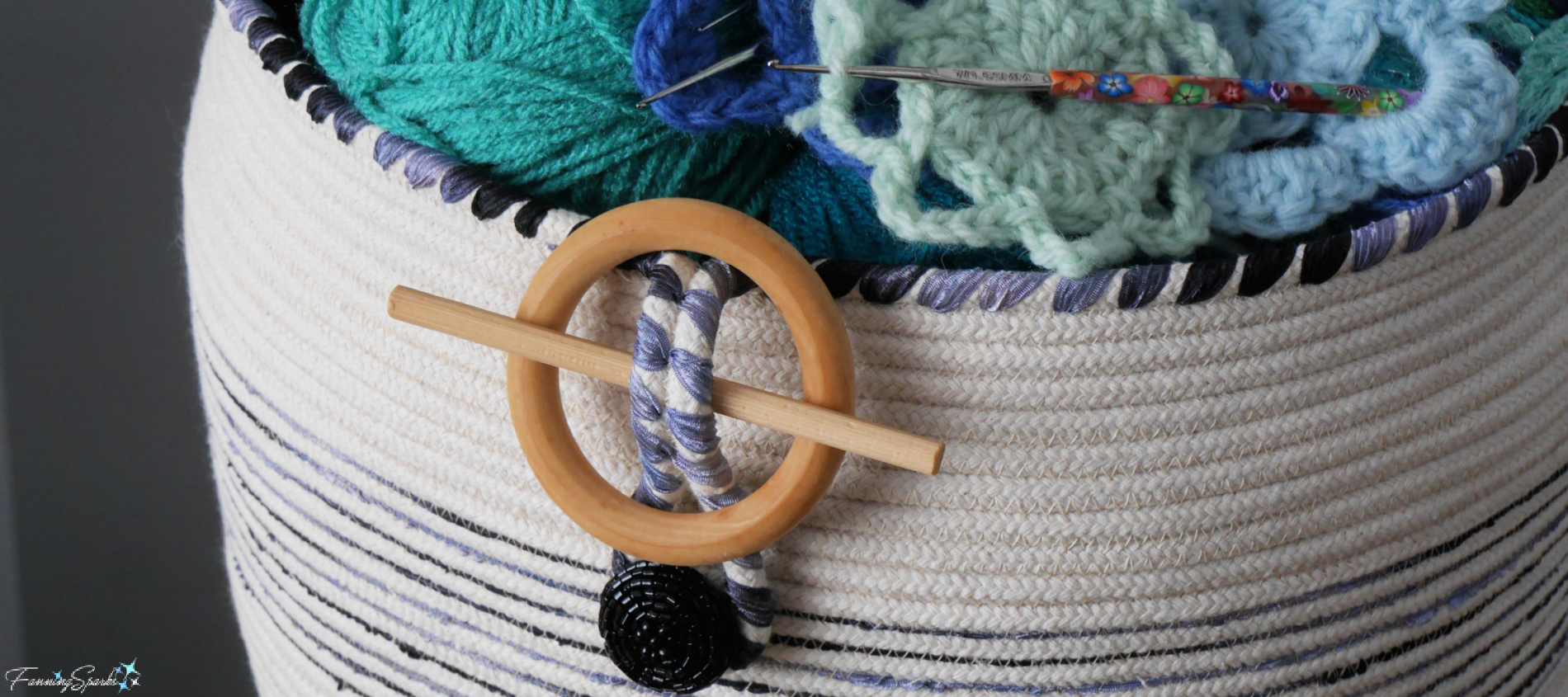
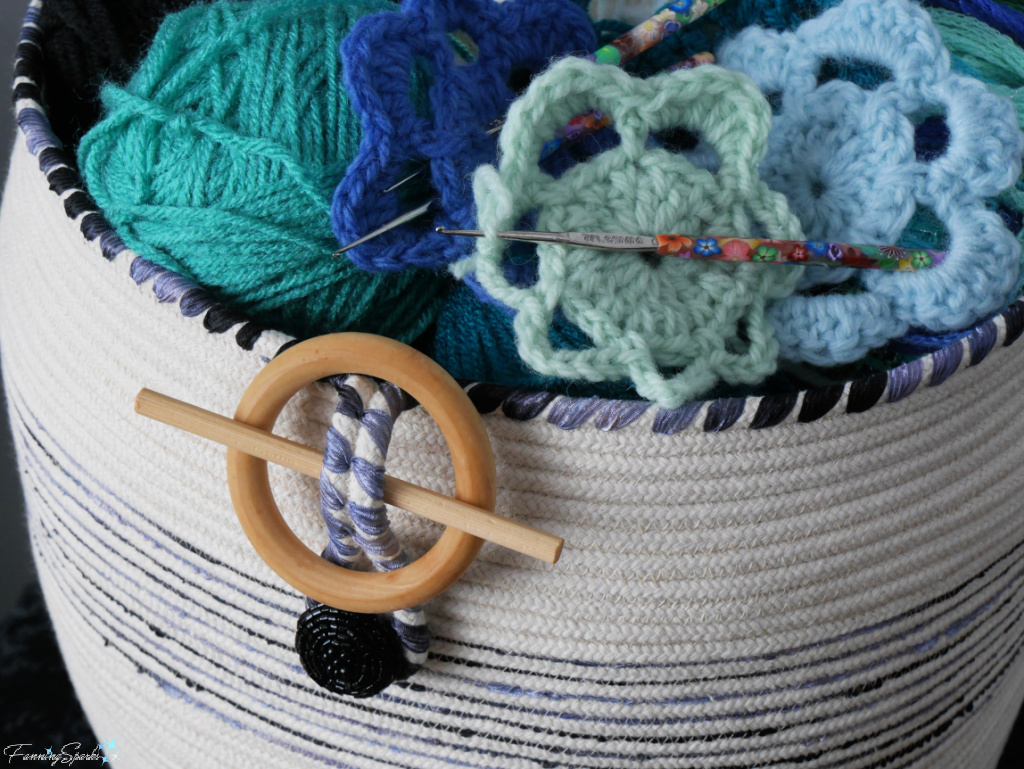
And the pièce de résistance is the false toggle and loop accent created with a wooden ring and dowel and fastened with a beaded black button. 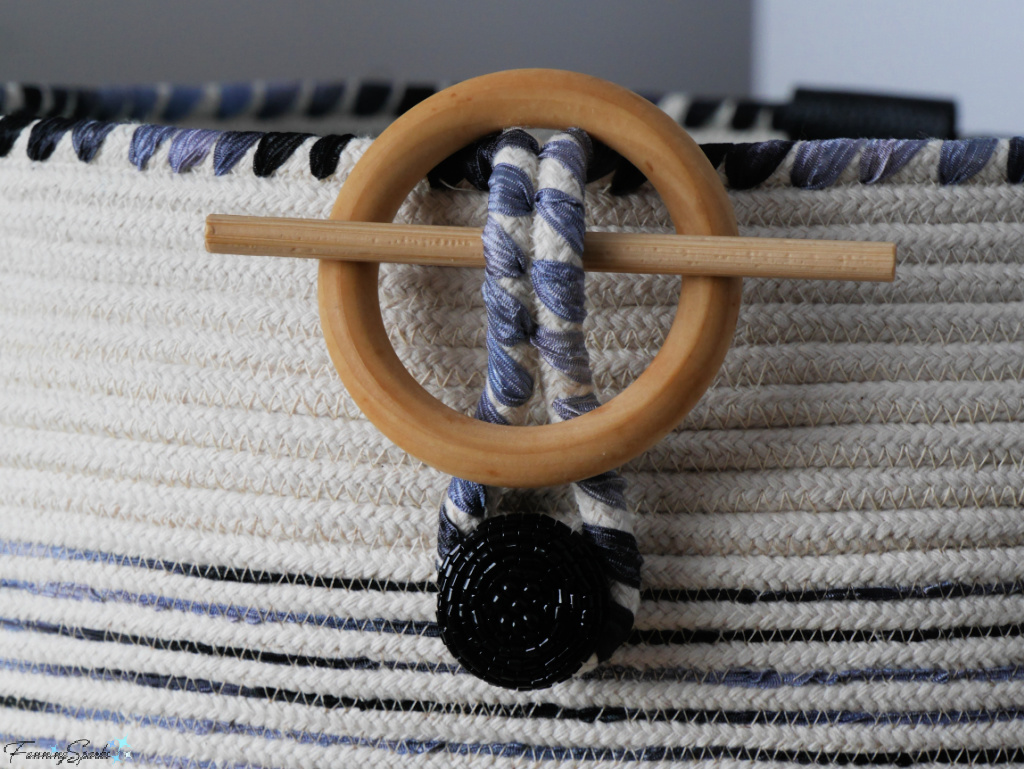
After having completed this online course and the associated class project, I’m ready to try a few more projects and eager to coil more rope!
More Info
Previous blog posts mentioned in this blog post include:
. Getting Roped into Coiled Rope Basketry
. Happiness is Handmade
. Coiled Rope Animal Coasters – DIY Tutorial.
The following books and articles were consulted in the writing of this blog post:
. The Arts of the Sailor: Knotting, Splicing and Ropework book by Hervey Garrett Smith which is available here on Internet Archives
. The Marlinspike Sailor book by Hervey Garrett Smith which is available here on Internet Archives
. Des Pawson’s Knot Craft: The Book That Makes All the Other Knot Books Work book by Des Pawson which is available here on Internet Archives
. The Complete Book of Basketry Techniques book by Sue Gabriel which is available here on Internet Archives
. Cordage: Its Origins, Construction, Properties and Uses in Ships article by John Prescott
. How to Make a Rope Thump Mat article by Knotter
. Coiled Rope Technique article by Ragged Life.
The following talented makers and artisans are mentioned in this blog post:
. HHK Arts Handcraft Atelier ― see more on Etsy
. Blue Cottage Rugs ― by Allison Rose ― see more on Instagram or their Etsy site
. Ragged Life ― by Elspeth Jackson – see more on Instagram or their website
. Loveline Baskets ― see more on Etsy or Instagram
. Hazen Home ― see more on Instagram or their website.
Jessica Geach’s Artisan Ropework Homeware course can be found here on Domestika. This course was very effective. As with other Domestika online classes I’ve taken, the information was clearly structured, the instruction was thoughtful and clear, the visuals were effective, and everything worked as expected. As noted on their website, “Domestika is the fastest-growing creative community where the best creative experts share their knowledge and skills through professionally produced online courses”.
Today’s Takeaways
1. “Orderliness-the habit of keeping things in their proper places and maintaining them in a shipshape condition, ready for use whenever needed.” Hervey Garrett Smith
2. The nature of trends is that unique, sought-after objects and treatments evolve into ubiquitous, run-of-the mill, mass-produced items and practices.
3. Online courses are a terrific option for learning or building new skills.

Comments are closed.