
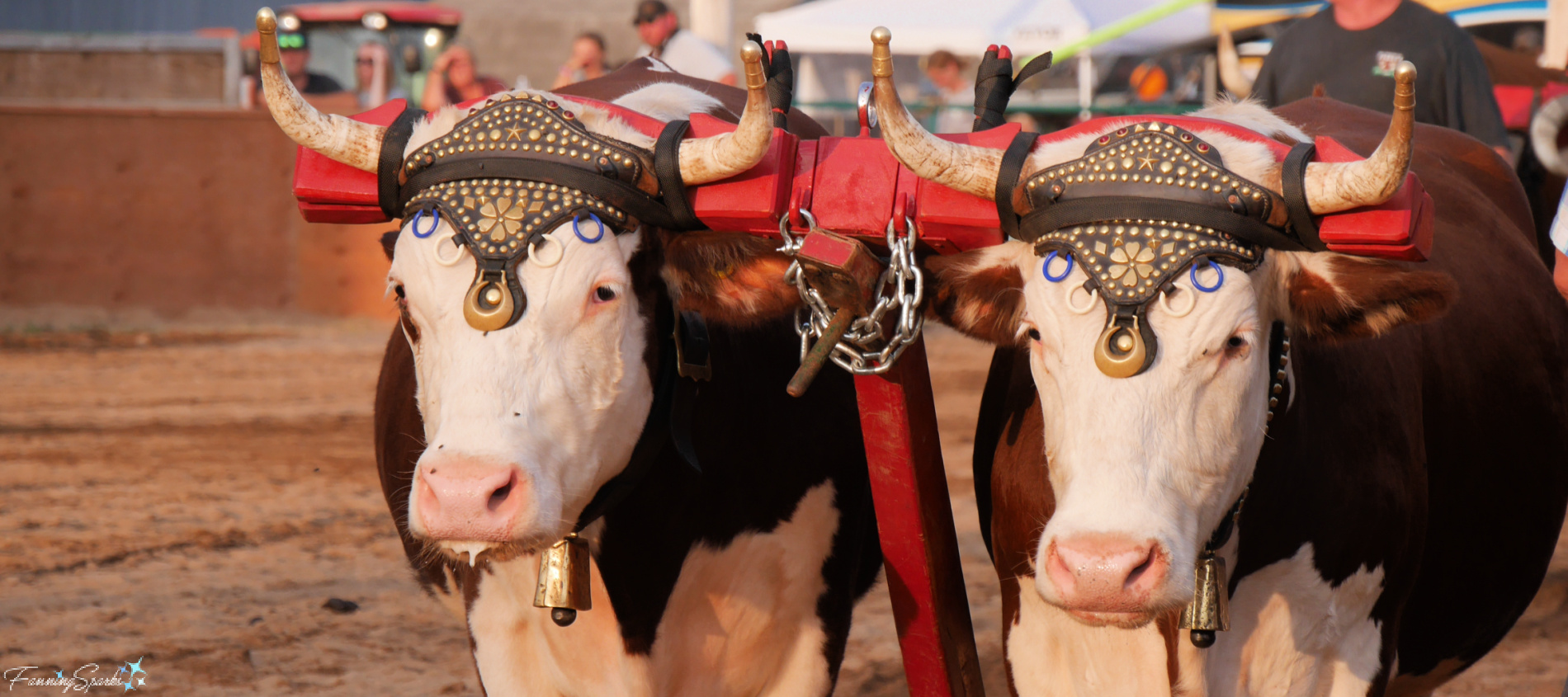
The phrase “strong as an ox” is often used to describe exceptional physical strength. But what exactly is an ox? And just how strong are they?
A recent opportunity to attend the Classic Ox Pull competition at the Halifax County Exhibition in Nova Scotia helped answer these questions. Billed as “a show of strength, teamwork and Maritime heritage in full regalia”, the beloved, annual event did not disappoint.
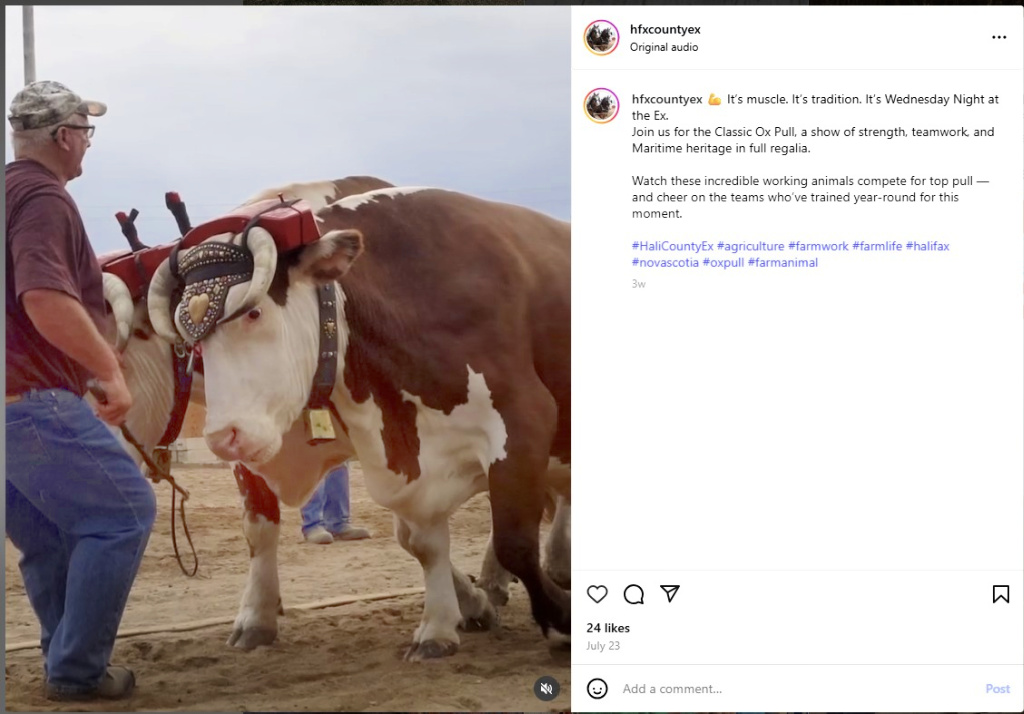
Oxen, I’ve learned, are created not born―meaning they start out the same way as any other dairy or beef calf. If they have the right attributes (ie calm disposition, good body conformation, broad shoulders, strong neck muscles), they could be selected by an oxen teamster to be trained as a draft animal.
 Ox are typically worked in pairs because, obviously, two oxen are significantly stronger than one. Size is the most important consideration when selecting calves to form a pair―the oxen in a team need to be about the same size to work together effectively. For teams destined for showing, it’s also common practice to select calves which look similar with the same breed, coloring and markings.
“Try to get calves born close together, preferably from cows bred by the same bull” explains John Scarlett in his article, Training Oxen and Farming with Oxen, “or–if you’re lucky enough–identical twins, in order to increase the chance that the mature animals will be the same size”.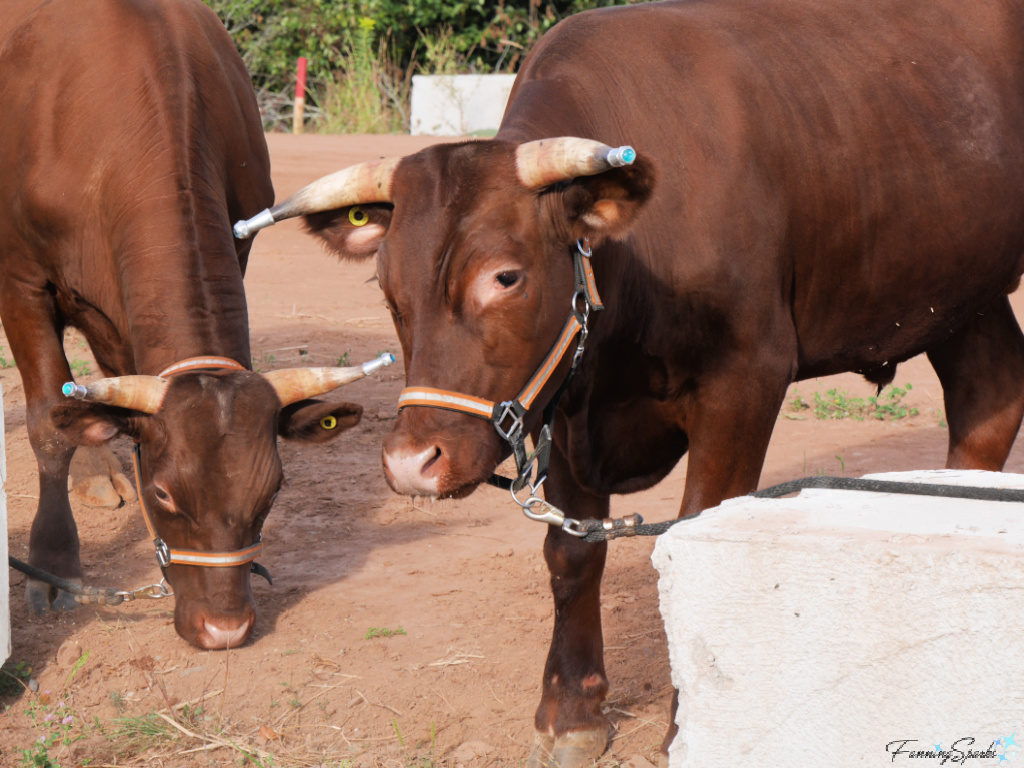
Not all pairings are successful. “Some of the pairs will grow apart, the growth rates of others will differ too widely and some simply won’t be compatible with humans” Ralph Hartzell is quoted as saying in the article Oxen No Has-Beens When It Comes to Hard Pulling. Author Sue Bowman goes on to explain, “For that reason, he [Hartzell] usually buys 6 to 8 calves to come up with the optimal pair. … Younger animals can be substituted for each other during the training process, but if an older pair has to go their separate ways due to injury or behavioral issues, Hartzell won’t attempt a new pairing”.
When male calves reach the age of six months or so, they are castrated making them steers and “more manageable than bulls …[since] castration helps in reducing aggressive behavior” explains the author of the How to Train Oxen to Work with a Yoke article on the Live to Plant website.
As with most competitive sports, there are only a few opportunities to become an award-winning champion oxen team. In the province of Nova Scotia, for instance, the sport of ox pulling is a time-honored tradition which remains popular to this day. There are approximately 110 active oxen teams competing and/or demonstrating in the province’s agricultural exhibitions and community fairs.
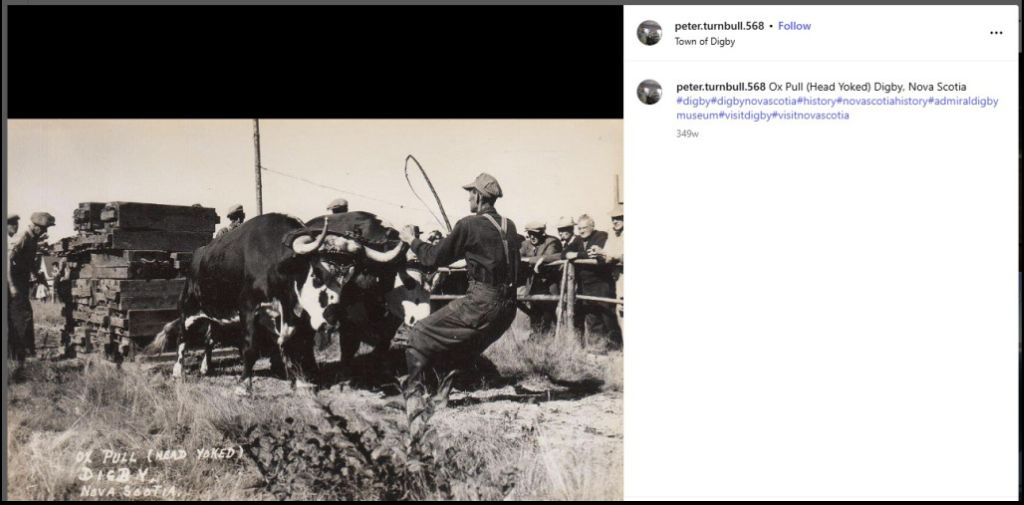
This undated photo, labelled “Ox Pull (Head Yoked) Digby Nova Scotia”, shows Nova Scotians have been enjoying this sport for some time.
Of course, long before ox pulling became a sport, oxen were used for real work. Nearly all the online resources I found, emphasize “the role played by oxen in American history. When Americans heading west arrived at portal cities like St. Louis with their horse-drawn covered wagons, they were advised by the wagon masters to trade their horses in for more practical oxen” writes Bowman. “Not only could oxen out-pull horses when it came to drawing a wagon, but the oxen were also able to thrive on poorer grass and brush instead of relying on the scarce and expensive grain required by horses. Oxen were superior at moving through mud and snow because they were actually able to ‘swim’ through these impediments. One final practicality was that, if an ox fell and broke a leg, it could still be butchered and used to provide meat on the journey.”
Meanwhile in Nova Scotia, settlers arrived by ship bringing oxen with them. “Nova Scotia’s first oxen came to Port Royal in 1610, with French explorers.” writes Marjorie Simmins in her article Lion & Bright. “Calm and hard-working, they worked for the Acadian settlers first, but were adopted by all following pioneers. Oxen toiled in the forests and fields, and on the beaches, hauling fish and seaweed. They transported lumber and goods. Harnessed singly or yoked as teams, oxen gave their all, raising homesteads and towns for the newcomers.”
The Nova Scotia Archives’ online collection includes a variety of photos depicting oxen teams at work. Oxen are shown hauling carts, wagons, plows and, even, boats.
Not all of the photos are dated but the photo shown below was taken by Clara Dennis in 1933. Interestingly, the names of the oxen―Bright and Lion―are also noted. Some experts report that at one time all oxen teams were named Bright and Lion and they were always assigned the same positions―Bright on the right and Lion on the left side. Apparently, this made it easier for drivers to switch teams especially in an emergency situation.
Nowadays, oxen are given a variety of names―some I’ve found in my research are Diamond and Spark, Bert and Ernie, Rough and Ready, Spark and Star, Lion and Turk, Beau and Luke, John and Paul, and Hoss and Howie.

This second photo from the Nova Scotia Archives is of particular note because it shows a farmer using a team of oxen to plow a field. A related note indicates the photo was taken near Riverport, NS.
Fun fact―the term “acre” was originally defined as the area a span of oxen could plow in a day” according to Wikipedia. Other experts have elaborated to clarify it was done on the longest day of the year with only a single-beam walking plow (which I assume is what’s being used in the photo below).
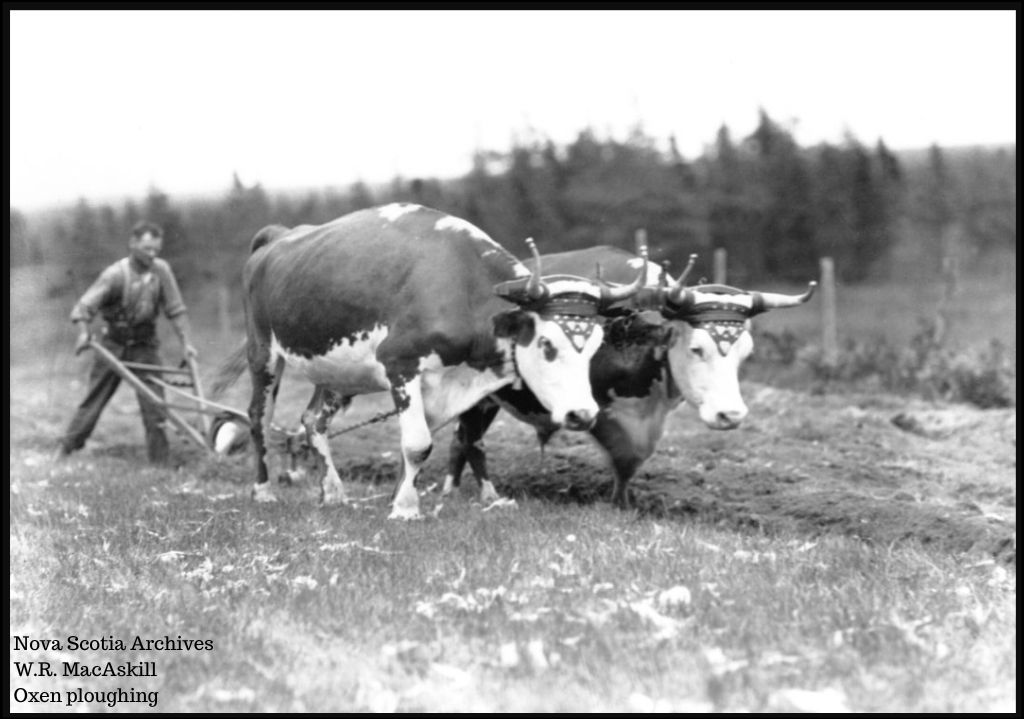 These photos suggest significant knowledge and skill would be needed to train and drive oxen. It’s not hard to imagine the information being handed down from generation to generation―a tradition which continues to this day.
In Nova Scotia, a close-knit community of oxen enthusiasts practice the age-old tradition of oxen driving and pass those skills from master to student. That close-knit community was evident at the Halifax County Ox Pull―the competitors all knew each other and several were family members. Most of the oxen drivers were seasoned professionals but there were younger competitors as well.
Observing the youngster pictured below working alongside, what I assumed to be, his father was heart-warming. And it wasn’t just me that noticed―I overheard seasoned veterans of the sport commenting on his enthusiasm and the importance of getting young people involved.
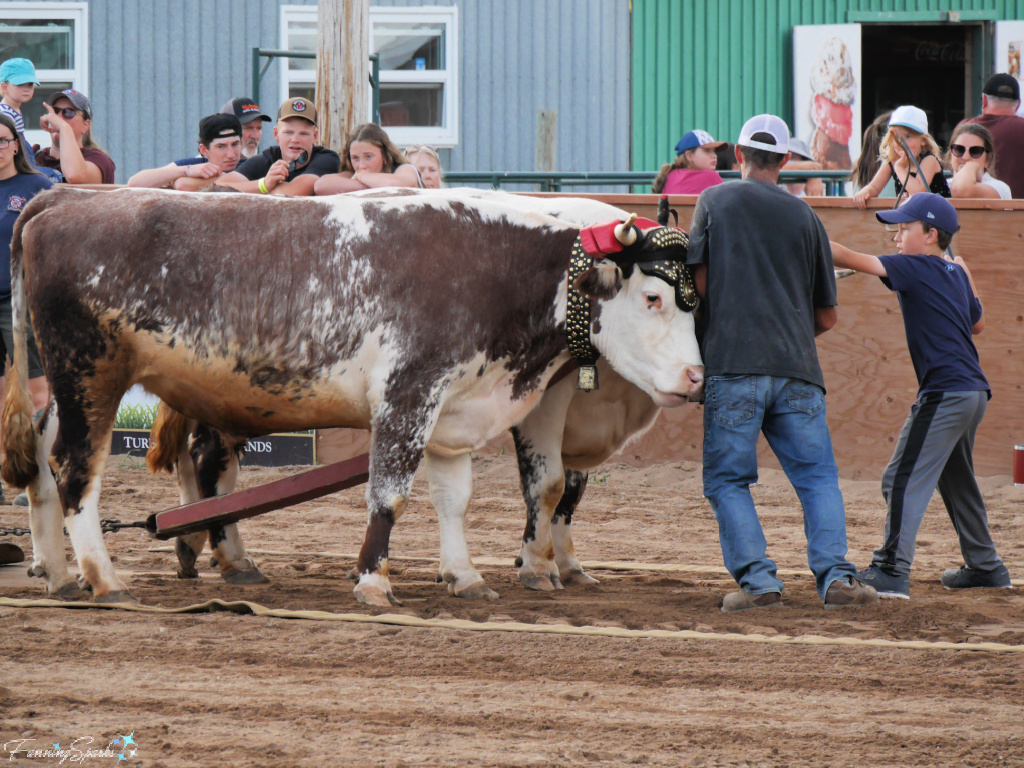
In the same way that it takes time for a person to become an oxen teamster, it takes time for a pair of calves to be trained as a synchronized oxen team.
“Training begins with halter lessons when the calves are 1 to 2 months of age” explain the authors of an online brochure entitled The Sport of Draft Animal Pulling. “This teaches the animals to walk and stop via voice command and pressure applied to the halter. Next, the pair are put into a calf yoke to learn how to walk together as a team. By a year of age, the team will be introduced to pulling. It is important to start them slow, allowing their muscles to form before weight is gradually added.”
Authors of the How to Train Oxen to Work with a Yoke article stress the commitment required, “The process of training them to work harmoniously with a yoke requires patience, understanding, and consistent effort”.
“As the training continues, a young steer will progress through several stages of proficiency, including ‘clever steer’, ‘handy steer’ and ‘working steer’ before earning designation as ‘ox’.” writes Bowman. Opinions seem to vary as to how long it takes for a steer to become an ox―I found references from 2 to 5 years.
At the Halifax County Ox Pull, spectators have an opportunity to view the oxen and chat with the teamsters prior to the competition.
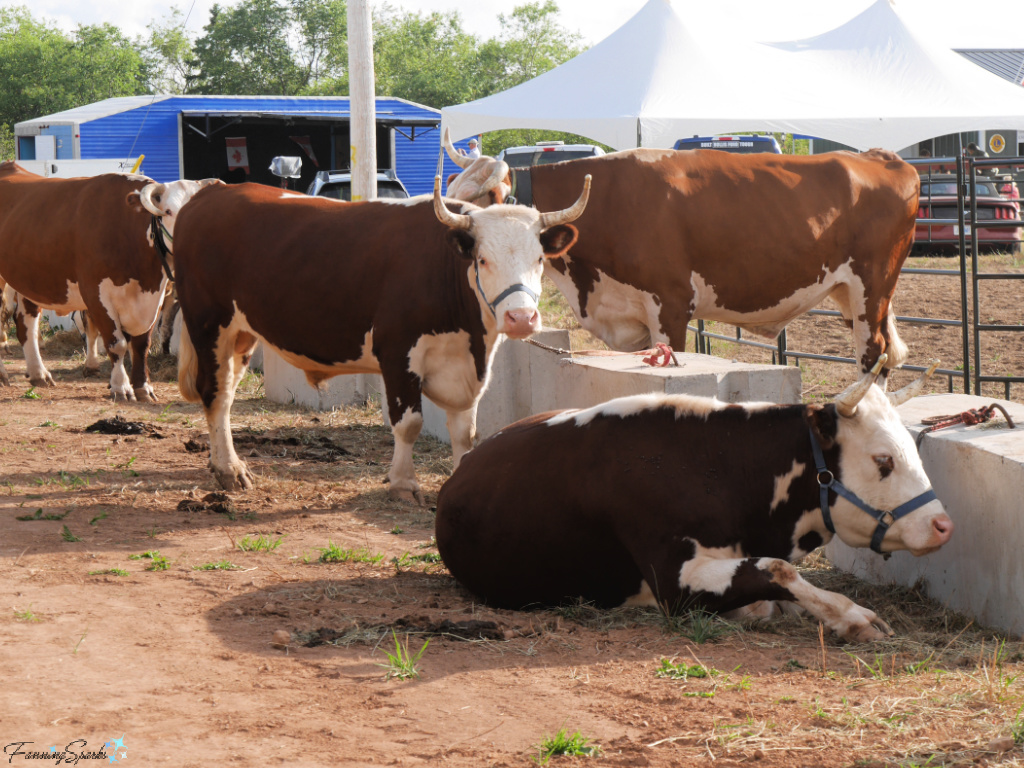
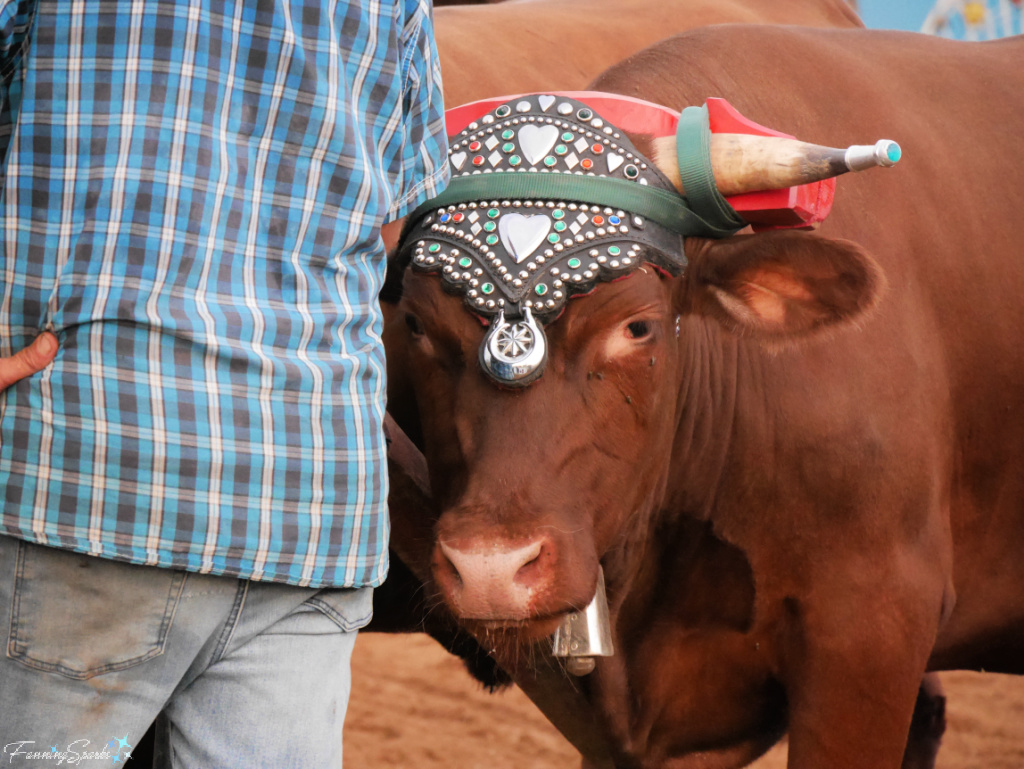
Viewed in the waiting area, the oxen seem like handsome, gentle giants… well… handsome, gentle giants with big, scary horns!
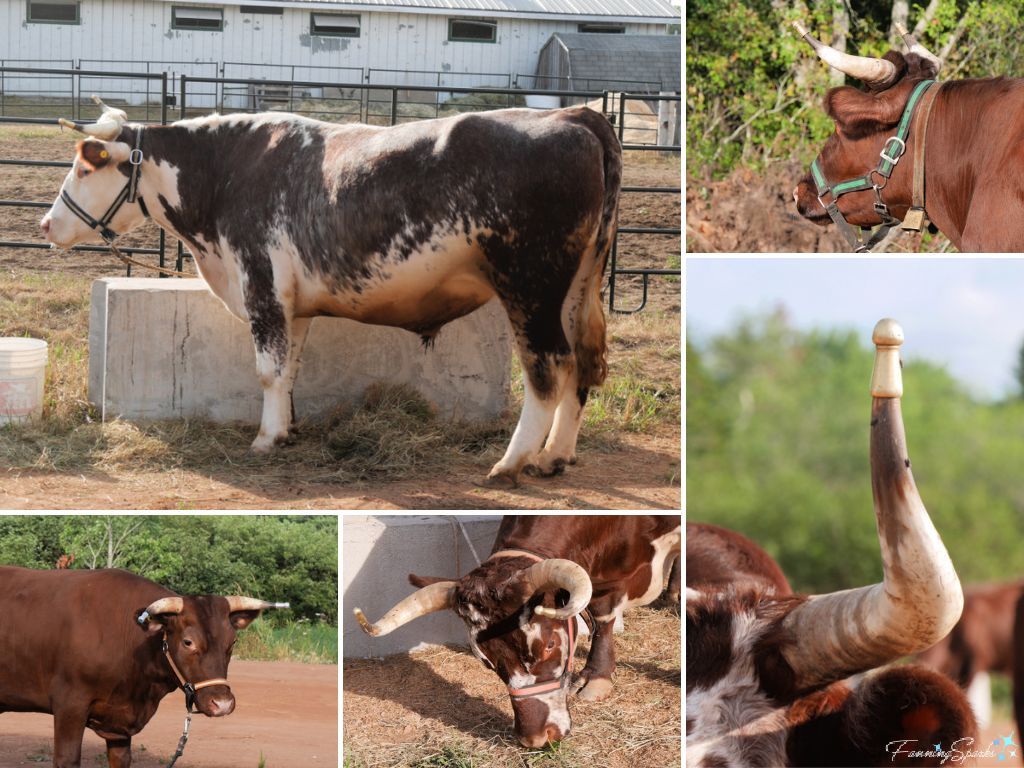
But the “gentle giant” impression changed as soon as the competition began.
It started with a parade of the oxen teams entering the show ring. Dressed in flashy gear with their coats gleaming and their neck bells ringing, the oxen walked in sync behind their drivers. It was a grand sight!
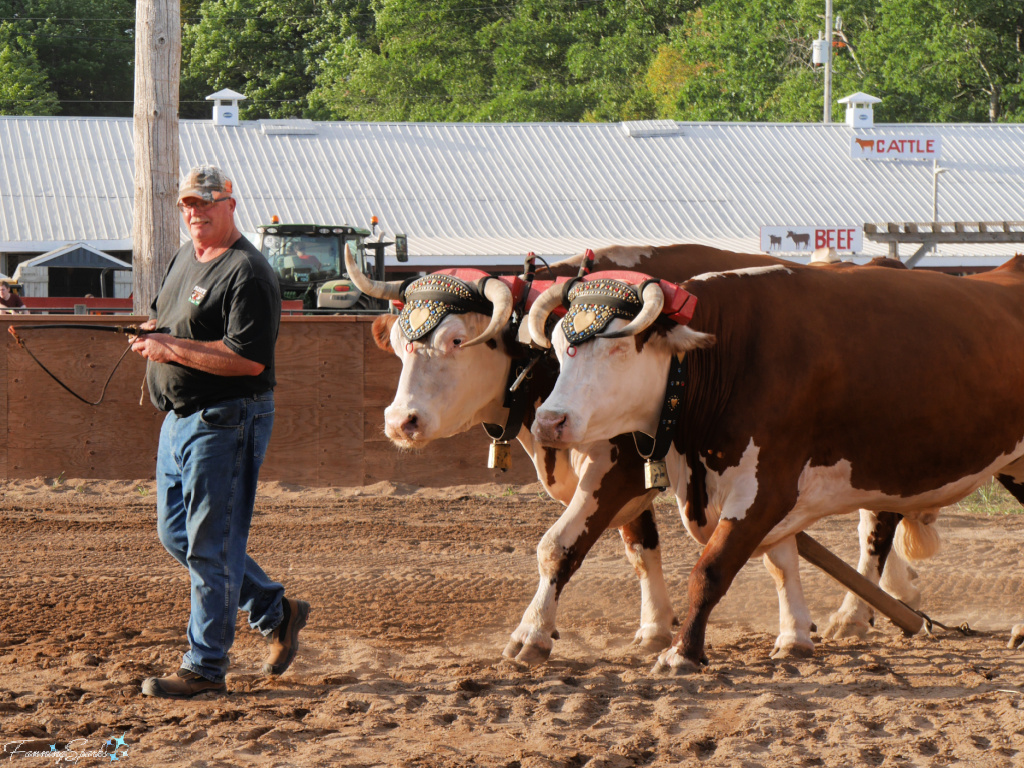
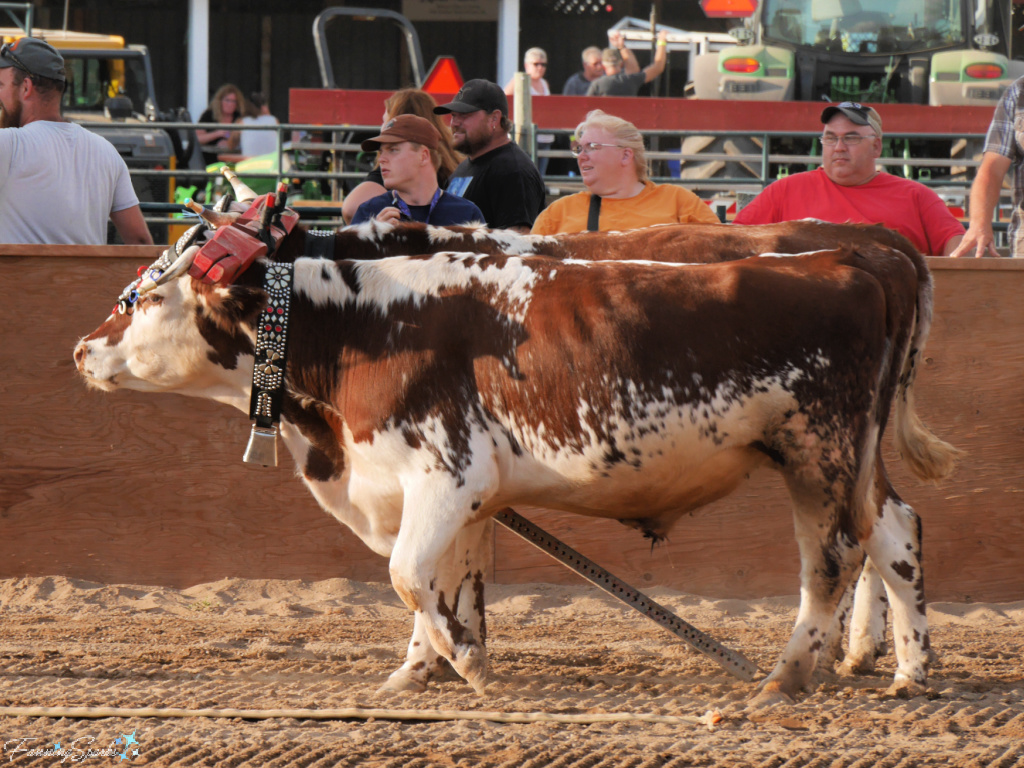
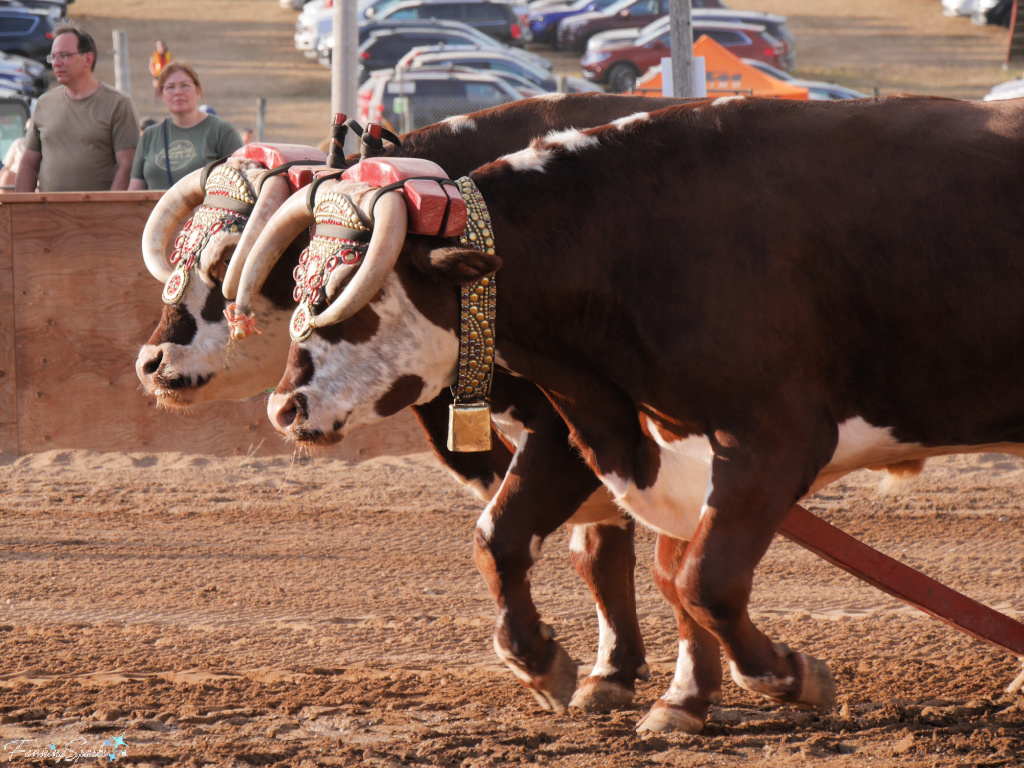
“Ox-pull competitions are all about strength and teamwork” writes Simmons. “The event requires two oxen, one teamster—and up to two tons of cement blocks being pulled along on a ‘stone boat’ or ‘drag’. At the Halifax County Exhibition, the ground crew used a tractor to load cement blocks onto the drag. This photo was taken early in the competition when there were only three cement blocks on the drag (see sled on the right). The sled was fully loaded by the time the final pull was completed.
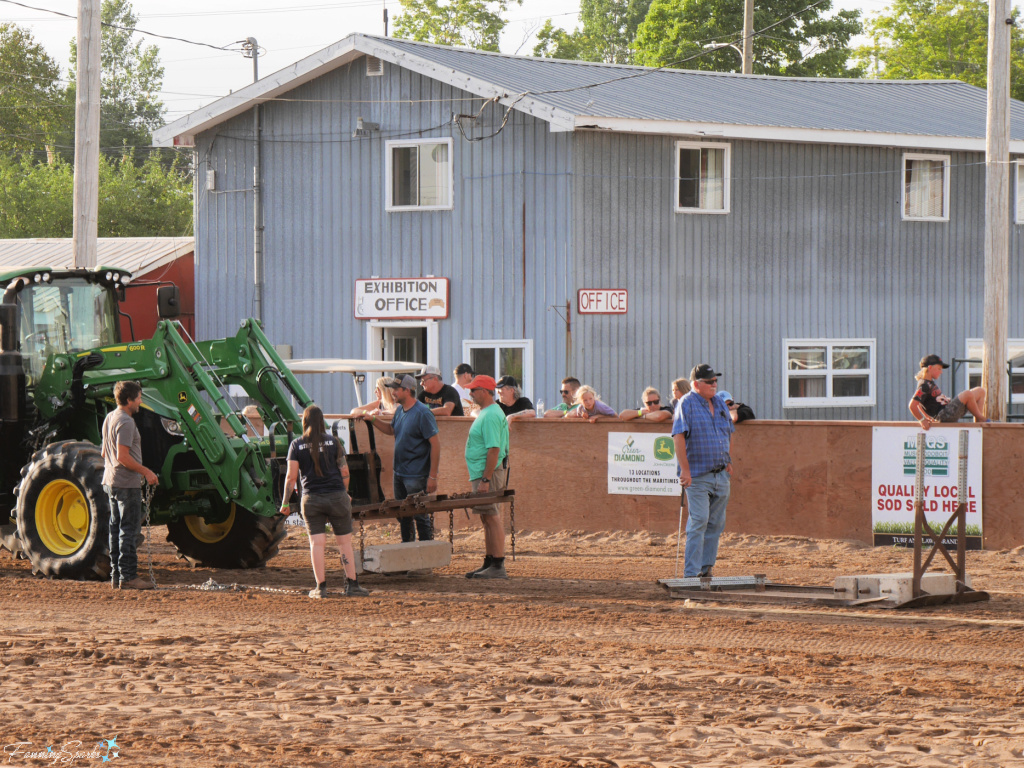
When the drag was ready, a teamster brought their team into position and, with the help of an assistant, hitched them to the drag.
Apparently, getting the oxen to walk backwards into the exact position is not an easy task. There are, in fact, explicit rules about this task. For instance, the Hants County Exhibition which hosts a similar event in a neighboring county, publishes their rules online. They state, “Teams when hooked to the drag must be kept within the pulling lines or they will be disqualified. Teams will have three attempts to hook on to the drag or they will be disqualified.”
In addition, the rules clearly address the use of whips. “Oxen are not to be hit on the face with any part of the whip when backing into the drag. Teamsters may lightly tap the oxen on the front legs from the knee down when backing up to hook on the drag. What is considered to be light tapping will be determined by the Judge. There is to be no use of the whip, lash or handle at any time during the act of pulling”.
Shown below, a teamster coaxes his team back into position so the drag can be attached. The dragging lines, the light beige lines on either of the team, can be seen in the photo.
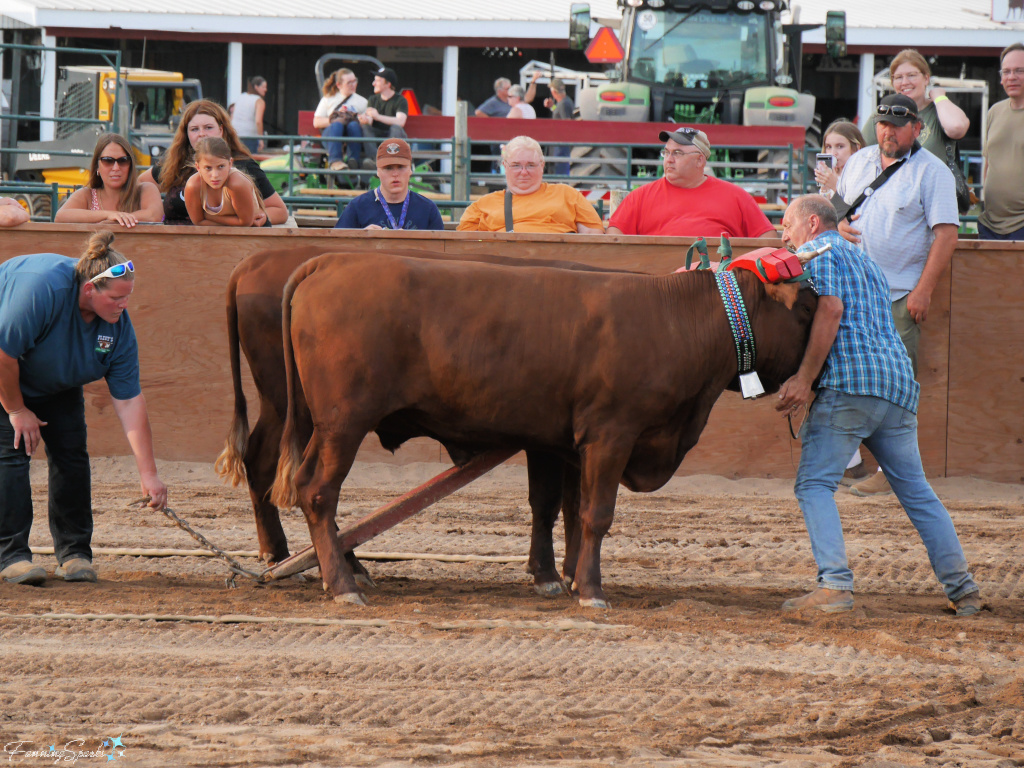
Once in position, the teamster stands at the head of the oxen team and gives the command to move forward. Mind you, they don’t just say “Walk” and step back to watch the oxen drag the sled forward. They coax, encourage and guide with voice and touch. Some teams, especially the steers, required significant physical contact with the drivers pushing and pulling. Obviously, this is where the “patience, understanding, and consistent effort” of training pays off since no one could possibly budge an unwilling pair of 1000-lb animals!
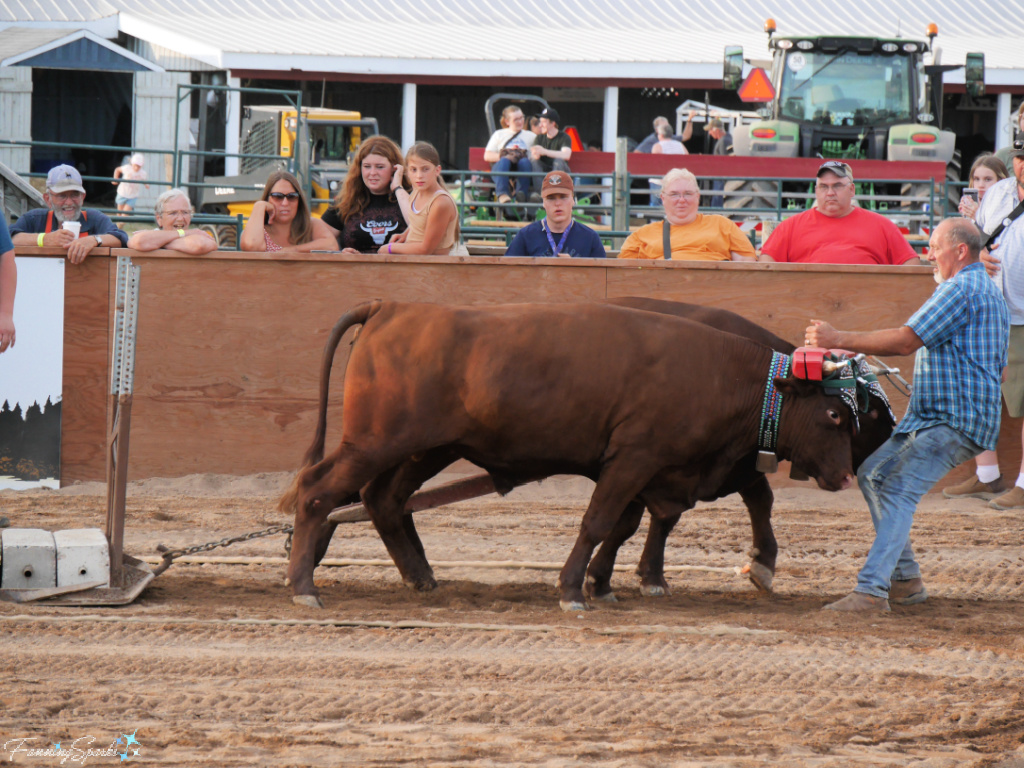
The oxen don’t need to pull the drag very far―only 3 feet. “An official pull will be distance of 36″. Three attempts will be given to pull the load 3 feet in one start.” states the Hants County Ox Pull rules. Everyone eagerly waits to hear the announcer proclaim “And that’s a good pull!”. Three feet may not be far but the drag weight increases substantially as cement blocks are added throughout the competition.
Speaking of weight, the weight of the oxen team is also an important factor in ox pulls. Weight is calculated as a total for the oxen team. If I recall correctly, the team pictured in the above photo weighed in at 1912 lbs.
Ox pulls are typically organized by weight class. The Hants County Ox Pull, for instance, sets four categories: “Steers – 1500 lbs.; Light – 2400 lbs.; Medium – 3000 lbs.; and Heavy – 3400 lbs.”.
Scores are typically calculated as a percentage meaning the weight pulled is divided by the weight of the team. As I understand it, winners are selected based on some combination of these factors. The Hants County Ox Pull selects winners based on percentage pulled within each weight class whereas the Halifax County Ox Pull (the one I attended) groups all competitors into a single class and ranks them based on percentage.
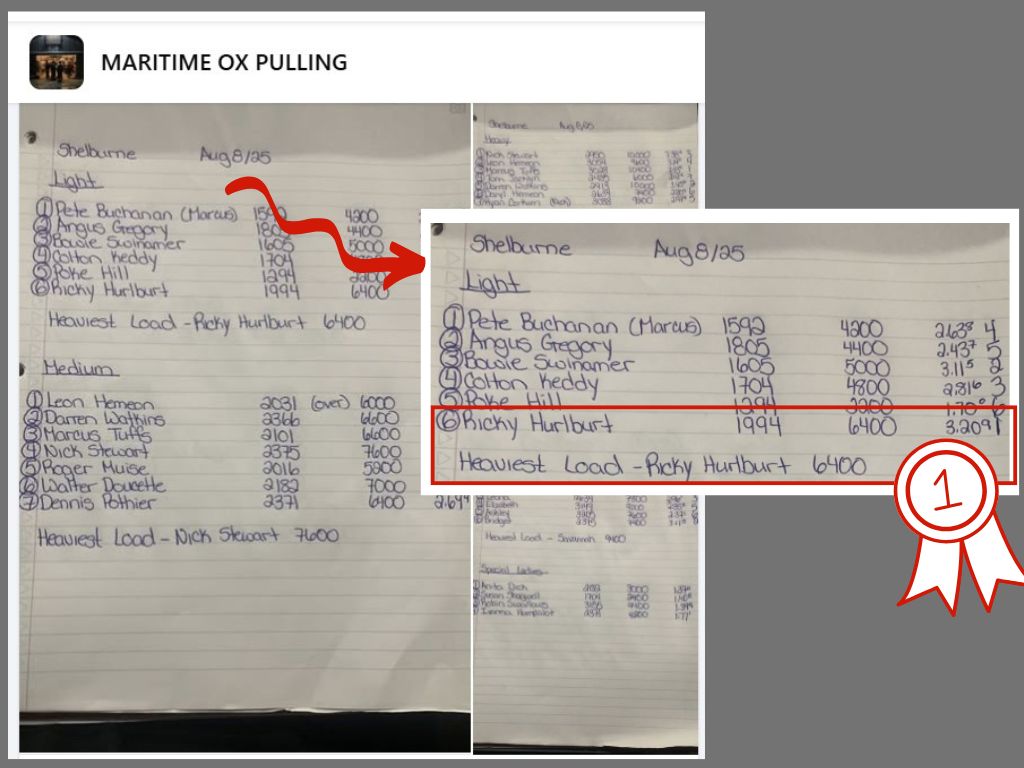
Shown below is an example of the results from a recent Ox Pull at Nova Scotia’s Shelburne County Exhibition as posted on the Maritime Ox Pulling Facebook page. Notice there were six contestants in the Light class and they were scored on percentage weight. Ricky Hurlburt’s oxen team weighed 1994 lbs and pulled 6400 lbs which is an astonishing 3.209 times their weight! They placed first in the class by percentage weight plus they pulled the heaviest load. This gives a whole new meaning to the expression “pulling your weight!”.
As incredible as the actual pulling was, I was also fascinated by the interactions and activities which took place while the competitors waited for their turn to pull. There were some last-minute adjustments such as tightening of the straps holding the yokes in place.
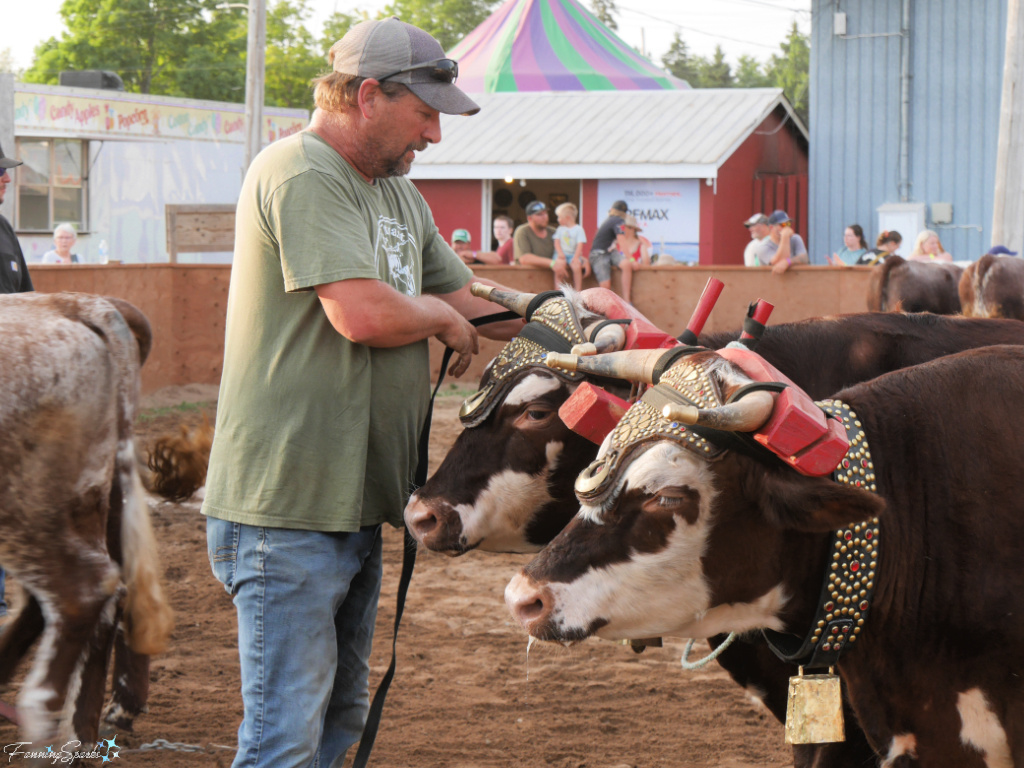
But for the most part, the oxen teams simply waited patiently.
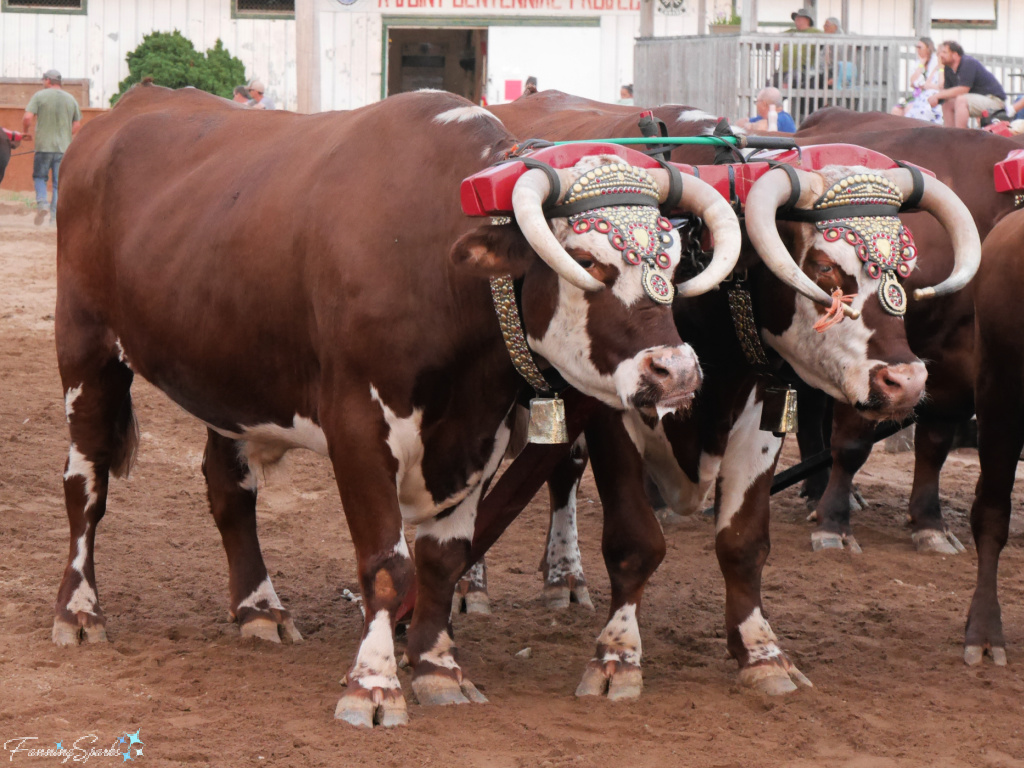

There was an easy camaraderie between drivers. After a particularly exasperating pull, one driver lamented his decision to have entered his young team instead of his mature one. Everyone chuckled―it seemed they could all relate.
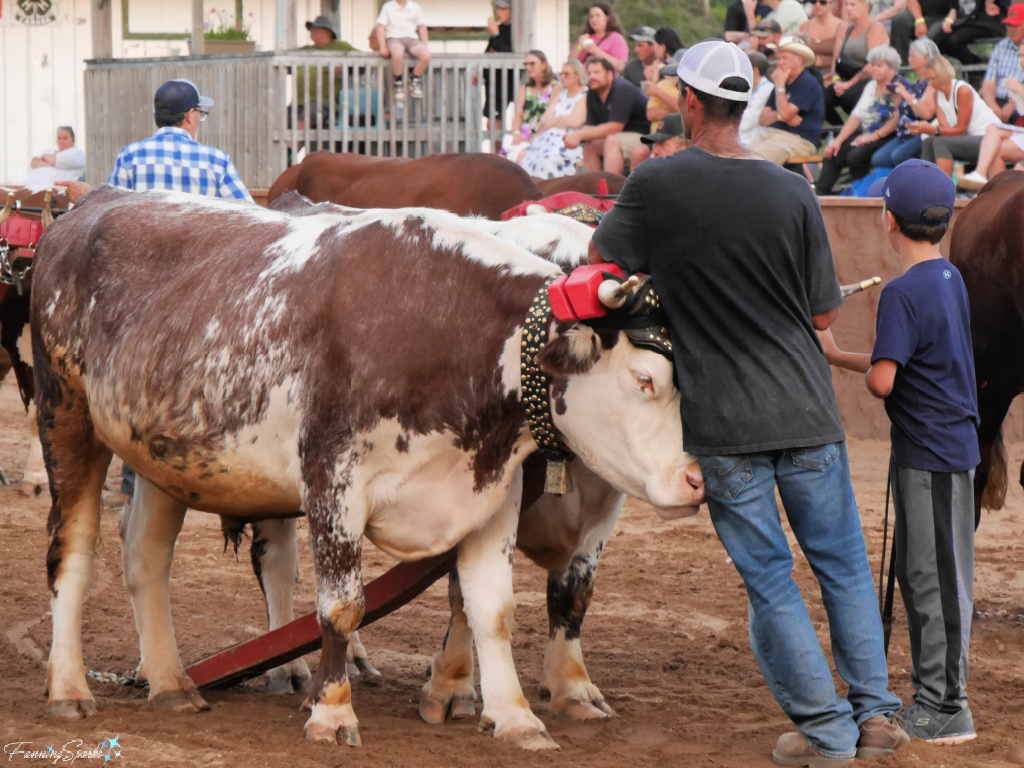
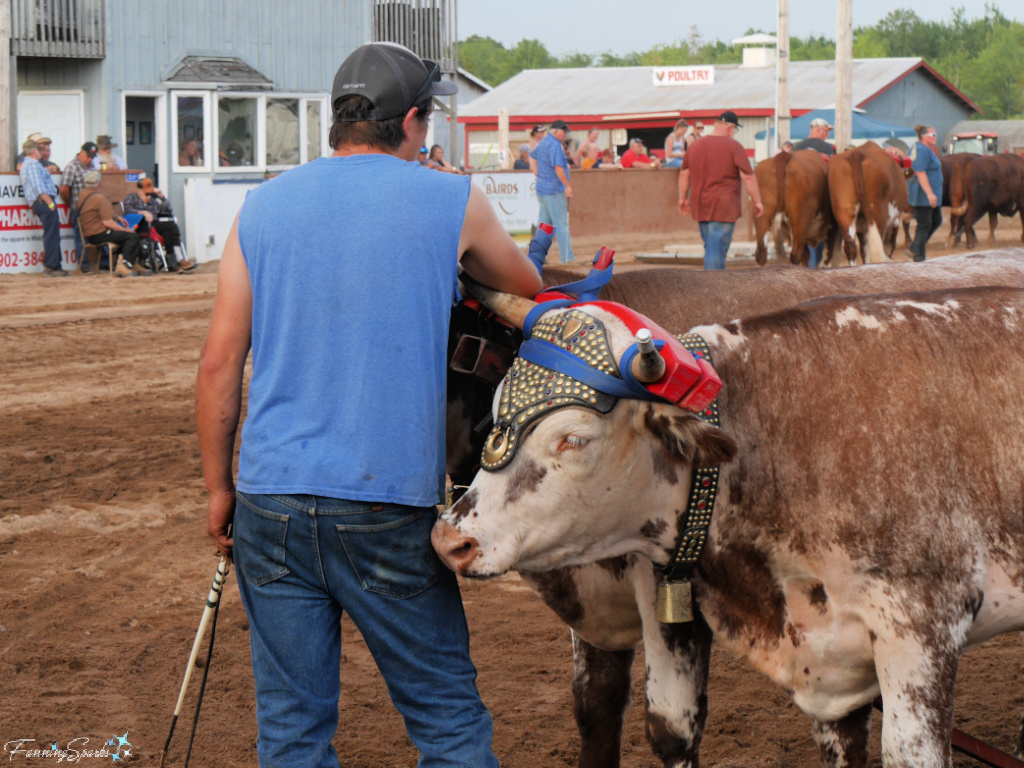
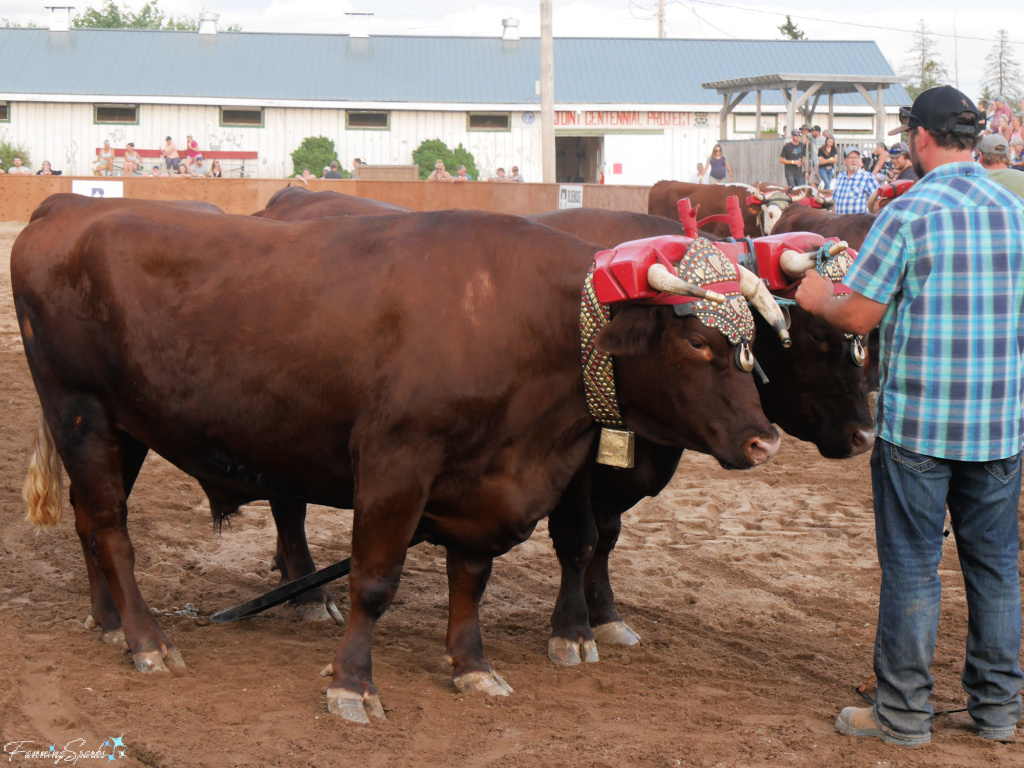
Most impressive was the obvious bond between the drivers and their oxen. The teamsters kept their oxen calm and in place with gentle body contact, petting and scratching, and quiet words of encouragement.

More Info
The Halifax County Exhibition is held in the small, rural community of Middle Musquodoboit in Nova Scotia, Canada. This annual summertime event has been held since 1884―over 140 years! This significant accomplishment is only made possible through the combined efforts of a dedicated group of community members who generously volunteer their time and talents every year. Thank you all!
If you’re interested in an authentic, country-life experience, be sure to check out one of Nova Scotia’s annual agricultural fairs. You can learn more on the Halifax County Exhibition website or Instagram page. And you can find the schedule and locations for all Nova Scotia’s exhibitions and fairs, here on the Exhibition Association of Nova Scotia website.
The following books and articles were consulted in the writing of this blog post:
. Training Oxen and Farming with Oxen 1973 Mother Earth News article by John Scarlett
. Oxen No Has-Beens When It Comes to Hard Pulling Lancaster Farming article by Sue Bowman
. How to Train Oxen to Work with a Yoke article on the Live to Plant website
. Lion & Bright 2015 Saltscapes article by Marjorie Simmins
. Nova Scotia Archives website
. The Sport of Draft Animal Pulling online brochure which appears to be authored in 2018 by The Big E, a multi-state exhibition in New England, USA
. Hants County Exhibition – 2025 Oxen Steers Prize List
. Maritime Ox Pulling Facebook page
. Various Wikipedia entries.
Today’s Takeaways
1. Long before ox pulling became a sport, oxen were used for real work.
2. The knowledge and skill needed to train and drive oxen is often passed from generation to generation.
3. Consider supporting your local agricultural exhibitions and country fairs.


Comments are closed.