
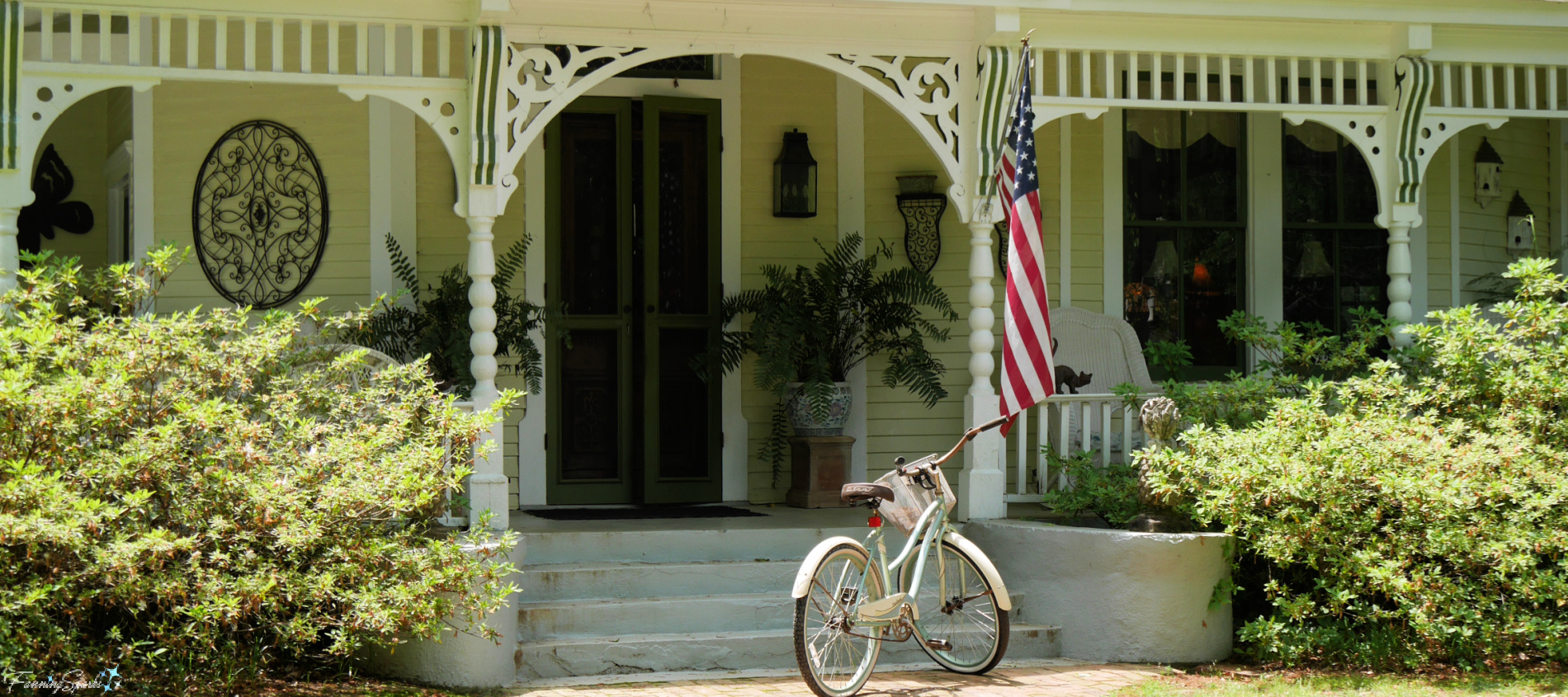
My recent stroll through the Madison Historic District, see Meet Me in Madison GA, started me thinking about front porches. In this beautifully-preserved small town―which reflects life in Georgia from the early 19th century onward―nearly every house has a front porch.
“By the mid-1800s”, writes Ann Rooney Heuer in her book The Front Porch, “families everywhere enjoyed ‘sitting a spell’ on their front porches. In fact, during the Victorian era … when a well-dressed home announced one’s place in society, decorative front porches were essential.”
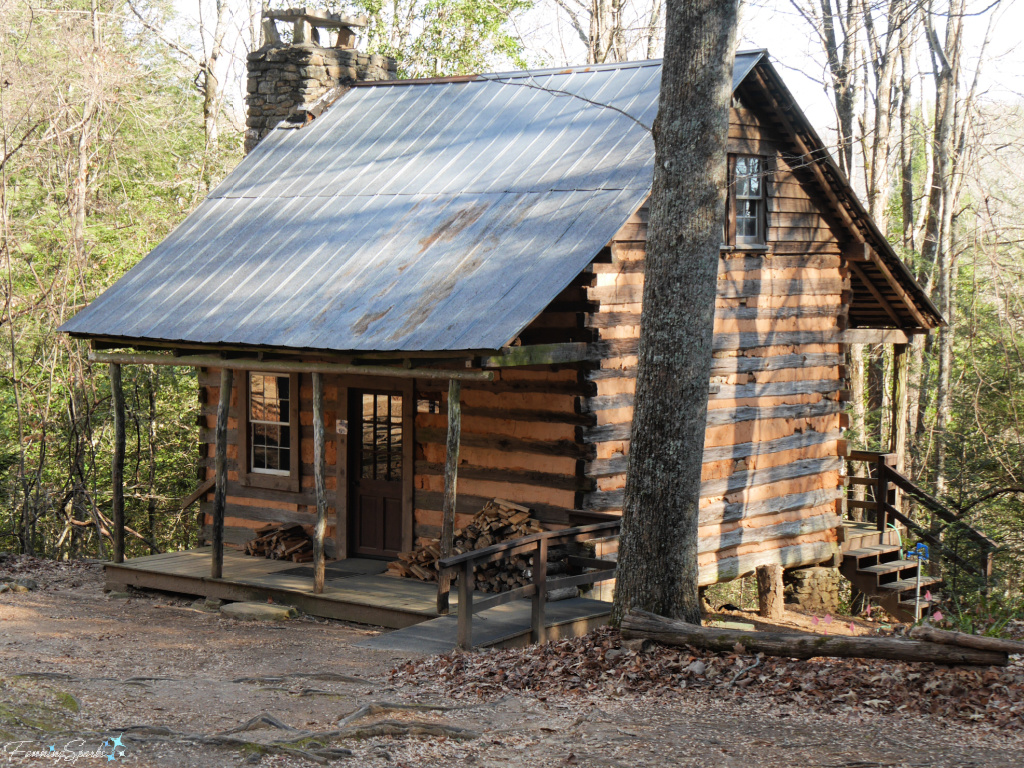
At its most basic, a front porch is a simple, covered entrance to a building―just large enough to shelter a person as they enter or exit. Pictured below is the simple, utilitarian front porch on Phillips Cabin at Foxfire Village Museum in Mountain City, Georgia. This rustic log cabin was originally built around 1860 and renovated in 2017.
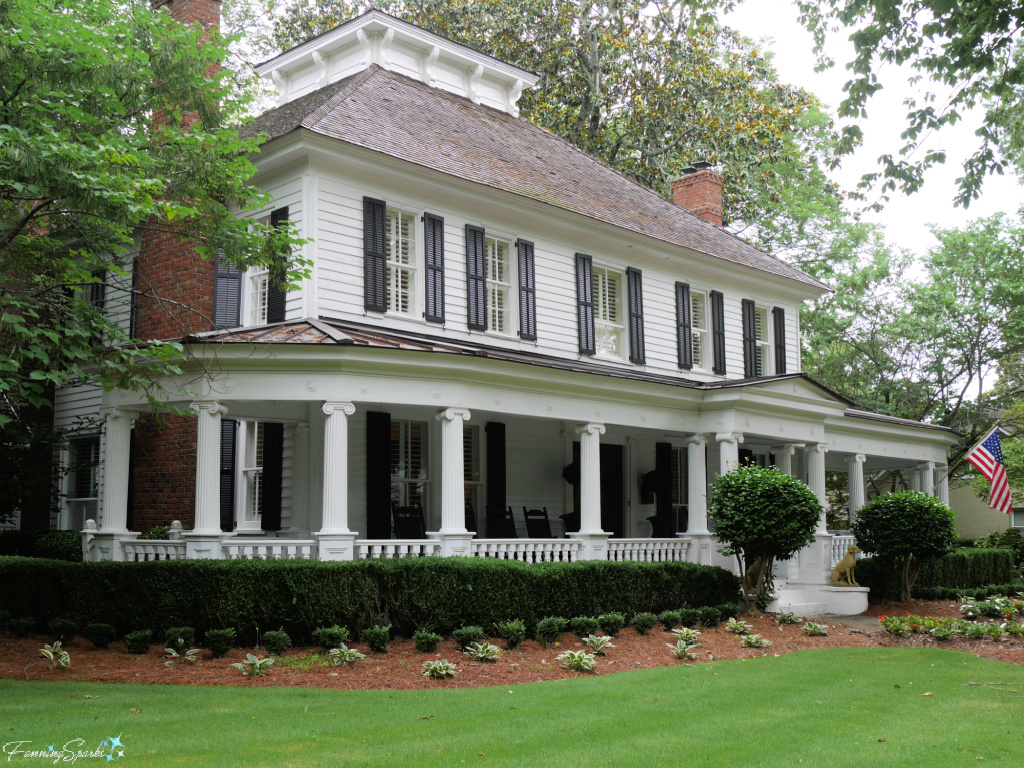
At its most elaborate, a front porch can wrap around the façade of the house like this one on Jessop-Atkinson Lindsey House or, …
… extend over multiple stories like this majestic porch on Serenata Farm and/or, …
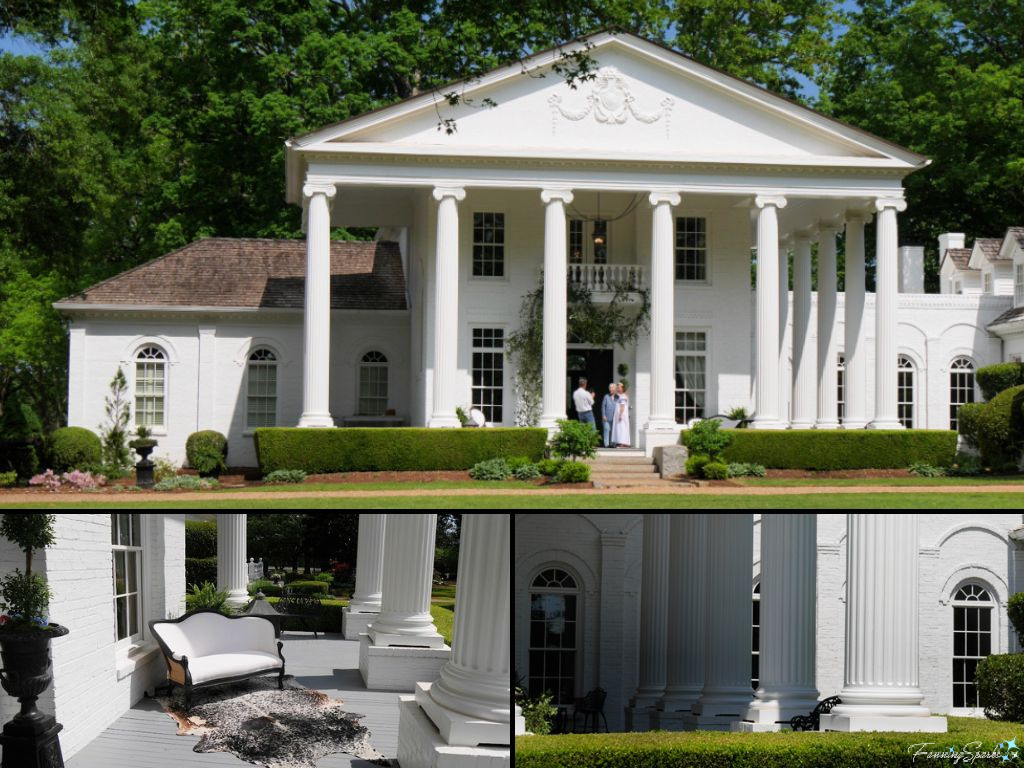
… provide extra outdoor living space as demonstrated at the 2022 Southern Living Idea House in Oriental, North Carolina.
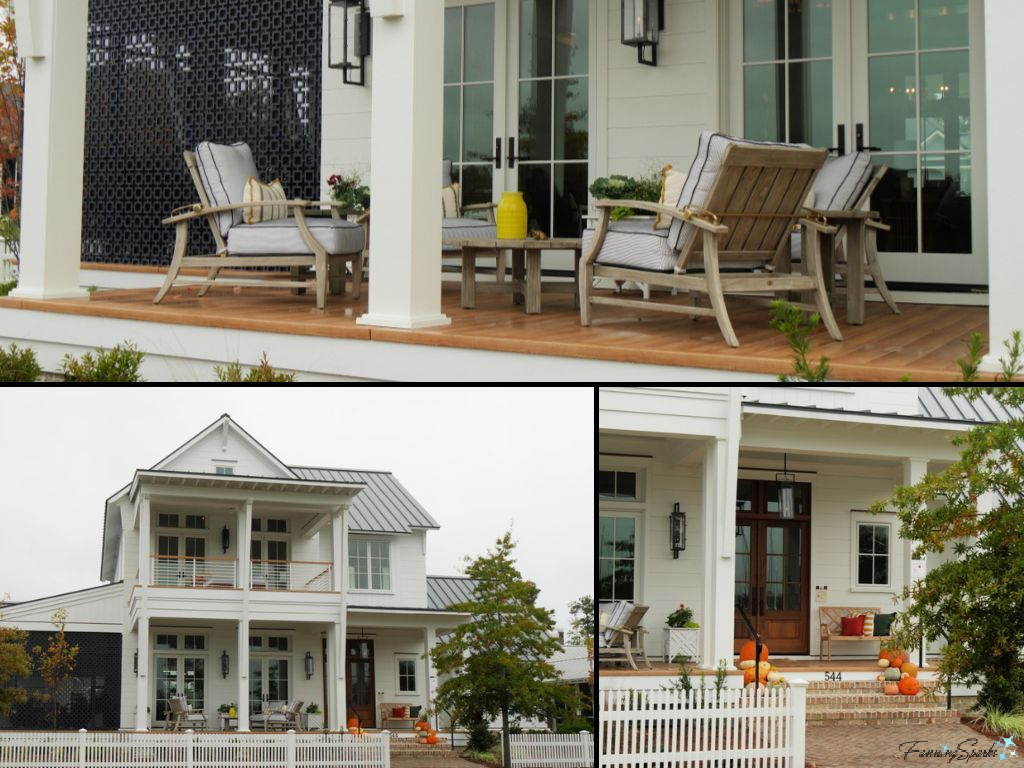
Porches were “inspired by the architecture of the West Indies … where the warm climate dictated a need for an open living space to catch cool breezes, block strong sunlight, and protect occupants from sudden showers” writes Barbara Ballinger in her book Porch Style. “During the same period and for the same climatic reasons, porches became pervasive among [USA] southern homes and especially plantations.”
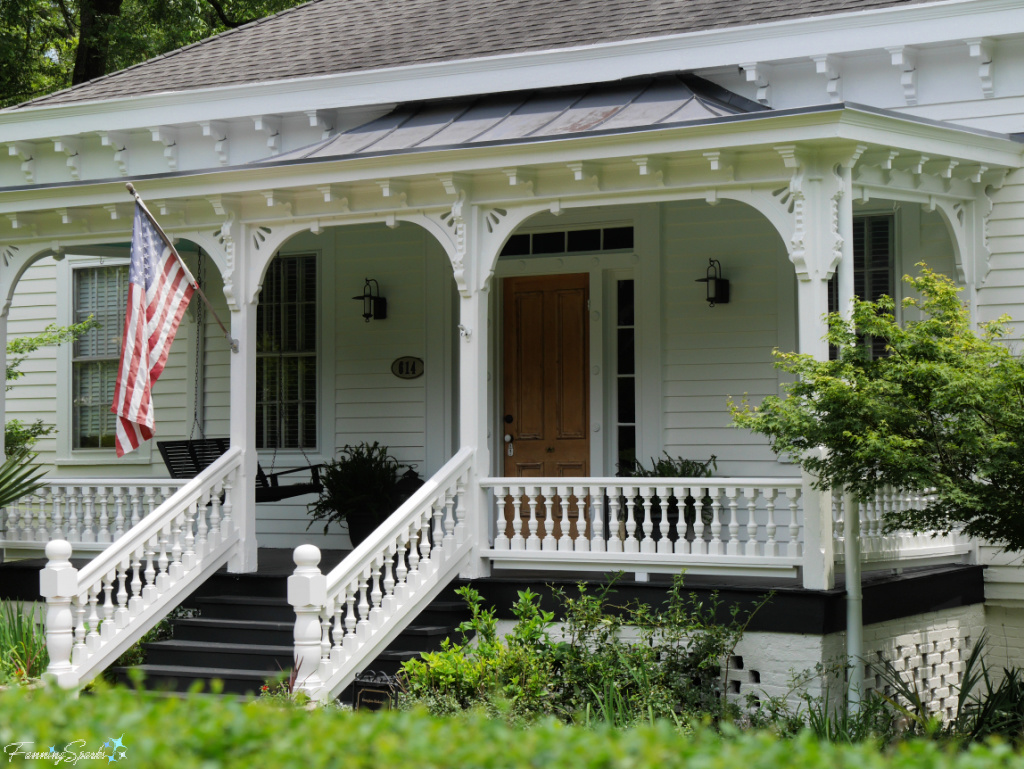
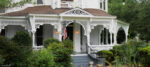
Madison’s Douglas-Rakoczy House, pictured below, features a gorgeous front porch. It would be perfect for porch sitting or “porching” as some folks say. Defined by Wikipedia as “sitting on a front porch or stoop, usually of a private residence” porch sitting “is a leisure activity which can be a direct or indirect form of social interaction”.
It’s not hard to imagine the homeowners relaxing on their porch swing while sipping a cool drink, chatting with neighbors and greeting passersby. This idyllic image of porch sitting has led to countless popular quotes proclaiming “Life is Better on the Porch” or “Come Sit on the Porch with Me Where the Drinks are Cold and the Friendships are Free” or “Leave Your Cares Behind: Join Us on the Porch” or “Welcome to the Porch Where Wasting Time is Considered Time Well Spent” or “Porch Therapy: Session in Progress”.
I was delighted to discover there is a Professional Porch Sitters Union (PPSU). It was founded in 1999 by Claude Stephens (a.k.a. Crow Hollister) in Louisville, Kentucky when he posted about the PPSU on the Orion Grassroots Network website (an online network of environmental and community nonprofit organizations). I wasn’t able to find the original post but I did find the Professional Porch Sitters Union – Founders Porch on Facebook. There, Crow Hollister, who signs himself as “Janitor, PPSU Local 1339” shared the background of the PPSU and answered frequently asked questions.
The professional union is tongue-in-cheek but the benefits of porch sitting are sincere. Crow Hollister explains “I posted the Union page some time ago and have never updated it. Don’t intend to either.” He encourages anyone who is interested to simply “take a walk and look for someone sitting on their porch. A good opener is to wave and say ‘hello’. … If you are the one on the porch I suggest offering lemonade or some such beverage to the person waving. They may or may not be a member of the Union. That will not be a problem.”
“PPSU is an informal organization with a large and growing grassroots membership” writes a commenter on the Facebook page. “To become a member, you simply need to say you are a member and agree to sit around with friends and neighbors shooting the breeze as often as possible or practical. Preferably on a porch but that’s not critical. There are no dues, no membership requirements, no mailings, no agenda, no committees, no worries. PPSU believes that the radical act of sitting around sharing stories with no specific agenda is critical to building sustainable communities.”
I have no idea if the folks in Madison are members of the Professional Porch Sitters Union, but I do know there’s no shortage of potential! Shown below is an array of the front porches found in this charming Southern town.
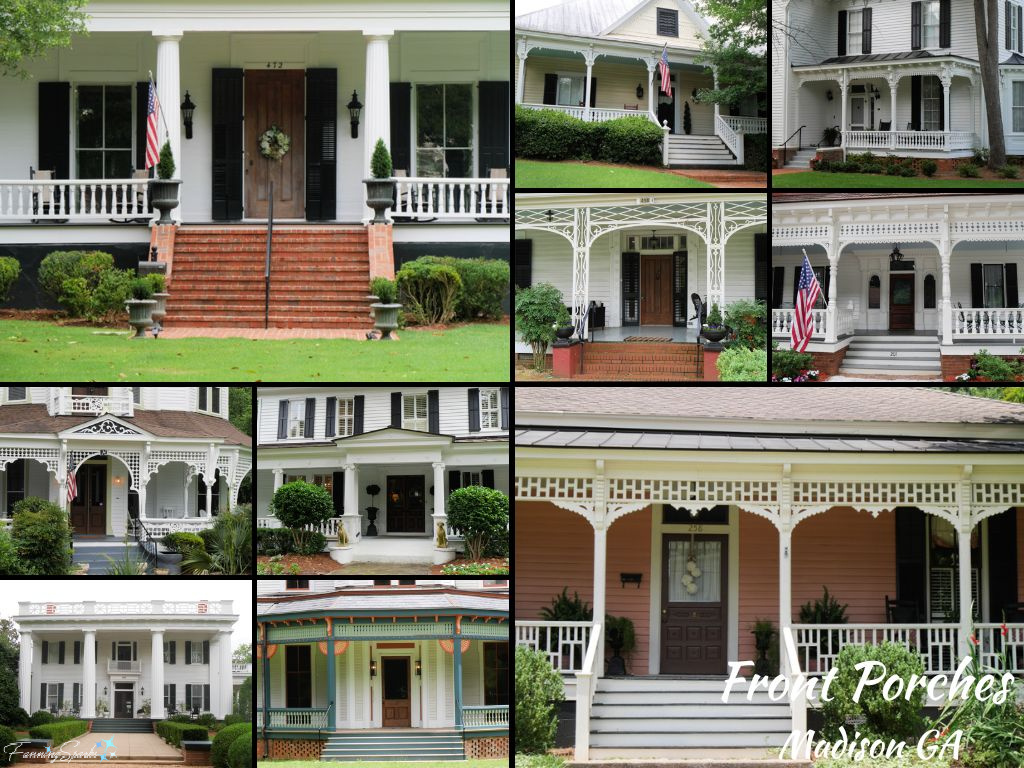
Viewing Madison’s front porches in a single image makes it easier to detect similarities and differences. They all have the same basic structure―a covered entrance to a building―but every one has its own personality and charm.
As I started to dig a little deeper, a new vocabulary emerged―shown below are a few of the unusual and new-to-me terms I discovered while researching front porches for this blog post.
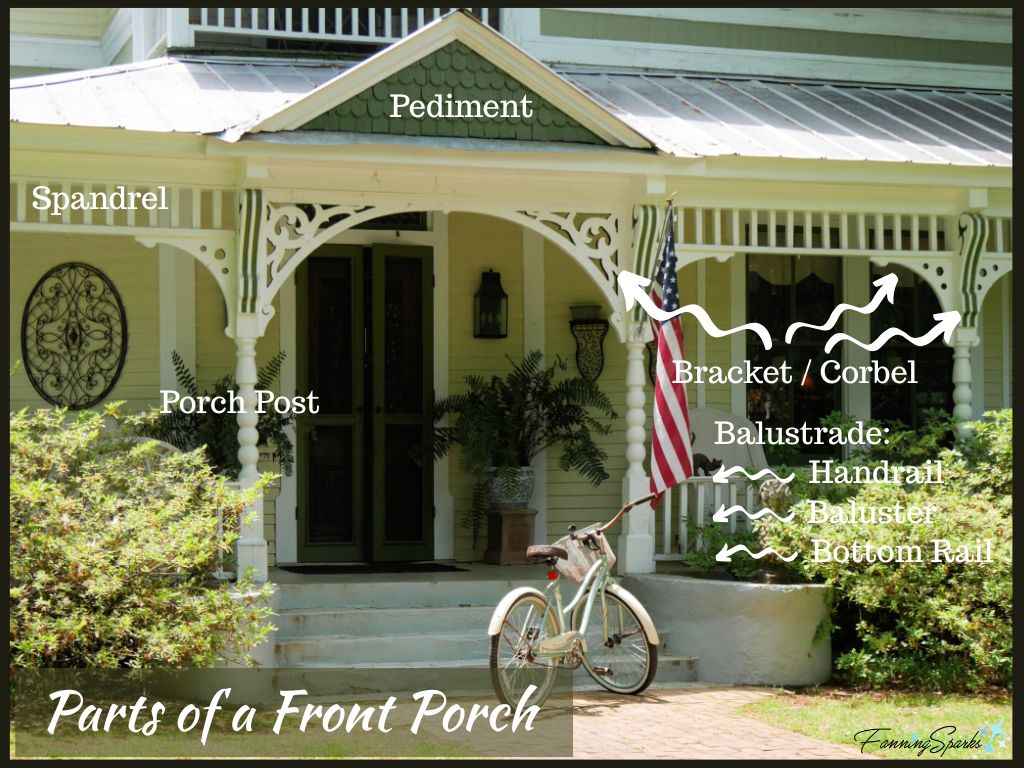
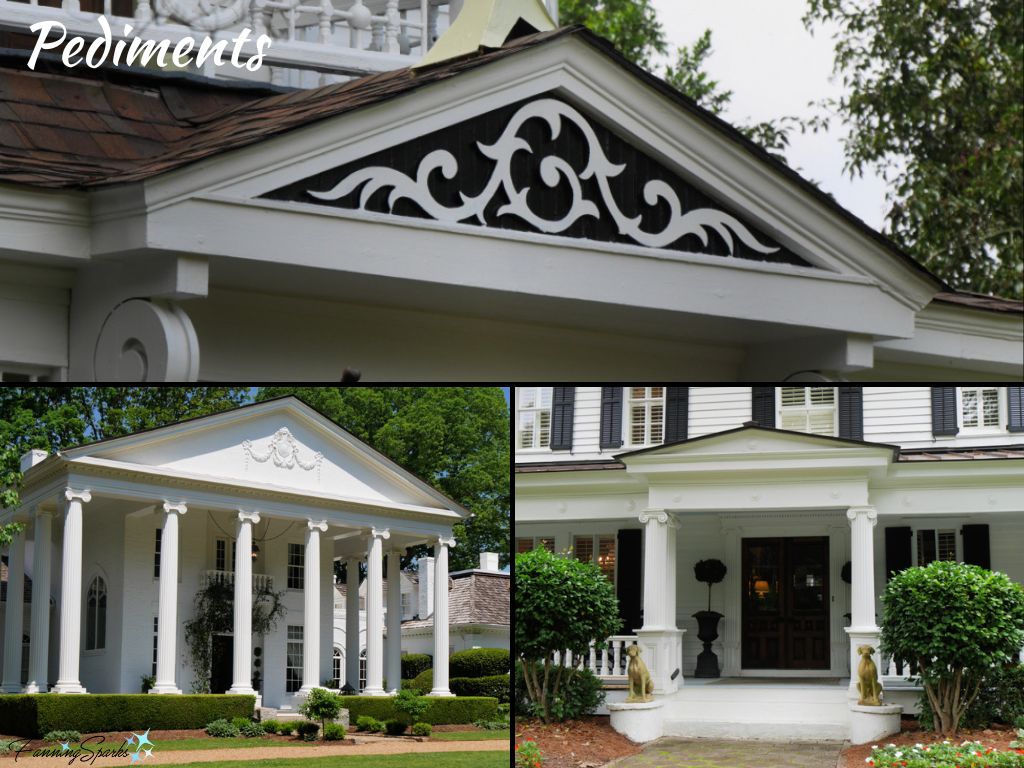
Pediments “Pediments were originally triangular gables found on Greek and Roman temples. During the Renaissance and subsequent Baroque and Rococo periods, new and more complex shapes were introduced.” writes Joseph Jutras in his article Pediments on The Institute of Traditional Architecture website. A pediment can also be a triangular (or rounded) ornament above a window or door.
Shown below are three examples of pediments― a fanciful Victorian styled pediment on Hunter House, the massive pediment on Serenata Farm and a neoclassical pediment on Jessop-Atkinson Lindsey House.
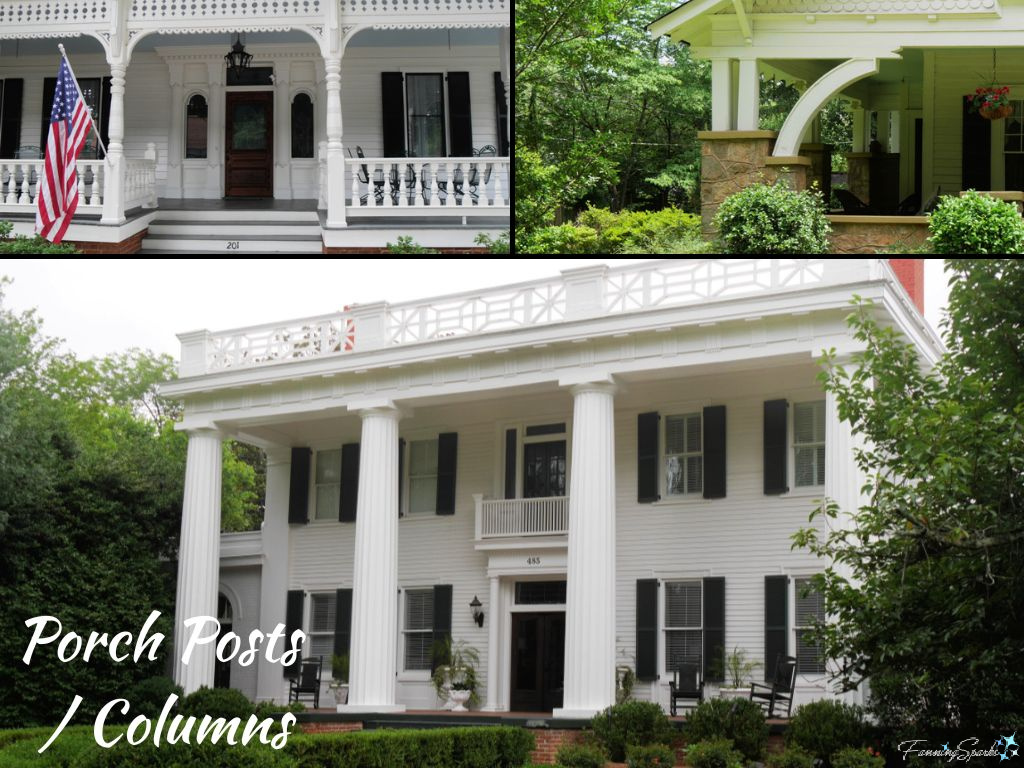
Porch Posts “Porch Posts structurally support the weight of the porch roof but can also be quite decorative” explains the Vintage Woodworks website. “Porch Posts extend from the top of the porch floor to the bottom of the Beam. Ideally, they are spaced uniformly along the porch.”
Columns Alternatively, columns can be used as vertical supports to hold up the roof. According to The Penguin Dictionary of Architecture, a column is “a free-standing upright member of circular section and usually slightly tapering, normally intended as a support but sometimes erected independently as a monument. In classical architecture it consists of a shaft, capital and, except in Greek Doric, a base”.
Shown below are three examples―turned wood porch posts on Dovecote House, Craftsman style masonry column bases topped with square columns on Paul Reid House and grand columns on Hill-Baldwin Huggins House.
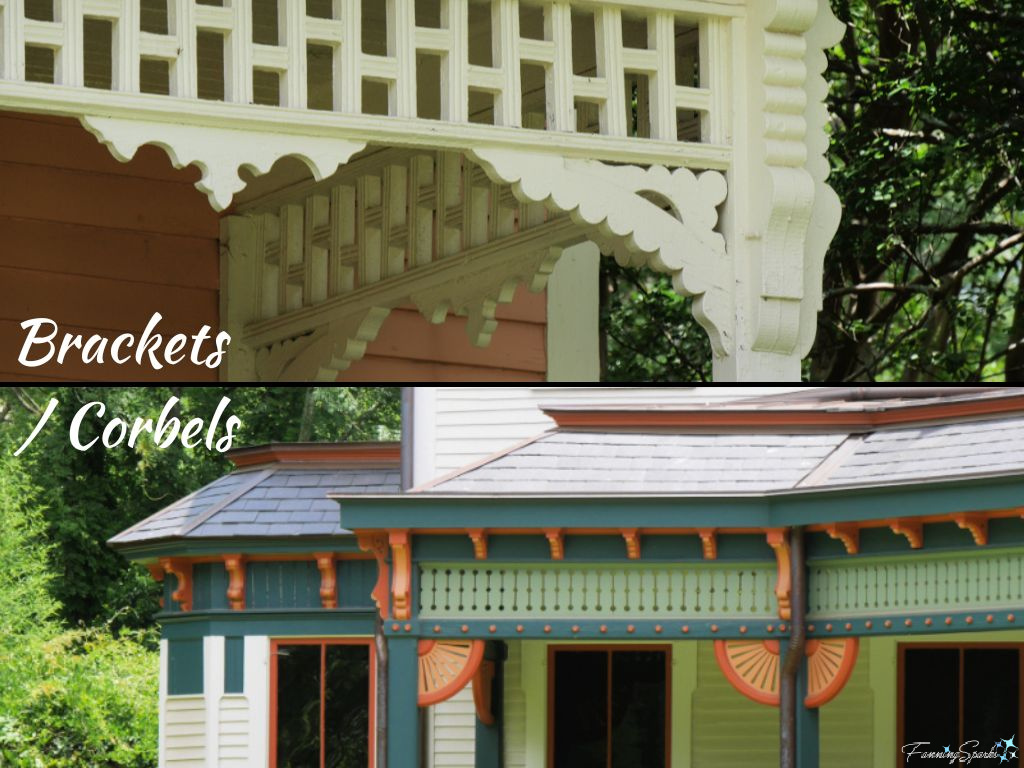
Brackets/ Corbels The differentiation between the terms “bracket” and “corbel” doesn’t seem to be consistent. Both are described as small projecting pieces, of stone or other material, used to support a beam or other horizontal member. Some resources differentiate by clarifying that brackets are structural while corbels are decorative. Other resources differentiate based on thickness―for instance brackets are less than 3” while corbels have a thickness of 3” or more. Brackets and corbels can, of course, be used to embellish other architectural elements in addition to front porches.
Shown below are a couple of examples of brackets/ corbels― scallop-shaped wooden brackets on Winter House and vibrantly colored, elaborately-formed brackets on Foster-Thomason Minnix House.
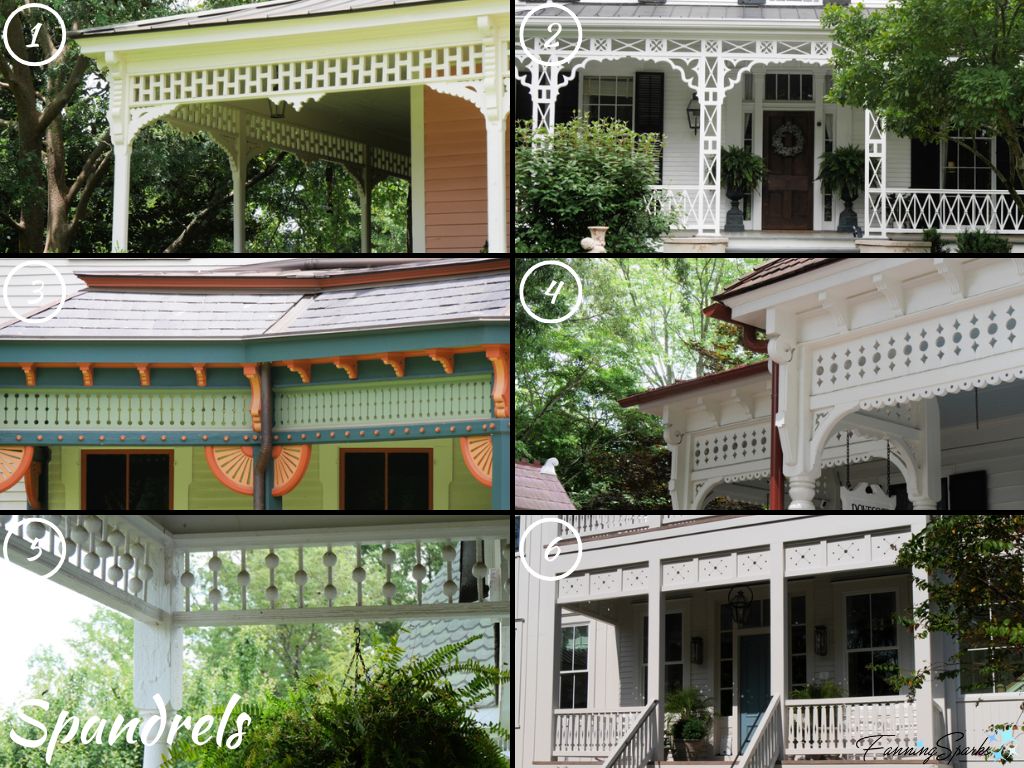
Spandrels Wikipedia describes spandrels as: “in architectural ornamentation, the horizontal decorative elements that are hung over interior and exterior openings between the posts. … Wooden ornamental spandrels are known as gingerbread spandrels.”
“Spandrels are rows of Balls & Dowels, Spindles, or Cutwork held between top and bottom rails” elaborates the Vintage Woodworks website. “When our forefathers discovered Spandrels, the porches and parlors of America were forever changed! Streets in every town and village soon displayed charm both pleasant to the eye and uplifting to the spirit”.
Spandrels are my new favorite architectural detail. Not only do they “please the eye and uplift the spirit”, but they also offer a great opportunity to be creative. Shown below are a number of examples of spandrels in several different forms, designs and executions. For instance, the spandrels shown in #3 and #4 and #6 are cutwork or fretwork. The spandrels in #1 appear to be constructed from wooden blocks and the spandrels in #5 are “ball and dowel” aka “ball and stick”. The spandrels in #2, the only example not made from wood, are cast iron. Spandrels can also be made with turned spindles and spools or they can be combined with other elements such as running trim, drops and medallions.
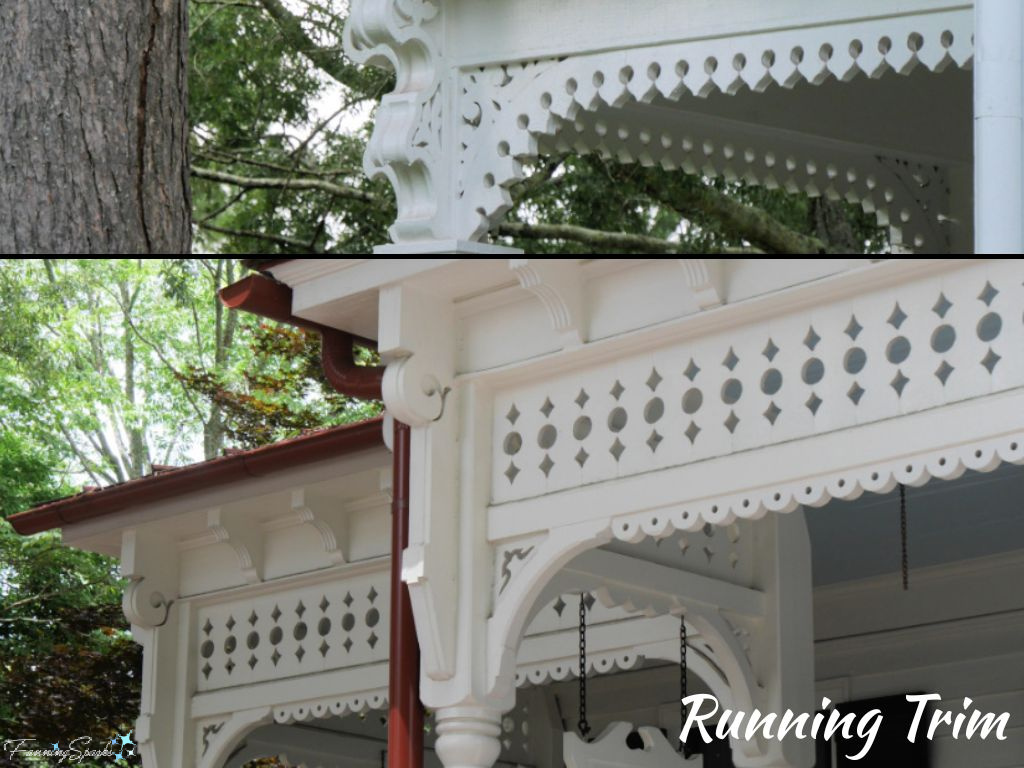
Running Trim The Vintage Woodworks website explains “Running Trims are characterized by their repeating pattern. They can be used below Spandrels”, with or without brackets, as well as on other architectural elements such as gables.
These photos feature running trim―shown without a spandrel on Owen-Landry House and below a spandrel on Dovecote House.
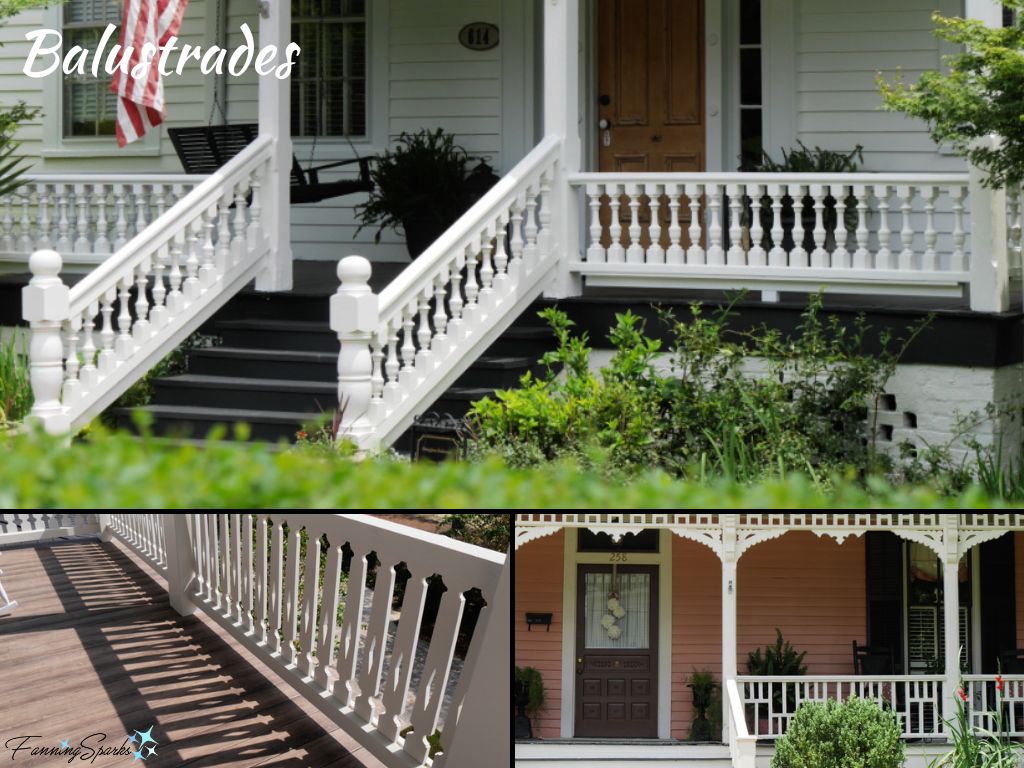
Balustrades (Handrails, Balusters, Bottom Rails) The Merriam-Webster Dictionary simply defines a balustrade as “a row of balusters topped by a rail” and a baluster as “an upright often vase-shaped support for a rail”. Balustrades are typically an integral part of a front porch although they are not restricted to this use case. “Many porches are open on the outward side with balustrade supported by balusters that usually encircles the entire porch except where stairs are found” explains Wikipedia.
Shown below are a number of examples of porch balustrades including classic turned spindles on Douglas-Rakoczy House, flat-sawn porch balusters on the 2019 Southern Living Idea House on Amelia Island and balusters which appear to be constructed from wooden blocks on Winter House.
It’s interesting to note that, like many architectural elements, front porches have fallen in and out of vogue over the years. Ballinger writes “Though the individual details of each type of home varied, almost every house had a front porch, offering its occupants the sort of interaction with their neighbors that fostered the growth of communities. Following World War II [1939-1945] however, the front porch and its tradition of hospitality began to fade into history.”
Author Michael Dolan elaborates in his book The American Porch: An Informal History of an Informal Place, “If you were to ask what killed the American porch, most people would blame air conditioning or television. Some would indict the social patterns that gestated in the suburbs that spread across the nation after World War II. Others would point to the automobile-induced hyper-speed pace of modern life at large. …
But no single pathology did the porch in. There is strong evidence that, long before a preponderance of American households had the central air, the big color set, two cars in the suburban driveway, and double incomes on the tax return, the porch―at least, the porch as we’d known it for a hundred years―as a center of family life, neighborhood socializing, and community connection, as well as a slice of Americana―had begun its slide into the dustbin of architectural history.”
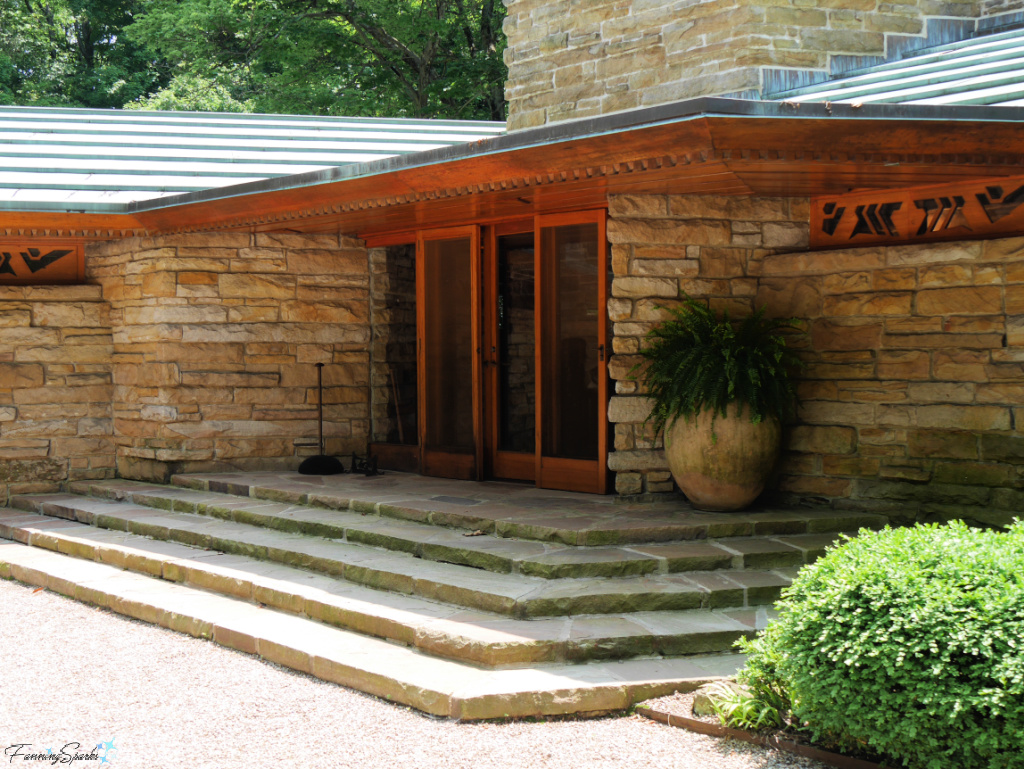
Many of the Post-World War II architectural styles, such as Frank Lloyd Wright’s Usonian houses, did not include front porches. To learn more about this famous American architect see my previous blog posts, Then Came FallingWater and Step Inside with Frank Lloyd Wright.
Pictured below is Kentuck Knob, also known as Hagan House, which was designed by Wright in 1956. This Usonian style house is located in Chalkhill, Pennsylvania. There is no front porch, per se, but the front entrance is flanked by wide, horizontal steps and protected by a roof overhang.
In her NPR article, Porches Knit Together New Urbanist Communities, writer Michele Norris confirms that “after World War II, the front porch took a back seat to the backyard”. Norris goes on to say “That began to change in the early 1980s, when the husband-and-wife architectural team of Andres Duany and Elizabeth Plater-Zyberk designed a community in northwest Florida that was based on a concept later known as New Urbanism. The town, called Seaside, is a modern development laid out like a small town: Businesses, parks and schools are all located near homes to encourage foot or bike traffic — and decrease the need for cars. … In order to decrease the use of air conditioning, each home in Seaside had to have a front porch. But Plater-Zyberk explains that planners quickly realized that the porch had other benefits as well.
‘People would sit on the front porch instead of in the backyard because they could see people coming and going, say hello to their neighbors and have short conversations,’ says Plater-Zyberk. ‘The bonds of community were being formed through that brief interaction.”
At the risk of stating the obvious, the possibility of homeowners greeting passersby from their front porches is really only applicable to an urban or suburban environment. That’s not to say, people living in the rural setting can’t drop by and gather on the front porch but the interaction would likely be planned and more intentional. Regardless, the PPSU’s belief that “the radical act of sitting around sharing stories with no specific agenda is critical to building sustainable communities” can apply anywhere.
More Info
Previous blog posts mentioned in this blog post include:
. Meet Me in Madison GA
. Then Came FallingWater
. Step Inside with Frank Lloyd Wright.
To see more photos from past Southern Living Idea Houses, see these blog posts:
. Ideas from the Idea House (2019) in Amelia Island, Florida
. 10 Ideas from the 2022 Idea House in Oriental, North Carolina.
I have the pleasure of living near the beautiful, historic town of Madison in Morgan County, Georgia. You can learn more about Madison GA on the Madison Morgan County Convention & Visitors Bureau’s Visit Madison GA website.
You can learn more about the Professional Porch Sitters Union (PPSU) on their Facebook page.
The following books, articles and websites were consulted in the writing of this blog post:
. The Front Porch book by Ann Rooney Heuer which is available here on Internet Archives
. Porch Style book by Barbara Ballinger which is available here on Internet Archives
. Pediments article by Joseph Jutras on The Institute of Traditional Architecture website
. Vintage Woodworks website
. The Penguin Dictionary of Architecture book by John Fleming which is available here on Internet Archives
. The American Porch: An Informal History of an Informal Place book by Michael Dolan which is available here on Internet Archives
. Porches Knit Together New Urbanist Communities 2006 article by Michele Norris on NPR All Things Considered
. Various Merriam-Webster Dictionary entries
. Various Wikipedia entries.
The Foxfire Village Museum, located in Mountain City Georgia, “is made up of over 20 historic log buildings, each filled with artifacts from Appalachian life between 1820 and 1940”. Learn more on the Foxfire website.
Today’s Takeaways
1. A front porch is a covered entrance to a building.
2. Front porches, in their various architectural styles, have moved in and out of vogue over the years.
3. “People would sit on the front porch instead of in the backyard because they could see people coming and going, say hello to their neighbors and have short conversations. The bonds of community were being formed through that brief interaction.” Elizabeth Plater-Zyberk


Comments are closed.